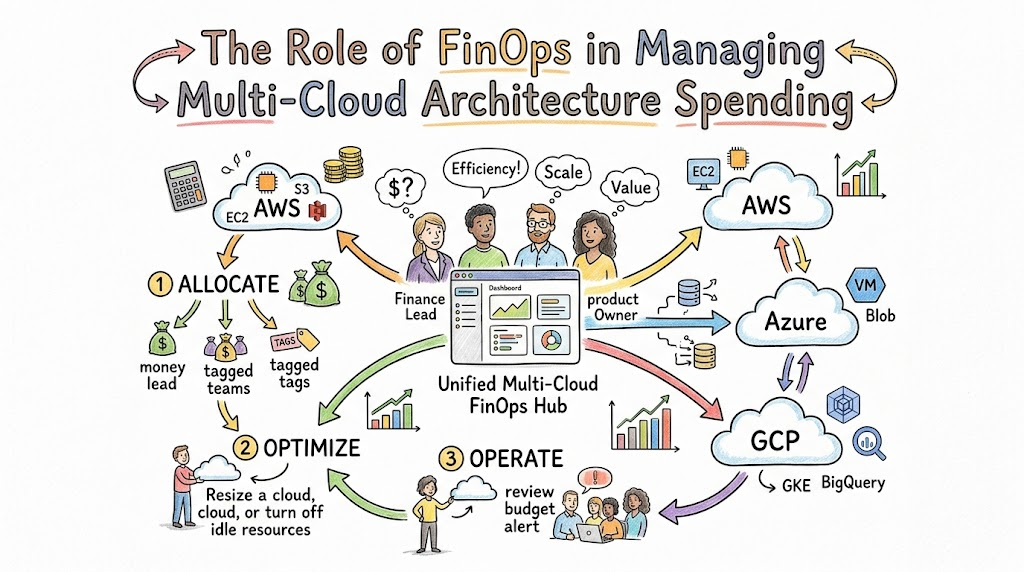
Managing infrastructure expenditures across multiple cloud vendors requires a coherent operational strategy. Organizations frequently encounter budget overruns because decentralized teams deploy resources across Amazon Web Services, Microsoft Azure, and Google Cloud Platform simultaneously. Consequently, establishing a unified financial management framework becomes crucial for maintaining healthy operational margins. By connecting technical teams directly with finance and executive leadership, enterprises regain absolute governance over heterogeneous cloud bills. Adopting structured educational programs from a premier platform like Finopsschool enables technical professionals to master multi-provider financial governance. This collaborative alignment ensures that every deployed workload directly supports strategic business goals.
Furthermore, engineering teams learn to evaluate resource costs across providers dynamically instead of viewing billing statements as month-end surprises. Developers gain clear visibility into the financial consequences of architectural decisions across disparate vendor ecosystems. Finance departments also forecast future infrastructure costs with far greater accuracy because they receive normalized billing telemetry. Ultimately, this systematic practice eliminates waste and cross-cloud inefficiencies without restricting deployment speed or compromising reliability.
Understanding Cloud Financial Operations
Multi-cloud computing introduces operational complexity by fragmenting bills, SKU definitions, and pricing frameworks across vendors. Historically, finance departments struggled to manage these diverse services because engineers could launch multi-region assets within minutes. Developers hold immense purchasing power through automated infrastructure-as-code scripts, often without realizing the multi-platform financial impact. Without standardized oversight, distributed cloud spending quickly expands beyond original enterprise allocations.
To solve these persistent hurdles, modern enterprises rely on structured financial governance specifically adapted to multi-provider environments. FinOps serves as this foundational discipline, merging cultural accountability with automated usage telemetry to drive business value. It establishes a continuous operational loop where platform engineers, financial analysts, and project managers coordinate closely. As a result, the entire organization treats efficiency as an ongoing architectural priority rather than a periodic cleanup task.
In addition, this operational practice operates across three iterative phases: Inform, Optimize, and Operate. The Inform phase normalizes billing data from every cloud vendor into a single dashboard to establish total cost visibility. The Optimize phase identifies actionable waste, such as cross-cloud data egress fees and unattached storage volumes. Finally, the Operate phase builds automated guardrails into deployment pipelines, ensuring continuous multi-cloud budget compliance.
Key Operational Concepts You Must Know
Billing Normalization and Cross-Cloud Allocation
Unifying disparate vendor billing schemas into a standardized data model represents the first essential operational requirement. Each provider categorizes compute, object storage, and egress traffic under unique naming structures and rate metrics. Organizations must adopt standardized frameworks to normalize line items across AWS, Azure, and GCP. Enforcing universal tagging taxonomies ensures that every provisioned resource maps directly to its designated business unit or service.
+------------------+    +------------------+    +------------------+
|   AWS Billing    |    |  Azure Invoices  |    |   GCP Telemetry  |
+------------------+    +------------------+    +------------------+
         \                       |                      /
          \                      v                     /
       +----------------------------------------------------+
       |          Normalized Multi-Cloud FinOps Hub         |
       +----------------------------------------------------+
                                 |
                                 v
       +----------------------------------------------------+
       |       Granular Cost Allocation & Showback          |
       +----------------------------------------------------+
Furthermore, robust tagging schemas eliminate unassigned infrastructure that secretly drains financial reserves across disconnected vendor accounts. Finance teams use this transparent data to implement fair showback or chargeback models across engineering departments. When development teams inspect their actual multi-cloud operational footprints, responsible architectural decisions follow naturally. Shared accountability turns cost management into a proactive team standard.
Data Egress Management and Traffic Topology
Network data transfer fees represent one of the largest hidden expenses in distributed, multi-cloud topologies. Moving gigabytes or terabytes of data between distinct cloud providers generates high egress charges that quickly break monthly estimates. Architects must evaluate their network dependencies carefully to minimize unnecessary cross-provider communications. Placing tightly coupled workloads within the same provider region dramatically curtails excessive transfer line items.
In addition, deploying global content delivery networks and edge-caching layers helps absorb heavy user request traffic efficiently. Engineers should constantly audit interconnected microservices to eliminate redundant cross-cloud data queries. By optimizing data routing, companies protect application response times while systematically lowering network costs.
Portfolio Commitment Management and Discount Optimization
Every major cloud provider delivers heavy price reductions in exchange for sustained resource commitments. These mechanisms include Savings Plans, Reserved Instances, and Committed Use Discounts. Managing these contracts across multiple providers requires meticulous telemetry analysis to prevent overcommitting on rigid instance types. FinOps practitioners continuously review baseline resource utilization to purchase balanced commitments across all accounts.
+-------------------------------------------------------------------+
|               Multi-Cloud Discount Lifecycle                      |
+-------------------------------------------------------------------+
| 1. Analyze Multi-Cloud Baseline Workload Demands                  |
| 2. Mix Flexible Savings Plans, CUDs, and Spot Compute Instances    |
| 3. Continuously Track Utilization Metrics to Avoid Shelfware      |
+-------------------------------------------------------------------+
However, migrating workloads between providers can leave long-term reservations underutilized, creating expensive, unrecoverable waste. Therefore, engineering roadmaps must synchronize closely with portfolio discount procurement strategies. Blending flexible commitments with ephemeral spot instances yields a resilient, cost-effective infrastructure footprint across all platforms.
| Dimension | AWS Model | Azure Model | GCP Model |
|---|---|---|---|
| Commitment Type | Savings Plans & RIs | Reservations & Savings Plans | Committed Use Discounts (CUDs) |
| Discount Scope | Compute, Database, Machine Learning | VMs, SQL, Dedicated Hosts | Resource-based and Spend-based |
| Allocation Mechanism | Cost Explorer & Allocation Tags | Cost Management & Resource Tags | Cloud Billing & Project Labels |
Platform Implementation vs. Culture — What’s the Real Difference?
The Mechanics of Tool Deployment
Platform deployment focuses on installing multi-cloud governance software, connecting APIs, and rendering visualization dashboards. Many enterprises assume that acquiring third-party cost platforms will magically resolve their organizational inefficiencies. These tools successfully ingest multi-vendor billing files, normalize SKUs, and highlight idle servers. However, installing software merely sets up technical observability rather than delivering active cost reduction.
+---------------------------------+       +---------------------------------+
|     Platform Implementation     |  -->  |        Cultural Adoption        |
| (Multi-Cloud Dashboards & APIs) |       | (Cross-Team Habits & Ownership) |
+---------------------------------+       +---------------------------------+
Without active engineering involvement, analytical dashboards remain passive monitors that describe waste without resolving it. Engineers must dedicate development cycles to downsize resources, refactor pipelines, and implement suggested changes. Consequently, relying solely on commercial tooling results in idle reports rather than authentic financial efficiency. Software supplies essential metrics, but human decision-making executes real transformation.
Driving Genuine Behavioral Transformation
Cultural adoption focuses on embedding financial awareness directly into daily software development and architecture design. In a mature culture, engineers instinctively weigh provider costs, data transfer fees, and instance types during solution design. This operational shift requires dismantling traditional organizational silos that isolate technical teams from corporate financial goals. Consistent education and transparent communication serve as the primary drivers of this internal change.
When finance professionals understand the architectural reasons for multi-cloud deployments, they craft realistic forecasts that encourage technical innovation. At the same time, when developers understand corporate margin targets, they build lean, efficient systems from the very first deployment. This mutual respect establishes an environment where cross-functional optimization occurs organically. Culture turns cost governance from an uncomfortable audit into an internal engineering achievement.
Real-World Use Cases of Modern Operations
Workload Portability and Arbitrage Across Multiple Providers
A global digital media enterprise maintains elastic compute clusters across two major public cloud platforms to support seasonal demands. Initially, static instance allocations across both environments generated staggering monthly charges during low-traffic periods. The engineering team resolved this issue by implementing containerized workloads alongside dynamic, spot-based scheduling.
+------------------------------------+
| Real-Time Spot Price Monitoring    |
+------------------------------------+
                  |
                  v
+------------------------------------+
| Containerized Cluster Dispatcher   |
+------------------------------------+
                  |
                  v
+------------------------------------+
| 40% Reduction in Compute Expenses  |
+------------------------------------+
By tracking real-time spot pricing across providers, the platform automatically directs fault-tolerant rendering jobs to the most cost-effective region. Concurrently, the finance department maintains automated commitment portfolios for steady-state baseline operations. This dynamic infrastructure management slashed overall compute expenses by forty percent while maintaining performance targets.
Multi-Tenant Kubernetes Cost Attribution
A large software-as-a-service enterprise deployed microservices across multiple managed Kubernetes environments spanning AWS and Azure. Although containerization increased infrastructure flexibility, it obscured the true operational costs of distinct product features. Multiple developer teams shared large container clusters without setting accurate CPU and memory limits.
To address this visibility gap, the platform team deployed open-source container cost allocation agents across all Kubernetes nodes. This telemetry mapped cluster compute and storage spending directly back to individual microservice owners. Equipped with granular data, developers right-sized their deployment requests, eliminating unused cluster capacity without degrading system throughput.
Common Mistakes in Operations Engineering
Inconsistent Tagging and Labeling Across Providers
One of the most frequent mistakes in multi-cloud operations is maintaining divergent tagging strategies across different providers. For example, a team might use “CostCenter” in AWS, “cost_center” in Azure, and neglect labels entirely in GCP. This inconsistency breaks unified billing pipelines and creates large pools of unallocated, unidentifiable spending.
To prevent this issue, platform teams must implement automated policy-as-code guardrails across all deployment environments. Setting up deployment checks that reject any resource lacking mandatory metadata ensures complete attribution across all accounts. Standardizing metadata keys across every environment provides clean, actionable data for financial dashboards.
- Enforce uniform naming rules across all cloud accounts and infrastructure scripts.
- Implement automated linting checks to reject untagged pull requests during CI/CD execution.
- Conduct regular metadata audits to clean up orphaned tags across active regions.
Overlooking Inter-Cloud Network and Storage Tiering Rules
Another critical mistake is failing to configure automated storage lifecycle rules while allowing unmonitored cross-cloud data synchronization. Engineers frequently configure distributed data lakes across providers, transferring gigabytes of objects without factoring in egress rates. Furthermore, teams often leave cold, unaccessed data resting in premium, high-performance storage tiers indefinitely.
+--------------------------------------+
| Unmonitored Cross-Cloud Data Flow    |
+--------------------------------------+
                   |
                   v
+--------------------------------------+
| Apply Lifecycle & Egress Controls    |
+--------------------------------------+
                   |
                   v
+--------------------------------------+
| Predictable, Low-Cost Data Topology  |
+--------------------------------------+
Operations teams must establish automated lifecycle policies that push aged objects into lower-cost archival tiers across all clouds. Additionally, configuring regional caches for cross-provider data pipelines prevents recurring network egress fees. Proactive storage and network management protects companies from compounding operational bills.
How to Become an Operations Expert — Career Roadmap
Mastering Multi-Cloud Architecture and Telemetry Pipelines
Building a successful career in multi-cloud financial operations requires a strong foundation in cloud system engineering. Practitioners must understand how compute, managed Kubernetes, serverless platforms, and storage tiers generate costs across all providers. Earning multi-cloud architecture certifications confirms technical capability and establishes domain credibility. Additionally, learning to build data ingestion pipelines using open billing specifications is a vital asset.
- Acquire foundational cloud credentials across AWS, Azure, and Google Cloud.
- Master open billing standards to aggregate and normalize disparate vendor telemetry.
- Develop scripting skills in Python and Terraform to automate cost governance policies.
Developing Financial Literacy and Executive Leadership
Technical proficiency alone is insufficient; true financial operations leaders must also communicate effectively with business executives. You must master corporate finance concepts such as operating expenses, capital allocations, unit economics, and margin forecasting. This expertise enables you to translate technical architecture decisions into clear business performance metrics. Connecting technical performance to business profitability positions you as an indispensable strategic advisor.
- Study corporate accounting fundamentals to understand how cloud spend influences overall profitability.
- Master unit economics modeling to track infrastructure costs relative to active user growth.
- Present regular financial reports that showcase measurable efficiency gains to leadership.
FAQ Section
- What makes managing multi-cloud costs more challenging than single-cloud cost governance?
Multi-cloud environments use different billing systems, metrics, SKUs, and discount programs across vendors. This fragmentation creates hidden expenses like data egress fees and makes cross-platform visibility difficult without unified normalization.
- How do organizations prevent unallocated spending across separate cloud accounts?
Organizations prevent unallocated costs by establishing consistent tagging standards and applying automated policy-as-code guardrails. These guardrails block the creation of any cloud resource lacking mandatory metadata tags.
- Can an enterprise manage multi-cloud spending effectively using only native provider consoles?
While native vendor tools help manage costs within their specific ecosystems, they lack cross-cloud normalization capabilities. Effective multi-cloud governance requires standardizing data into a centralized repository or multi-cloud platform.
- What role does unit economics play in measuring multi-cloud financial efficiency?
Unit economics connects total cloud expenditure directly to business outputs, such as cost per customer order or transaction. This metric shows whether rising infrastructure spend stems from operational waste or productive business growth.
- How can development teams reduce inter-cloud network egress fees effectively?
Teams reduce egress costs by co-locating dependent services in the same provider region and setting up caching layers. Eliminating redundant cross-cloud data transfers keeps network spending predictable.
Final Summary
Establishing an effective financial management practice across multi-cloud environments is essential for modern, scalable technology enterprises. By connecting engineering workflows with financial transparency, organizations protect their operational margins while accelerating technical innovation. This continuous governance turns disparate billing data into actionable insights for long-term growth. Ultimately, mastering these FinOps disciplines transforms complex multi-cloud architecture into a resilient, cost-efficient engine for business success.