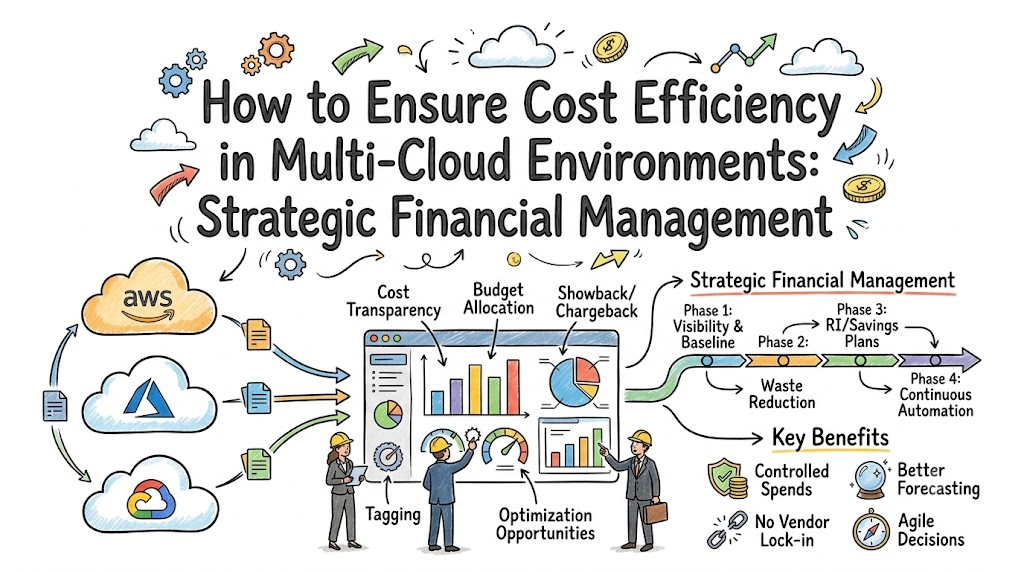
Managing infrastructure spending across multiple cloud vendors requires a unified financial strategy and clear operational discipline. Organizations frequently deploy workloads across different cloud platforms to avoid vendor lock-in and optimize technical performance. However, operating across disjointed environments often leads to unpredictable billing cycles and uncontrolled egress expenses. Therefore, establishing a centralized operational framework becomes absolutely necessary for maintaining healthy corporate margins. Adopting a proven multi-cloud methodology through Finopsschool enables modern engineering teams to master cross-provider cost optimization effectively. This collaborative structure ensures that distributed deployments actively support overarching business priorities.
Consequently, technical teams gain full transparency into the true costs of running diverse multi-platform architectures. Engineers can immediately evaluate how specific infrastructure decisions influence operational spending across different platforms. Finance departments can build dependable forecasting models because they receive consolidated telemetry from every environment. Ultimately, this operational alignment prevents expensive resource sprawl without slowing down release schedules or platform scalability.
Understanding Cloud Financial Operations
Operating across multi-cloud environments fundamentally changes the economics of modern enterprise IT management. Instead of dealing with a single billing console, organizations must navigate completely different pricing models and discount structures. Furthermore, decentralized engineering groups can spin up resources in multiple cloud platforms simultaneously without central coordination. Without clear guardrails and cross-platform oversight, enterprise expenses inevitably expand far beyond initial projections within weeks.
To overcome these structural complexities, companies must deploy an active cost governance model built specifically for multi-provider ecosystems. Cloud financial management delivers this unified framework by combining practical data analysis with cultural accountability. It creates a collaborative environment where system architects, finance managers, and security leaders meet regularly. As a result, the entire organization learns to treat cost efficiency as a continuous operational habit rather than an afterthought.
Moreover, this multi-cloud practice operates through three continuous, iterative stages to ensure long-term sustainability. The inform phase consolidates telemetry across all cloud platforms to establish absolute visibility into departmental spending. Next, the optimize phase targets immediate waste reduction, such as removing unused virtual assets and eliminating duplicate data paths. Finally, the operate phase embeds automated governance rules into everyday deployment pipelines, ensuring ongoing architectural efficiency.
Key Operational Concepts You Must Know
Unified Cross-Cloud Tagging and Cost Attribution
Accurate cost attribution forms the foundation of multi-cloud efficiency because unmapped infrastructure inevitably generates hidden waste. Organizations must enforce standardized metadata tagging schemas that function seamlessly across every cloud provider. This practice ensures that every running instance, storage bucket, or database maps directly to a specific product or business unit. When engineering teams receive clear financial statements for their cross-platform resources, personal accountability develops naturally.
Furthermore, uniform tagging eliminates the challenge of reconciling divergent naming conventions from different cloud consoles. Finance managers can easily compare resource costs across environments to determine the most cost-effective hosting platforms. Consequently, project leads actively participate in budget management rather than treating it as an administrative chore. Consistent visibility turns cross-cloud cost governance into a shared operational priority.
Cross-Provider Right-Sizing and Waste Elimination
Right-sizing requires balancing resource allocations directly against real-time application demands across every active platform. Engineering teams often select larger machine types during initial deployments to safeguard against unexpected traffic surges. However, this cautious approach generates idle capacity that quietly consumes financial resources around the clock. By actively tracking performance telemetry, automated systems can downsize over-provisioned instances safely without causing service interruptions.
Through continuous performance reviews, infrastructure architects can identify inactive virtual machines and unattached storage volumes across all providers. In addition, removing abandoned network load balancers and outdated test environments produces immediate monthly savings. This proactive hygiene ensures enterprises pay strictly for active utilization rather than speculative capacity requirements.
Strategic Multi-Cloud Discount Management
Each cloud provider offers specialized pricing models and volume commitments designed to reward long-term usage. Navigating these options across multiple platforms requires deep historical consumption analysis and precise forecasting capabilities. Financial engineering teams evaluate historical workloads to establish baseline resource requirements across every vendor. Securing provider-specific savings plans allows companies to reduce baseline compute rates substantially compared to on-demand pricing.
However, overcommitting resources on multiple platforms can lock an enterprise into costly inflexibility if technical requirements evolve. Therefore, capacity planning must remain a collaborative effort between technical architects and financial analysts. Balancing commitments across platforms establishes an agile, highly cost-effective operational footprint.
| Operational Concept | Primary Focus Area | Key Business Outcome |
|---|---|---|
| Unified Tagging | Metadata Standardization | Total spending visibility across all providers |
| Resource Right-Sizing | Workload Matching | Immediate elimination of idle computing waste |
| Commitment Management | Cross-Platform Discounts | Substantial reduction in baseline infrastructure spend |
Platform Implementation vs. Culture — What’s the Real Difference?
The Mechanics of Tool Deployment
Platform implementation focuses on deploying centralized management tools, connecting APIs, and configuring multi-cloud monitoring dashboards. Companies frequently invest in third-party cost management platforms expecting automated software to eliminate financial waste instantly. These platforms excel at aggregating billing telemetry, illustrating cost anomalies, and highlighting optimization opportunities. However, installing software tooling provides only the visibility layer of a complete cost management program.
+---------------------------------+       +---------------------------------+
|     Platform Implementation     |  -->  |        Cultural Adoption        |
|  (Dashboards, Tools & Testing)  |       |  (Accountability & Daily Habits) |
+---------------------------------+       +---------------------------------+
Without proactive engineering intervention, monitoring dashboards simply visualize unnecessary spending without addressing the architectural causes. Engineers must review the generated alerts, validate recommendations, and execute necessary code updates in production. Therefore, relying solely on automated platforms creates a passive reporting environment rather than an active culture of optimization. Centralized tools provide essential telemetry, but they cannot replace thoughtful engineering choices.
Driving Genuine Behavioral Transformation
Cultural adoption focuses on transforming employee mindsets so that technical teams instinctively view cost as an essential engineering metric. In an optimized organization, developers consider the financial footprint of an architecture during early system design phases. This transformation requires breaking down corporate silos that historically separated procurement departments from development teams. Continuous education and transparent communication channels serve as the primary mechanisms for fostering this cultural evolution.
When finance teams comprehend multi-cloud engineering workflows, they build flexible budgets that support technical experimentation. Simultaneously, when software developers understand corporate financial constraints, they design efficient, modular architectures from day one. This mutual understanding creates a productive ecosystem where cross-functional alignment happens naturally. Culture transforms cost governance from an external enforcement exercise into an internal engineering standard.
Real-World Use Cases of Modern Operations
Optimizing Data Egress in Hybrid-Cloud Pipelines
A global software enterprise distributed its operational services across two public cloud providers and an internal data center. While this architecture maximized service availability, it created massive data transfer and egress costs between environments. Engineering teams had established multiple uncompressed data synchronization pipelines that continuously moved records across network boundaries. To address this financial drain, the organization restructured its data transport pipelines.
By deploying localized caching tiers and implementing efficient data compression protocols, the engineering team slashed cross-provider transfer volumes. In addition, they scheduled non-urgent batch synchronization jobs during off-peak network windows. Consequently, the enterprise maintained seamless application performance while drastically reducing monthly data egress expenses.
Container Cost Allocation Across Multi-Provider Clusters
A digital financial services organization deployed containerized microservices across managed Kubernetes platforms provided by multiple cloud vendors. While this strategy accelerated feature releases, it obscured the operational costs of specific application components. Multiple product teams deployed workloads without setting proper resource requests, causing overall cluster costs to surge. The organization solved this challenge by implementing unified container cost telemetry.
+-----------------------------------+
| Multi-Cloud Container Telemetry   |
+-----------------------------------+
                 |
                 v
+-----------------------------------+
| Enforce Strict Resource Limits    |
+-----------------------------------+
                 |
                 v
+-----------------------------------+
| Eliminate Cross-Provider Waste    |
+-----------------------------------+
This telemetry enabled management to attribute container expenditures directly to specific business services across both platforms. Armed with accurate data, developers refined their workload configurations to align with actual resource requirements. This precise intervention delivered significant savings across all clusters without compromising reliability.
Common Mistakes in Operations Engineering
Ignoring Cross-Cloud Network Transfer Expenses
A common mistake in multi-cloud operations involves underestimating the cumulative cost of inter-cloud data movement. Engineers frequently design distributed systems where microservices hosted on one platform query databases residing on another. While individual network calls appear inexpensive, high transaction volumes quickly generate massive data egress invoices. Because these network fees accumulate quietly, they often catch financial managers completely off guard.
To avoid this budget drain, system architects must design workloads to minimize data transit across cloud boundaries. Storing and processing dependent data within the same provider region significantly mitigates avoidable network charges. Furthermore, establishing automated network monitoring alerts ensures that unusual data transfer spikes are resolved promptly.
- Locate interconnected services within the same provider boundaries whenever possible.
- Implement automated compression on all cross-platform data pipelines.
- Audit data egress charges monthly to identify inefficient microservice communications.
Mismanaging Multi-Provider Commitment Portfolios
Many organizations attempt to purchase long-term commitment discounts across multiple cloud providers without centralized coordination. When individual teams purchase reserved instances independently, companies risk locking themselves into redundant capacity commitments. If project priorities shift, these underutilized commitments turn into fixed expenses that cannot be easily recovered. Managing multiple commitment portfolios requires central visibility and coordinated planning.
+--------------------------------------+
| Fragmented Departmental Purchases    |
+--------------------------------------+
                   |
                   v
+--------------------------------------+
| Centralized Usage Trend Analysis     |
+--------------------------------------+
                   |
                   v
+--------------------------------------+
| Balanced Multi-Cloud Commitments     |
+--------------------------------------+
Enterprises should centralize the governance and acquisition of long-term commitment plans under a dedicated review group. Cross-functional teams evaluate overall usage trends before approving multi-year commitments with any single vendor. This disciplined practice maximizes discounted pricing while maintaining operational flexibility across all environments.
How to Become an Operations Expert — Career Roadmap
Mastering Multi-Cloud Architecture and Observability
Building a successful career in cross-platform operations requires a deep understanding of major cloud provider architectures. Aspiring professionals must master compute paradigms, storage classes, container orchestration, and multi-cloud networking mechanics. Earning professional-level certifications across multiple primary cloud platforms establishes technical credibility and expertise. Furthermore, acquiring practical experience with cross-platform observability tools is essential for career advancement.
- Acquire foundational certifications from multiple public cloud providers to understand platform differences.
- Master container orchestration across managed Kubernetes services on diverse platforms.
- Build custom dashboards using modern observability tools to monitor distributed systems.
Developing Financial Acumen and Stakeholder Leadership
Technical mastery must be paired with strong corporate finance knowledge to deliver maximum business value. Professionals need to grasp budgeting processes, operational forecasting, depreciation principles, and unit cost economics. This financial literacy allows engineers to articulate the business impact of technical decisions to executive leadership. Bridging the gap between engineering and finance transforms technical specialists into trusted corporate advisors.
- Study corporate accounting principles to understand operational expenditure models.
- Translate technical metrics into clear financial statements and return on investment analyses.
- Lead cross-functional reviews that align engineering roadmaps with business budgets.
FAQ Section
- Why do multi-cloud environments typically experience higher cost complexity than single-cloud setups?
Multi-cloud setups introduce divergent billing structures, unique pricing rules, and separate monitoring consoles for each vendor. Additionally, moving data across provider boundaries introduces egress fees that require specialized governance to control.
- How can organizations enforce consistent tagging policies across multiple cloud platforms?
Organizations enforce consistent tagging by deploying policy-as-code guardrails directly into their deployment automation pipelines. These automated rules block the provisioning of any resource that lacks mandatory ownership and environment tags.
- What is the most effective way to manage data egress costs in multi-cloud architectures?
The most effective strategy involves co-locating dependent microservices and databases within the same provider region. Additionally, utilizing data compression protocols and regional edge caching minimizes unnecessary cross-provider data transfers.
- Is it better to use native cloud cost tools or a third-party multi-cloud platform?
Native tools offer deep visibility into individual provider platforms and work well for smaller, isolated deployments. However, organizations operating at enterprise scale across multiple vendors benefit significantly from third-party tools that aggregate telemetry into a single interface.
- How does tracking unit economics improve multi-cloud cost efficiency?
Tracking unit economics connects infrastructure spending directly to core business metrics, such as cost per active user or transaction. This approach helps leaders determine whether spending increases reflect healthy business growth or operational inefficiency.
Final Summary
Achieving sustainable cost efficiency across multi-cloud environments requires a balanced combination of automation, visibility, and cultural accountability. By breaking down organizational silos and establishing standardized governance frameworks, enterprises eliminate waste while maintaining technological flexibility. This cross-functional alignment gives engineering teams the freedom to innovate while providing financial leaders with predictable spending. Ultimately, mastering modern multi-cloud management practices transforms distributed infrastructure into a dependable engine for long-term business success.