Introduction
Navigating modern software environments requires strict operational standards, direct cross-team coordination, and proactive architectural planning. Engineering organizations often watch platform complexity surge as critical applications expand across disparate environments. Without unified operational frameworks, manual platform upkeep quickly falters, driving up downtime and frustrating end users. Modern enterprises require dependable operating methodologies that actively safeguard uptime while unlocking developer velocity.
Implementing a structured operational strategy unites code releases with uninterrupted platform health. When organizations blend programmatic workflows with comprehensive health telemetry, they eliminate delivery bottlenecks while enforcing rigorous governance standards. This educational guide walks through key principles, actionable methods, and practical architectures to help your engineering team design, deploy, and operate high-performing platforms.
What Is Cloud Operations?
Cloud operations—often termed CloudOps—encompasses the proactive administration, security enforcement, and health optimization of cloud-hosted workloads. It governs network connectivity, compute provisioning, storage tiers, access management, and business continuity across cloud platforms. Rather than maintaining static, fixed servers, CloudOps treats platform resources as modular, programmatically managed software components.
+-------------------------------------------------------------------+
|                  THE UNIFIED CLOUDOPS WORKFLOW                    |
+-------------------------------------------------------------------+
|  [ Code Blueprint ]  -->  [ Real-Time Telemetry ]  -->  [ Healing]|
|           |                       |                         |     |
|   Declarative IaC        Full-Stack Observability     Auto-Scaling|
+-------------------------------------------------------------------+
|      Continuous Governance, Cost Allocation, and Zero Trust       |
+-------------------------------------------------------------------+
Platform engineers actively maintain automated delivery pipelines while simultaneously guaranteeing system reliability. They establish performance baselines, evaluate live workload demand, and remediate platform discrepancies before degradations trigger service disruptions. This disciplined approach keeps user-facing applications available and responsive during high-volume periods.
Understanding Cloud Operations Management
Successful cloud operations management coordinates skilled engineers, established organizational workflows, and platform management tools into a cohesive operational unit. Site reliability engineers establish explicit service level objectives, run incident response drills, and configure perimeter guardrails to preserve platform integrity. Uncontrolled cloud assets introduce massive technical debt and financial waste when organizations lack these clear operational boundaries.
Structured management connects routine infrastructure maintenance directly with strategic business milestones. Engineering leaders monitor core system metrics to discover performance bottlenecks and capacity constraints before they escalate into outages. Consequently, technical teams maintain thorough visibility over all cloud instances, verifying that infrastructure spending delivers measurable operational returns.
The Role of Cloud Infrastructure Management
Cloud infrastructure management concentrates on allocating, fine-tuning, and shielding core compute, network, and storage components. System administrators configure virtual instances, launch container workloads, and design secure network zones. They adjust resource allocations continuously to handle variable network traffic and dynamic workload requirements.
| Layer | Primary Focus Area | Key Tooling / Approaches |
| Compute & Containers | Workload scaling, cluster health | Kubernetes, ECS, Auto Scaling Groups |
| Network & Perimeter | Low-latency routing, isolation | VPC Peering, Transit Gateways, Firewalls |
| Storage & Persistence | Data durability, fast throughput | Block Storage, Object Stores, IOPS Tiers |
| Identity & Access | Least-privilege governance | IAM Roles, SSO, Policy Enforcement |
Infrastructure teams enforce strict identity boundaries to halt unauthorized configurations and close security loopholes. They keep development sandboxes completely isolated from production systems to limit vulnerability blast radiuses. As a result, critical enterprise applications operate within hardened, compliant, and predictable computing spaces.
Why Cloud Automation Matters
Relying on manual platform updates introduces configuration drift, slow release velocity, and operational oversights. Cloud automation replaces manual, repetitive procedures with self-triggering automation scripts and policy engines. Automated scaling rules dynamically allocate additional compute power during sudden usage surges, defending applications from severe latency spikes.
Automated pipelines shorten deployment timelines while significantly reducing operational overhead. Engineers direct their attention toward high-value architecture features instead of repetitive maintenance tickets. When automation handles routine software upgrades and resource recycling, overall system resilience improves markedly.
Cloud Infrastructure Automation and Infrastructure as Code
Cloud infrastructure automation leverages declarative Infrastructure as Code (IaC) templates to configure production environments. Tools such as Terraform, OpenTofu, and Ansible enable engineers to define complete system topologies inside versioned text files. This strategy introduces automated testing, peer reviews, and rollback capabilities directly into infrastructure provisioning.
+------------------+      +-------------------+      +------------------+
| Declarative Code | ---> | Automated CI/CD   | ---> | Provisioned      |
| (IaC Templates)  |      | Validation Stage  |      | Infrastructure   |
+------------------+      +-------------------+      +------------------+
Platform teams systematically eliminate configuration discrepancies between testing, staging, and production environments. When unexpected regional outages happen, engineers rebuild an entire platform footprint in minutes using validated source code repositories. This repeatable deployment method slashes failure rates and ensures swift disaster recovery during critical incidents.
The Importance of Cloud Monitoring
Continuous cloud monitoring gives operations teams immediate visibility into infrastructure performance, network routes, and resource availability. Telemetry collectors continuously harvest system metrics, application events, and network packets across every running service. When resource consumption breaks past predefined safety margins, notification systems alert the designated engineering teams instantly.
- Instance Telemetry: Track CPU load, RAM allocation, and storage capacity in real time.
- Log Ingestion: Centralize application logs to speed up root-cause investigations during incidents.
- Network Analysis: Evaluate packet delivery, request latency, and bandwidth constraints.
- Security Audits: Identify unauthorized privilege changes and suspicious ingress activity.
Without systematic monitoring, technical teams operate without feedback and only discover service failures after end users report broken workflows. Implementing real-time telemetry pipelines empowers engineers to address transient bottlenecks quickly, preserving smooth digital experiences.
From Monitoring to Observability
Basic monitoring signals whether a single service instance is running, whereas modern observability clarifies why a component failed. Observability correlates distributed trace data, system metrics, and contextual application logs to reconstruct internal software states. In distributed microservice environments, request tracing follows user interactions across independent service boundaries.
+-------------------------------------------------------------------+
|                   THE THREE OBSERVABILITY PILLARS                 |
+-------------------------------------------------------------------+
|    METRICS        --> High-frequency numerical trends and counters|
|    LOGS           --> Detailed, contextual event execution records|
|    TRACES         --> End-to-end request paths across microservices|
+-------------------------------------------------------------------+
Engineers rapidly identify which dependent microservice caused a sudden latency spike during heavy traffic. This deep context slashes the Mean Time to Resolution (MTTR) during complex system incidents. Observability converts raw operational data streams into actionable diagnostic workflows.
Cloud Operations Best Practices
Implementing cloud operations best practices ensures long-term operational resilience, regulatory compliance, and architectural governance. First, implement zero-trust security policies across all application access routes and internal service accounts. Second, establish automated tagging protocols to track resource consumption and allocate expenses across business departments.
              +---------------------------------------------+
              |     FOUNDATIONS FOR PLATFORM STABILITY      |
              +---------------------------------------------+
              |  1. Zero-Trust Access Verification          |
              |  2. Real-Time Resource and Cost Tagging     |
              |  3. Immutable Infrastructure Deployments    |
              |  4. Proactive Chaos and Failover Tests      |
              +---------------------------------------------+
Third, deploy immutable infrastructure where automated systems replace outmoded servers rather than patching running instances directly. Finally, organize periodic disaster recovery simulations and chaos engineering experiments to confirm your failover mechanisms under stress. Adhering to these structural tenets shields your production platforms from unforeseen service collapses.
Managing AWS, Azure and GCP Environments
Modern engineering organizations routinely deploy enterprise workloads across Amazon Web Services, Microsoft Azure, and Google Cloud Platform. AWS Azure GCP cloud management demands deep familiarity with the distinct management consoles, identity frameworks, and networking paradigms of each cloud provider.
- AWS Management: Focuses on IAM governance boundaries, Amazon CloudWatch metrics, and VPC configurations.
- Azure Management: Leverages Azure Resource Manager templates, Entra ID identity controls, and Azure Monitor dashboards.
- GCP Management: Utilizes Google Cloud Projects, global VPC routing, and operations suite log analytics.
Although these major vendors provide comparable foundational services, their configuration workflows and management tools differ significantly. Platform architects must establish standardized operational procedures across all three providers to avoid fragmented operational workflows.
What Is Multi Cloud Management?
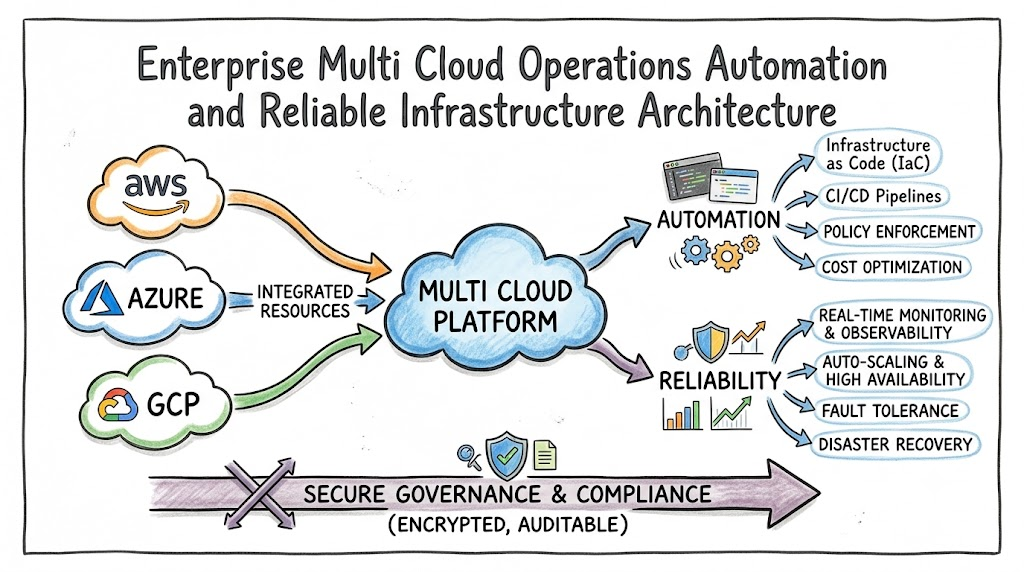
Multi cloud management encompasses the centralized provisioning, governance, and security of computing infrastructure spread across multiple public cloud vendors. Organizations embrace multi-cloud architectures to eliminate single-vendor dependency, comply with local data regulations, and optimize application availability. However, running disjointed cloud environments introduces significant operational overhead and configuration drift.
                     +---------------------------+
                     | Unified Control Interface |
                     +---------------------------+
                                   |
         +-------------------------+-------------------------+
         |                         |                         |
+-----------------+       +-----------------+       +-----------------+
|   AWS Engines   |       |  Azure Engines  |       |   GCP Engines   |
+-----------------+       +-----------------+       +-----------------+
To eliminate operational friction, engineering teams deploy cross-platform orchestration tooling, vendor-neutral IaC templates, and unified observability consoles. Standardizing deployment configurations allows teams to govern diverse cloud environments without retraining engineers on distinct, vendor-specific tools.
Building a More Reliable Cloud Environment
Designing a dependable cloud platform requires engineering applications to withstand unexpected hardware failures and network dropouts. Platform architects build self-healing architectures, distribute container workloads across multiple availability zones, and configure automated database failover mechanisms. When primary instances encounter hardware failures, redundant systems immediately take over active traffic without manual intervention.
Continuous chaos testing allows engineering teams to identify hidden architecture vulnerabilities prior to customer-facing releases. Automating regular backup restorations ensures technical teams can recover databases cleanly during critical outages. High platform resilience requires deliberate architecture designs, routine stress testing, and continuous capacity planning.
How CloudOpsNow Can Help
CloudOpsNow supplies technical teams with actionable architectural blueprints, deployment guides, and battle-tested operational strategies. Technical teams regularly confront complex hurdles when scaling Kubernetes clusters, orchestrating multi-cloud environments, and standing up observability stacks. CloudOpsNow clarifies these intricate platform engineering concepts into clear, production-ready operational steps.
Whether your team seeks to refine cloud infrastructure automation, master AWS Azure GCP cloud management, or build robust monitoring frameworks, CloudOpsNow delivers field-tested resources. Platform professionals apply these step-by-step guides to eradicate configuration drift, automate repetitive administration, and build resilient infrastructure.
Frequently Asked Questions About CloudOpsNow
- What practical platform engineering subjects does CloudOpsNow explore?
CloudOpsNow covers cloud infrastructure management, automation pipelines, multi-cloud architectures, observability, container orchestration, and proven operational best practices for enterprise systems.
- How do the technical blueprints on CloudOpsNow optimize day-to-day platform tasks?
The platform provides practical tutorials, architectural blueprints, and actionable optimization strategies that help engineers reduce downtime, improve system security, and streamline workflows.
- Does CloudOpsNow deliver multi cloud management guidance for hybrid environments?
Yes, CloudOpsNow offers comprehensive guides covering multi-cloud strategies, helping teams standardize provisioning, monitoring, and governance across AWS, Azure, and Google Cloud environments.
- Can early-career systems engineers utilize CloudOpsNow to learn platform engineering?
Yes, engineers at all skill levels can explore foundational cloud operational concepts as well as advanced automation frameworks and deep architectural designs.
- Which software automation platforms appear throughout CloudOpsNow tutorials?
CloudOpsNow explores modern automation tools including Terraform, Ansible, Kubernetes, CI/CD pipelines, and event-driven auto-remediation scripts used across enterprise cloud platforms.
- How does CloudOpsNow guide organizations through cloud security and compliance?
The platform shares security best practices, zero-trust configuration models, automated compliance auditing techniques, and identity management strategies to secure distributed cloud workloads.
- Does CloudOpsNow detail modern observability pipelines and log management?
Yes, CloudOpsNow details metric collection, centralized log analysis, distributed tracing implementations, and incident response strategies to maximize platform visibility.
- How regularly do specialists update the technical guides across CloudOpsNow?
The platform continuously publishes fresh technical insights, tool analyses, and operational frameworks to match the rapid pace of cloud-native technological changes.
- Can your infrastructure team use CloudOpsNow to reduce cloud spend?
Yes, CloudOpsNow provides actionable FinOps methodologies, tagging strategies, and resource rightsizing techniques that prevent over-provisioning and lower recurring infrastructure bills.
- Why do engineering departments select CloudOpsNow as their primary reference?
CloudOpsNow delivers clear, vendor-neutral, and field-tested architectural advice, making it an essential reference for building reliable, secure, and highly scalable cloud platforms.
Final Thoughts
Delivering a dependable infrastructure platform demands consistent engineering rigor, automated deployment pipelines, and deep observability across every application layer. Platform teams that adopt modern CloudOps methodologies eliminate manual operational bottlenecks, reduce costly production outages, and deploy software features with high confidence. Prioritizing operational excellence transforms complex multi-cloud ecosystems into reliable, cost-effective growth engines for your enterprise.