Introduction
Engineering leaders constantly face the difficult balance between rapid feature releases and production stability. Disjointed handoffs, fragmented server fleets, and unpredictable cloud spending often paralyze delivery cycles. As a result, software developers spend precious hours troubleshooting server environments rather than shipping innovative features.
Cotocus removes these operational hurdles by implementing resilient automation patterns and scalable platform designs. Instead of relying on manual interventions, progressive businesses establish deterministic pipelines, container orchestration, and continuous observability.
This comprehensive strategic manual examines the core mechanisms of modern software delivery. In the following sections, you will discover how cloud adoption, container management, shift-left security, and reliability engineering combine into an efficient operational engine.
What Does DevOps Actually Help a Business Do?
DevOps establishes operational alignment by uniting application programmers and infrastructure operators under shared goals. Consequently, software squads streamline delivery cycles and eliminate release bottlenecks across all environments.
Continuous integration and automated pipelines replace error-prone server adjustments. Because testing engines validate every pull request immediately, developers uncover regressions before they touch user-facing systems. Therefore, enterprises protect digital revenue streams while rapidly delivering features to the market.
- Faster Delivery: Programmers translate raw ideas into functional production artifacts in minutes.
- Fewer Outages: Automated checks catch regressions early, eliminating painful emergency rollbacks.
- Unified Squads: Centralized visibility dashboards eliminate inter-departmental finger-pointing.
Why Are So Many Businesses Moving Toward DevOps?
Global enterprises face relentless technical competition across modern commercial markets. Because consumers demand uninterrupted platform availability and regular feature drops, old-fashioned change review committees fail to keep pace.
Empirical market data shows that high-velocity software teams push updates daily while keeping change failure rates remarkably low. Conversely, teams that run manual deployment scripts regularly experience severe downtime and missed project deadlines.
- Market Competitiveness: Agile release cycles enable businesses to adapt instantly to shifting consumer demands.
- Financial Optimization: Infrastructure automation tears down unutilized server capacity to prevent cloud waste.
- Staff Retention: Technical talent thrives when building core software instead of executing repetitive deployment scripts.
Where Can DevOps Consulting Make a Difference?
Replacing legacy monolithic practices with modern automated workflows presents steep organizational challenges. Therefore, engaging experienced DevOps Consulting Services gives companies an actionable implementation plan and proven architectural designs.
Consider a practical example: a financial platform once spent three business days deploying each minor release. Our consultants re-engineered their pipeline architecture from the ground up, adding automated validation stages. Consequently, release durations dropped to twenty-five minutes, cutting operational overhead by ninety percent.
- Infrastructure as Code: Codify server fleets consistently using declarative tools like Terraform and Ansible.
- Standardized CI/CD: Establish deterministic delivery pipelines that run integration suites, unit tests, and security scans.
- Workflow Acceleration: Eliminate communication roadblocks between system operations teams and application engineers.
What Are Managed DevOps Services and Who Needs Them?
Supporting high-traffic infrastructure around the clock demands deep technical specialization that many internal engineering teams lack. Therefore, growing organizations rely on Managed DevOps Services to oversee ongoing operations, platform automation, and cloud management.
| Operational Discipline | Internal Team Strain | Managed Service Coverage |
|---|---|---|
| Pipeline Maintenance | Consumes developer hours | Fully maintained CI/CD runners and deployment tooling |
| System Patching | Causes high maintenance fatigue | Automated infrastructure patching with zero application downtime |
| Incident Response | Produces patchy off-hours coverage | Continuous 24/7 telemetry monitoring and rapid incident mitigation |
| Budget Control | Leads to unmonitored resource sprawl | Ongoing resource right-sizing and cloud cost governance |
This managed engagement model empowers internal developers to concentrate solely on customer-facing features. Meanwhile, platform specialists safeguard system health, patch software dependencies, and preserve high availability.
How Does Cloud Computing Change the Way Teams Build Software?
Cloud platforms convert fixed physical hardware into dynamic, software-defined infrastructure. Because teams launch compute instances programmatically, multi-month procurement cycles vanish completely.
In addition, modern cloud vendors offer managed data storage, automated scaling rules, and global edge distribution networks. Therefore, software squads build flexible distributed applications that adapt compute capacity dynamically during massive usage spikes.
- Elastic Scaling: Expand computing clusters automatically to support promotional sales and unexpected user traffic.
- Geographical Redundancy: Replicate mission-critical data stores across diverse availability zones to ensure fault tolerance.
- Strategic Focus: Hand over physical hardware management to hyperscale providers such as AWS, Azure, and Google Cloud.
When Should You Consider Cloud Consulting Services?
Managing distributed networks, multi-cloud platforms, and rising operational invoices demands rigorous architectural governance. Consequently, businesses retain Cloud Consulting Services when technical complexity exceeds existing team capabilities.
Specialized cloud consultants inspect your active deployments to resolve architectural weaknesses and security vulnerabilities. Furthermore, they implement automated budget limits, resource tagging, and reserved instance strategies to curb rising cloud expenses.
- Infrastructure Audits: Inspect active cloud topologies to eliminate single points of failure and security misconfigurations.
- Multi-Cloud Blueprints: Construct resilient architectures that prevent single-vendor dependency.
- FinOps Governance: Decommission idle computing assets and adjust server footprints to minimize recurring operational costs.
What Should You Know Before Moving Applications to the Cloud?
Transferring legacy systems directly to cloud instances without planning often drives up recurring bills without improving uptime. Therefore, businesses must execute methodical Cloud Migration Services that evaluate application dependencies, database throughput, and networking limitations.
| Migration Pathway | Technical Considerations & Trade-offs | Ideal Operational Context |
|---|---|---|
| Rehost (Lift & Shift) | Enables fast cutover; limits cloud-native elasticity | Short-lifecycle applications near planned retirement |
| Replatform (Lift & Reshape) | Requires minor code tuning; adopts managed cloud databases | Monolithic applications needing moderate modernization |
| Refactor (Cloud-Native) | Demands extensive code rewrites; unlocks elastic microservices | Core strategic revenue-generating systems |
A large logistics company recently modernized thirty-two core applications using a phased replatforming strategy. By decoupling interconnected components methodically, the engineering team avoided data corruption and achieved zero unplanned downtime during the entire migration.
Why Is Kubernetes Becoming Important for Modern Applications?
Containers encapsulate application code alongside necessary operating libraries, guaranteeing identical execution on any machine. However, supervising hundreds of decoupled containers across large fleets creates substantial operational chaos.
Kubernetes resolves this deployment bottleneck by orchestrating container scheduling, self-healing, traffic routing, and rollout automation. As a result, distributed software workloads execute reliably across enterprise servers without perpetual human supervision.
- Automated Self-Healing: Kubernetes restarts failed containers and shifts workloads away from degraded compute nodes.
- Dynamic Workload Scaling: Horizontal Pod Autoscalers dynamically increase instance counts to handle incoming application requests.
- Uniform Packaging: Predictable container images eliminate environment discrepancies between development workstations and production servers.
When Can Kubernetes Consulting Services Be Useful?
Managing enterprise Kubernetes clusters on AWS (EKS), Azure (AKS), or Google Cloud (GKE) demands specialized infrastructure expertise. Consequently, organizations engage Kubernetes Consulting Services to secure network perimeters, manage persistent storage volumes, and tune ingress routing.
Container consultants configure namespace boundaries, automate scaling triggers, and implement service meshes to handle encrypted internal communication. As a result, product engineers ship containerized software with total operational confidence.
- Cluster Hardening: Enforce role-based access control, configure namespace isolation, and secure the control plane.
- Storage and Ingress Management: Configure persistent storage backends and deploy ingress gateways with automated SSL certificate renewal.
- Operational Troubleshooting: Resolve complex container crashes, networking deadlocks, and pod eviction cycles rapidly.
How Does DevSecOps Bring Security Into Everyday Development?
Treating security validations as a final gatekeeper right before launch creates severe delivery logjams. Progressive technology teams instead adopt DevSecOps Consulting Services to embed automated security controls throughout the entire software lifecycle.
Developers execute static code scans right inside source code repositories. Next, delivery pipelines evaluate container base images for known vulnerabilities before deployment. Finally, runtime monitoring agents supervise live systems, allowing engineers to patch security gaps during development rather than during production crises.
- Shift-Left Testing: Uncover code flaws directly inside developer code editors.
- Dependency Auditing: Scan third-party libraries for open vulnerabilities and compliance issues.
- Automated Policy Enforcement: Halt non-compliant deployment scripts automatically before they reach staging or production environments.
Why Is Automation So Important for DevSecOps?
Manual compliance audits consume weeks of engineering effort and grow outdated the moment developers ship new code. In contrast, automated security scans evaluate pull requests in minutes, offering immediate remediation feedback to the engineer.
Furthermore, automated secret detectors prevent team members from committing private credentials and API tokens to public codebases. Therefore, organizations maintain stringent corporate governance without compromising release tempo.
- Immediate Remediation: Engineers receive precise vulnerability details the moment a scanner flags insecure code.
- Unblocked Delivery: Automated rules evaluate compliance without relying on manual security approvals.
- Verifiable Audit Trails: Continuous deployment runners maintain detailed records that satisfy regulatory compliance requirements.
What Is SRE and Why Does Reliability Matter?
Site Reliability Engineering translates software development techniques into infrastructure operations practices. Rather than relying on guesswork, teams use SRE Consulting Services to establish precise, quantitative reliability standards.
- Service Level Indicators (SLIs): Track exact operational metrics such as service latency and error percentages.
- Service Level Objectives (SLOs): Set unambiguous reliability targets that keep users satisfied.
- Error Budgets: Define acceptable system downtime allowances, balancing aggressive feature releases against platform stability.
A healthcare software provider suffered repeated morning outages caused by unverified software releases. By introducing strict reliability goals and error budget guardrails, the team halted non-essential updates whenever outages depleted the error budget. Consequently, production availability improved to 99.98% within three months.
How Can Better Observability Help Your Engineering Team?
Simple health checks merely confirm whether a physical server remains online. In contrast, modern distributed systems require comprehensive observability to expose unexpected microservice behaviors.
By consolidating operational metrics, structured logs, and distributed network traces into a single platform, engineers follow live user requests across disparate hosts. Consequently, incident response squads pinpoint the root causes of service degradations in minutes.
- Distributed Request Tracing: Follow incoming traffic through interconnected microservices to reveal database bottlenecks.
- User-Centric Alerts: Dispatch urgent notifications based on degrading user experience rather than noisy server telemetry.
- Faster Incident Resolution: Reduce the time needed to fix production issues by viewing contextual trace logs.
What Is Platform Engineering and Why Are Teams Adopting It?
As modern application architectures grow more complex, product engineers waste excessive time managing container definitions and infrastructure scripts. In response, modern organizations adopt Platform Engineering Consulting Services to build dedicated internal developer platforms.
The platform team treats internal developers as customers by providing self-service interfaces and automated developer environments. Therefore, product engineers focus their cognitive energy entirely on building high-value business features.
- Reduced Cognitive Load: Insulate developers from complex Kubernetes manifests and cloud permission configurations.
- Self-Service Portals: Enable developers to spin up complete testing environments on demand without filing operations tickets.
- Standardized Infrastructure: Integrate corporate security, network rules, and backup policies directly into foundational templates.
What Are Golden Paths and How Do They Help Developers?
Golden Paths represent pre-configured, fully supported deployment templates created by platform teams. Instead of figuring out infrastructure pipelines from scratch, developers follow proven architectural patterns to push code safely.
- Instant Project Scaffolding: Developers generate production-ready microservices complete with CI/CD, telemetry, and automated security scans in minutes.
- Architectural Consistency: Prevent technical debt by ensuring all internal services adhere to standardized patterns.
- Seamless Autonomy: Developers choose standardized paths to deploy code independently without facing bureaucratic reviews.
When an international logistics company established golden paths across four hundred developers, onboarding time for new hires dropped from four weeks to three days. Engineers could deploy a verified microservice on their very first afternoon without submitting administrative support tickets.
How Can Corporate DevOps Training Strengthen Internal Teams?
Tools and infrastructure automation deliver minimal business impact if engineering teams continue working inside traditional operational silos. Consequently, forward-looking enterprises invest in hands-on Corporate DevOps Training to upskill their internal workforce.
Professional technical training equips engineers with practical skills across containerization, pipeline automation, security integration, and reliability engineering. Furthermore, team-wide education fosters an empathetic engineering culture focused on shared operational ownership.
- Hands-on Lab Environments: Engineers learn by troubleshooting simulated production failures and container outages.
- Standardized Engineering Practices: Align distributed development squads around common version control, testing, and deployment standards.
- Internal Leadership Growth: Empower senior engineers to champion modern automation and mentoring practices across the company.
How Do DevOps, Cloud, Kubernetes, and SRE Work Together?
Modern software engineering disciplines do not function as isolated, standalone practices. Instead, they interlock to form an automated, self-healing, and scalable software delivery ecosystem.
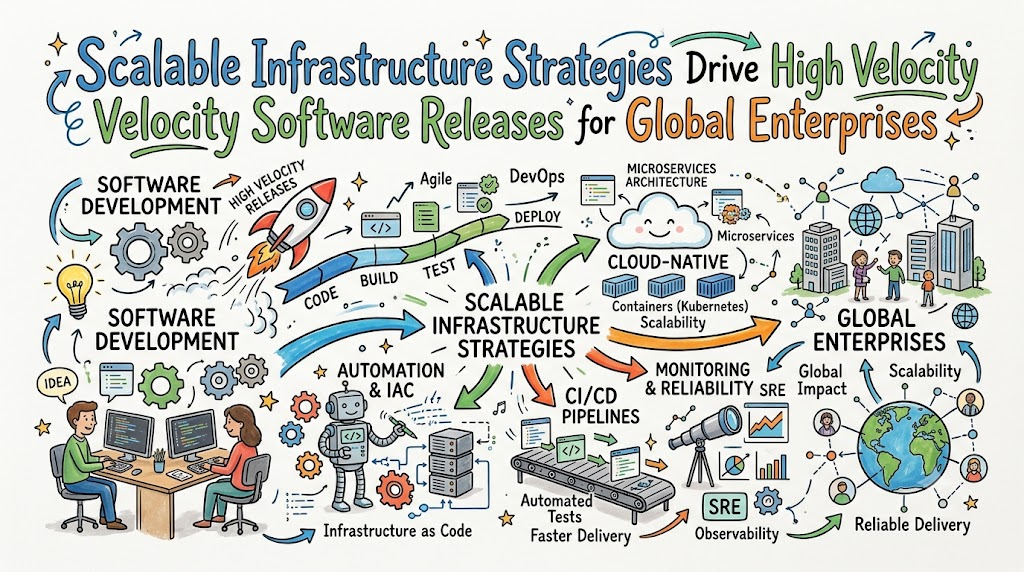
Cloud infrastructure delivers elastic computing, storage, and networking layers. On top of this foundation, automated delivery pipelines compile and test secure container images. Kubernetes orchestrates these workloads across clusters, while internal developer platforms provide self-service golden paths. Finally, site reliability practices monitor observability metrics and enforce error budgets. Working in unison, these practices turn software engineering into a predictable business growth driver.
What Problems Can Slow Down a DevOps Transformation?
Enterprise modernizations often struggle when management prioritizes tool purchases over cultural habits. Acquiring expensive software subscriptions will not fix operational dysfunction if teams maintain isolated workflows.
- Cultural Resistance: Teams hesitate to abandon familiar manual routines without clear leadership backing and safety guardrails.
- Overly Ambitious Scope: Attempting to rewrite complex legacy architectures all at once introduces paralyzing delivery delays.
- Tooling Fragmentation: Adopting competing automation tools across departments creates disjointed workflows and operational overhead.
Organizations overcome these common pitfalls by pursuing iterative improvements. Starting with a single, highly visible project demonstrates tangible wins, inspiring wider corporate adoption across remaining engineering divisions.
How Can You Tell Whether Your DevOps Strategy Is Working?
Measuring engineering progress requires tracking clear, objective business outcomes rather than subjective impressions. Engineering leaders rely on standard software delivery metrics to evaluate automation performance and operational health.
| Software Delivery Metric | Low Performance Profile | High Performance Target |
|---|---|---|
| Deployment Frequency | Monthly or quarterly updates | Multiple automated deployments per day |
| Lead Time for Changes | Weeks or months | Under one hour from commit to production |
| Change Failure Rate | Greater than 30% failure rate | Below 5% failure rate |
| Time to Restore Service | Days or multiple hours | Resolved in under one hour |
Tracking these key performance indicators enables engineering managers to locate pipeline bottlenecks and justify continuous investments in automation infrastructure.
What Does a Practical DevOps Roadmap Look Like?
Transforming enterprise delivery workflows requires a phased, predictable rollout plan. Attempting to modernize every system simultaneously leads to operational chaos and team exhaustion.
- Step 1: Pipeline Modernization: Unify version control workflows, establish centralized automated builds, and eliminate manual testing handoffs.
- Step 2: Cloud Modernization & Containers: Package workloads inside standard containers and provision cloud infrastructure via declarative code.
- Step 3: Security & Telemetry: Embed automated scanning tools inside release workflows and set up distributed tracing dashboards.
- Step 4: Platform Self-Service: Provide developers with pre-approved golden paths to spin up infrastructure and applications autonomously.
How Can Cotocus Support Your Modern Engineering Journey?
Modernizing infrastructure while maintaining continuous business operations can strain internal engineering resources. Cotocus provides complete end-to-end guidance to help companies build, secure, and operate scalable cloud platforms.
Our technical specialists integrate directly with your teams to implement automated delivery pipelines, migrate critical workloads, and optimize container clusters. Furthermore, organizations seeking extra engineering bandwidth can leverage our specialized DevOps Outsourcing Services to scale their engineering capacity instantly.
- Full-Lifecycle Cloud Support: Accelerate cloud adoption with proven migration, automation, and cost-reduction patterns.
- Container & Platform Excellence: Construct resilient Kubernetes architectures and internal developer portals tailored to your workflows.
- Skill Enablement: Elevate internal engineering teams through focused Corporate DevOps Training programs.
Frequently Asked Questions
- What technical capabilities does Cotocus provide for modern delivery initiatives?Our consultants deliver engineering consulting, managed cloud environments, and hands-on corporate upskilling across multi-cloud setups. These offerings cover pipeline automation, cloud migrations, Kubernetes design, DevSecOps pipelines, platform portals, and SRE frameworks.
- How do cloud specialists curb unnecessary computing expenditures?Our teams audit billing accounts, eliminate orphan volumes, downsize overprovisioned instances, and enforce dynamic auto-scaling rules. These interventions lower monthly cloud bills while keeping service performance high.
- Can Cotocus restructure monolithic codebases into container architectures?Yes. Our architects build structured roadmaps that divide monolithic software into secure, containerized services managed through EKS, AKS, or GKE.
- How much time does an initial engineering evaluation require?A deep evaluation of build workflows, cloud architecture, and security controls takes between two and three weeks. We then deliver an actionable modernization roadmap.
- Where do engineers insert automated security checks during development?Our teams embed static source scans, third-party dependency validations, and container image assessments into CI/CD pipelines. This ensures teams discover vulnerabilities long before software enters production.
- Does Cotocus offer 24/7 monitoring coverage for live production systems?Yes. Our managed operational plans provide continuous 24/7 telemetry monitoring, proactive alert triage, and emergency incident resolution to preserve high platform availability.
- How does an internal developer platform enhance engineering productivity?Platform engineering establishes internal self-service portals and golden paths. These remove infrastructure complexities, allowing developers to provision environments and ship features independently.
- Can our business hire specialized engineers through DevOps Outsourcing Services?Yes. Cotocus supplies experienced cloud, container, platform, and reliability engineers to augment your internal teams and accelerate important technical initiatives.
- What industries benefit most from the engineering services offered by Cotocus?Our engineering engagements support diverse sectors including financial technology, healthcare, logistics, e-commerce, and software-as-a-service enterprises requiring reliable digital infrastructure.
- How does Cotocus help internal teams adopt site reliability engineering practices?We help engineering organizations define actionable Service Level Objectives, set up telemetry dashboards, establish error budget policies, and run productive incident reviews.
Final Thoughts
Sustainable competitive advantage demands resilient, automated, and developer-friendly delivery ecosystems. By combining cloud architectures, container orchestration, automated security checks, and reliability engineering, organizations unlock sustained business agility. Cotocus remains dedicated to guiding enterprises through every stage of this technical journey, ensuring your infrastructure scales reliably as your business grows.