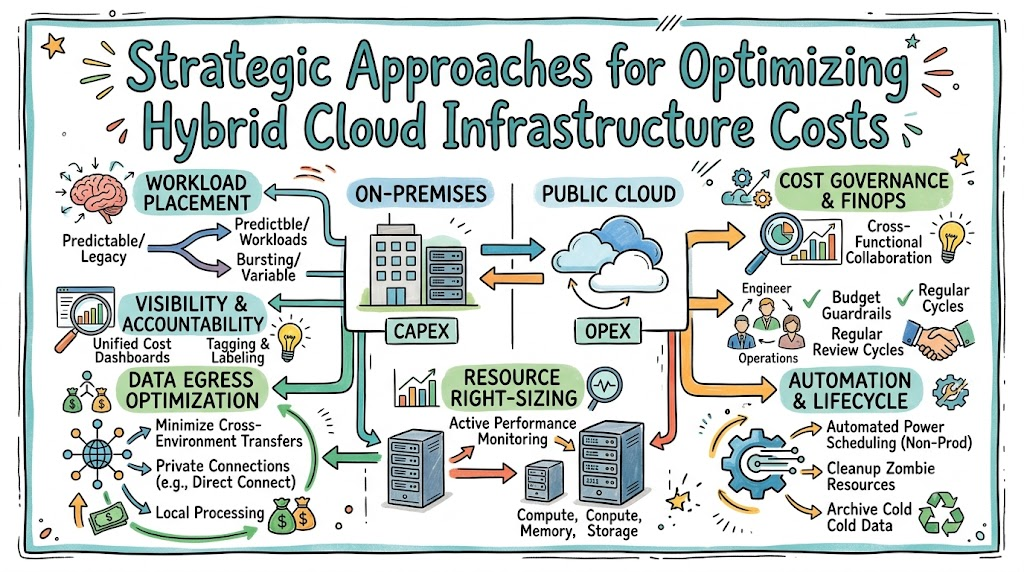
Managing expenses across hybrid IT architectures requires balancing private on-premises assets with dynamic public cloud services. Organizations frequently struggle with hidden expenditures—especially cross-environment networking, misallocated workloads, and inconsistent operational tooling. Implementing structured financial governance enables engineering and finance leaders to optimize resources across both ecosystems without sacrificing stability or developer velocity. Learning industry-standard frameworks through structured platforms like Finopsschool equips teams with the practical techniques needed to bridge disparate cost models. This unified approach guarantees that infrastructure provisioning choices actively support broader business and financial goals.
Furthermore, hybrid cost optimization transforms unpredictability into a structured forecasting model. Technology leaders gain immediate clarity on unit economics, distinguishing between capital depreciation on-premises and pay-as-you-go public cloud rates. Financial planners receive consistent, consolidated reporting instead of fragmented bills across multiple systems. Ultimately, strategic workload placement and continuous monitoring eliminate idle resource accumulation while maintaining reliable, enterprise-grade application performance.
Understanding Cloud Financial Operations
Hybrid deployments create unique financial governance hurdles because traditional accounting principles collide directly with consumption-based billing models. On-premises data centers rely on static capital allocations, where infrastructure investments are planned and amortized over long multi-year horizons. In stark contrast, public clouds operate dynamically on variable operational spending driven by continuous API calls and automated scaling policies. When organizations merge these two paradigms without established guidelines, overall expenditures often increase sharply rather than decrease.
To maintain financial discipline, engineering and finance teams must adopt unified visibility across private data centers, colocation sites, and public cloud zones. This holistic approach forms the foundation of modern hybrid FinOps, unifying resource telemetry under standardized metrics. Cross-functional teams evaluate total cost of ownership by considering server utilization, power consumption, data egress, and licensing costs in unison. Consequently, organizational teams move away from isolated, tribal budgeting habits and embrace ongoing financial collaboration.
Moreover, this continuous practice operates through iterative phases: establishing cost attribution, executing targeted workload balancing, and cementing operational policies. Initial discovery maps every physical hypervisor and public compute instance to its specific business function. Subsequently, tactical adjustments move heavy, steady-state processing to the most cost-effective environment available. In the final phase, governance frameworks automate deployment guardrails, securing long-term cost containment.
Key Operational Concepts You Must Know
Unified Cost Visibility and Tagging Alignment
Establishing centralized visibility is the first operational priority when managing hybrid cloud expenditures. Private data center resources must be tagged and cataloged using metadata frameworks that align with public cloud naming conventions. Without standardized taxonomy, teams cannot track operational expenditures back to distinct product features, development groups, or customer segments. Granular cost attribution provides engineers with clear feedback on how architectural decisions impact real-world balance sheets.
Furthermore, comprehensive tagging prevents unassigned compute and orphan storage instances from slipping through reporting gaps. Clear dashboarding exposes resource efficiency to team leads, cultivating organic accountability across development departments. As operational transparency deepens, teams instinctively prioritize efficiency during standard code deployments and release cycles. Transparent attribution transforms budget adherence from a top-down mandate into a natural engineering standard.
Workload Placement and Strategic Portability
Cost-effective hybrid operations depend heavily on intelligent workload placement based on consumption profiles. Predictable, non-bursting, and compute-heavy legacy tasks are often more economical to run on fully capitalized on-premises hardware. Conversely, transient batch processing, experimentation spaces, and high-variance customer portals thrive on elastic public cloud nodes. Adopting containerization and cloud-agnostic orchestrators ensures workloads can move seamlessly between on-prem environments and public providers as economic realities change.
In addition, teams must monitor the ongoing cost curves of both environments to rebalance applications over time. What was initially cost-effective in the cloud might evolve into an expensive enterprise footprint requiring repatriated infrastructure. Conversely, retiring aging on-premises servers can eliminate maintenance contracts, moving those tasks into optimized serverless services. Evaluating placement options continuously guarantees optimal infrastructure allocation across the enterprise.
Controlling Data Egress and Network Topology
Data movement fees between private data centers and public clouds present one of the most volatile budget risks in hybrid setups. Cloud providers routinely charge significant fees for outbound data transfer, quickly inflating monthly invoices when systems communicate frequently. Implementing dedicated, private network interconnections—such as AWS Direct Connect, Azure ExpressRoute, or Google Cloud Interconnect—often slashes data transfer charges compared to public internet transit.
Architects must also design distributed data systems deliberately, processing localized workloads as close to primary data stores as possible. Caching frequent queries at network perimeters and avoiding unnecessary synchronization of large datasets between data centers curbs egress bills. Prudent network routing keeps communication lines fast, secure, and financially predictable.
| Operational Concept | Primary Focus Area | Hybrid Business Impact |
|---|---|---|
| Unified Attribution | Standardized Tagging | Complete spend visibility across on-premises and multi-cloud assets |
| Intelligent Placement | Workload Profiling | Aligns steady-state vs. burst tasks with the cheapest hosting medium |
| Network Governance | Direct Peering & Egress | Eliminates massive outbound network fees and stabilizes latency |
Platform Implementation vs. Culture — What’s the Real Difference?
The Mechanics of Tool Deployment
Platform implementation centers on integrating centralized telemetry software, collecting billing APIs, and establishing hybrid management consoles. Many technical organizations fall into the trap of purchasing expensive multi-cloud SaaS products, expecting software alone to resolve financial sprawl. These tools excel at collecting granular metrics, displaying colorful cost breakdowns, and spotting basic configuration anomalies. However, software consoles merely document inefficiencies without fixing the core structural code or deployment habits causing them.
+-----------------------------------+       +------------------------------------+
| Hybrid Monitoring Platforms       |  -->  | Organizational Cultural Discipline |
| (API Ingestion, Dashboards, Logs) |       | (Ownership, Governance, Review)    |
+-----------------------------------+       +------------------------------------+
Automated suggestions require human review and implementation by engineering teams familiar with specific application dependencies. If engineers are not incentivized or given dedicated sprint time to remediate warnings, dashboards quickly turn into neglected backlogs. Therefore, relying solely on technology tooling builds passive reporting rather than active financial management. Multi-cloud monitoring software provides essential diagnostic data, but meaningful improvements demand proactive human decisions.
Driving Genuine Behavioral Transformation
Cultural adoption focuses on embedding financial awareness into standard architectural planning and everyday development lifecycles. In a mature hybrid culture, developers naturally evaluate hosting and egress expenses alongside uptime, latency, and cyber resilience. This shift breaks down traditional silos between procurement professionals in corporate finance and systems engineers in IT departments. Providing continuous education and shared accountability metrics bridges communication barriers across these separate groups.
When finance leaders understand the technical realities of on-premises hardware refreshes and cloud elastic limits, they build more adaptive budgets. At the same time, when developers understand the enterprise margin implications of recurring operational expenses, they write leaner infrastructure code. This shared context builds a collaborative space where infrastructure optimization happens routinely every week. Cultural evolution turns cost management into a badge of technical craftsmanship rather than an unwelcome administrative audit.
Real-World Use Cases of Modern Operations
Hybrid Bursting for High-Performance Analytics
A large-scale financial modeling enterprise historically kept large server farms on-premises to process intensive computational analytics. Maintaining enough physical machines to handle month-end peak loads created heavy overhead, leaving seventy percent of hardware idle during mid-month operations. To address this inefficiency, the enterprise adopted a hybrid compute-bursting architecture that retains steady-state calculations on-prem while offloading burst requirements to public cloud compute pools.
The engineering group configured automated orchestration scripts to spin up spot instances dynamically in the cloud during peak reporting periods. Once calculations concluded, the cloud instances were immediately terminated, scaling cloud bills down to zero for idle periods. The on-prem data center maintained near-continuous utilization, maximizing existing hardware value while eliminating over-provisioning. This balanced workload strategy reduced total infrastructure expenditures by more than a third without degrading calculation speed.
Unified License Management and Mobility
A multinational manufacturing enterprise operated enterprise database systems across private enterprise clusters and several public cloud regions. The organization suffered from duplicated licensing payments, purchasing on-premises database licenses while simultaneously paying full on-demand software rates in the cloud. By restructuring their vendor enterprise contracts, the business adopted Bring-Your-Own-License (BYOL) policies across their cloud accounts.
+-----------------------------------+
| Enterprise License Portfolio      |
+-----------------------------------+
                 |
                 v
+-----------------------------------+
| Automated License Tracking Agent  |
+-----------------------------------+
                 |
                 v
+-----------------------------------+
| Dynamic Cross-Platform Allocation |
+-----------------------------------+
The team deployed specialized asset management agents that dynamically track software license usage across both physical and virtual environments. If an on-premises node is decommissioned or scaled down, its license reassigns automatically to an active cloud instance. This unified licensing model prevented accidental compliance breaches and removed redundant commercial licensing fees entirely.
Common Mistakes in Operations Engineering
Unmonitored Cross-Zone and Egress Data Transfers
The most frequent financial misstep in hybrid engineering involves overlooking data routing between private racks and public subnets. Applications designed without location awareness often pull massive database tables across hybrid boundaries repeatedly for single transactions. This architectural oversight results in exorbitant monthly egress bills that catch finance teams by surprise. Because individual calls seem negligible, developers rarely notice the aggregate financial drain during local testing.
To counter this issue, architects must implement data egress alerts and conduct network traffic audits regularly. Deploying local caching layers, consolidating cross-site calls, and colocating interdependent services minimizes hybrid network dependencies. Educating software developers on network billing structures ensures applications are engineered to process data locally whenever feasible.
- Audit network traffic routes quarterly to locate chatty cross-environment application microservices.
- Implement egress consumption budgets with automated alarms triggered by sudden usage spikes.
- Leverage local content caches to reduce repetitive hybrid data fetching.
Maintaining Zombie Instances and Abandoned Testbeds
Engineers frequently deploy hybrid test beds to evaluate cross-cloud migrations, data ingestion pipelines, or disaster recovery systems. Once testing concludes, team members often tear down public compute instances while forgetting connected storage volumes, load balancers, and dedicated direct connect circuits. These orphaned assets run silently for months, generating continuous hourly charges while producing zero commercial value.
+--------------------------------------+
| Isolated Cross-Platform Testing Bed  |
+--------------------------------------+
                   |
                   v
+--------------------------------------+
| Automated Life-Cycle Sweep Scripts   |
+--------------------------------------+
                   |
                   v
+--------------------------------------+
| Clean Decommissioning of Idle Nodes  |
+--------------------------------------+
Engineering organizations must implement automated lifecycle policies that flag and terminate idle resources after set inactivity thresholds. Scheduled scripts should review storage volumes, network gateways, and unattached virtual disks weekly across all environments. Treating environment teardown as an essential component of the delivery process keeps overall footprints lean.
How to Become an Operations Expert — Career Roadmap
Mastering Multi-Environment Infrastructure and Telemetry
Building a career as a hybrid cloud financial specialist requires deep, cross-disciplinary technical skills. Candidates must master virtualization platforms (like VMware vSphere and OpenStack) alongside major public cloud providers (such as AWS, Azure, and Google Cloud). Additionally, aspiring engineers should develop strong competencies in containerization, service meshes, and infrastructure-as-code platforms. Understanding how resource provisioning generates bills across these diverse technologies builds essential engineering credibility.
- Attain professional certifications covering both enterprise virtualization systems and public cloud architectures.
- Master infrastructure-as-code scripting to automate cost-aware provisioning and tagging frameworks.
- Develop expertise in querying billing datasets using tools like SQL, Python, or specialized data engines.
Bridging Corporate Finance with Technical Strategy
Technical capabilities must be paired with clear financial communication skills to influence organizational leadership. Modern operations experts must understand capital expenditure depreciation, operational cash flows, and unit-economic cost modeling. Translating raw engineering metrics (like vCPU utilization or network throughput) into tangible business KPIs makes optimization recommendations actionable for executive leadership. This hybrid communication mastery transforms technical specialists into indispensable strategic partners.
- Study corporate accounting principles to grasp how hardware depreciation balances against operating expenditures.
- Synthesize technical performance data into clear executive dashboards displaying return on investment.
- Facilitate cross-departmental alignment sessions between software engineering squads and procurement leads.
FAQ Section
- What is the most significant financial pitfall when moving to a hybrid cloud model?
Unmonitored data egress fees between private on-premises environments and public cloud availability zones represent the largest hidden expenditure. Without careful network design, high-volume transactional systems quickly accumulate substantial egress bills.
- How can organizations ensure that private data center costs are tracked as accurately as cloud billing?
Companies must implement modern IT financial management tools that track physical server amortization, power usage, rack space, and hypervisor licenses. Translating these capital expenditures into hourly unit metrics creates parity with public cloud billing models.
- Should burstable development environments be kept on-premises or deployed into public clouds?
Non-production testing environments are generally best deployed in public clouds equipped with automated start-stop scripts. This approach prevents purchasing physical on-premises servers that sit idle during nights, weekends, and holiday periods.
- Who should be responsible for managing cloud cost optimization in a hybrid enterprise?
Optimization requires a shared-responsibility model orchestrated by a dedicated FinOps or Cloud Center of Excellence team. This team includes cloud architects, finance analysts, and engineering leads working collaboratively toward unified efficiency targets.
- How does containerization assist with cost containment in hybrid cloud setups?
Containers abstract workloads away from specific hardware or proprietary provider services, enabling flexible workload migration based on costs. This portability lets teams shift resource-intensive containers to where compute is most affordable.
Final Summary
Controlling expenses across a hybrid cloud footprint demands a continuous, strategic framework rather than periodic cost-cutting initiatives. By aligning on-premises assets with public cloud agility, modern enterprises achieve superior technical elasticity while securing their profit margins. Establishing clear tagging policies, eliminating forgotten resources, and routing network traffic intentionally stops budget leakages permanently. Ultimately, building a culture of continuous operational discipline turns a complex hybrid infrastructure into an efficient, predictable growth engine.