Navigating the pathway to a new life abroad often introduces a overwhelming maze of paperwork, legal definitions, and shifting entry barriers. Prospective candidates routinely confront the confusing reality of ranking algorithms, which transform their life achievements into dry mathematical values. This digital barrier creates immense anxiety because small errors in estimation can delay relocation dreams by several years. Fortunately, an intelligent analytical tool provides clarity amid this systemic confusion, mapping a transparent path forward for global applicants. By deploying the online Canada PR CRS Calculator, individuals immediately demystify the migration matrix, turning anxious guesswork into a structured data-driven strategy.
What Is a PR Points Calculator?
The Core Purpose of PR Points Calculator
Immigration systems utilize a PR Points Calculator to rank global applicants objectively based on human capital attributes. This digital instrument eliminates subjective bias from the immigration assessment architecture, establishing a pure meritocracy. Governments seek specific profiles that actively support domestic labor markets and fill structural economic gaps. Consequently, the calculator transforms raw personal histories into structured quantitative metrics. It allows users to gauge their competitive standing before committing substantial financial resources to formal application procedures.
How the PR Points Calculator System Works
The tool operates by processing various user inputs through a complex matrix of pre-programmed scoring rules. When a user enters data regarding language capability, academic achievements, and job history, the system processes these values instantly. Furthermore, the underlying algorithm assigns specific weights to independent attributes, multiplying scores when certain high-value combinations occur. This mathematical structure ranks the individual against a broader talent pool, updating outcomes whenever user attributes improve. Ultimately, the system generates a single consolidated score that determines candidate ranking within global selection pools.
Eligibility Standards vs. Selection Criteria
Applicants frequently confuse initial eligibility parameters with the actual competitive selection thresholds. Minimum eligibility frameworks merely act as a gatekeeper, verifying whether a candidate possesses the baseline rights to enter an immigration pool. For example, an individual might pass the preliminary entry line but still fail to secure an actual invitation. Conversely, selection criteria determine the final cut-off ranks within the active candidate pool. The PR Points Calculator tracks both metrics simultaneously, showing whether an applicant merely qualifies or actually commands a winning competitive advantage.
PR Points Calculator Components: The Building Blocks
Age Factors in PR Points Calculator
Demographic variables heavily influence economic contribution timelines, giving younger professionals a distinct statistical advantage. The ranking architecture favors individuals within their peak productive years, typically maximizing point allocations for candidates between twenty and twenty-nine. As an applicant passes the thirty-year threshold, the system gradually reduces the allocated point values each year. This systematic reduction reflects long-term fiscal planning, ensuring incoming residents contribute to national tax bases for several decades. Consequently, the calculator highlights the urgent value of early application submissions.
Educational Evaluation for PR Points Calculator
Academic credentials serve as an indicator of cognitive adaptability and specialized skill sets within the modern economy. The calculator evaluates the depth and breadth of your scholastic history, awarding higher points for postgraduate qualifications. However, domestic authorities require international applicants to validate foreign degrees through designated credential assessment agencies. A Master’s degree or a doctoral qualification significantly boosts the ranking metric compared to a basic three-year undergraduate degree. The system also rewards candidates who hold multiple distinct diplomas, acknowledging their diverse academic background.
Performance Standards and Benchmarks
Language capability represents a foundational pillars of long-term economic integration and societal success. The PR Points Calculator demands verified results from standardized language tests, measuring reading, writing, listening, and speaking competencies. Small variations in test scores trigger exponential shifts in the final score due to advanced skill-transferability combinations. Scoring at the highest bands of approved linguistic frameworks unlocks massive point bonuses. Furthermore, demonstrating proficiency in a second official language provides an exceptional competitive edge, maximizing the overall score.
Professional Experience Verification
The system scrutinizes your occupational history to confirm immediate employability within local industries. It categorizes jobs using structured national occupational classification frameworks, separating skilled managerial work from routine labor. The calculator evaluates both the continuous duration of employment and the geographical location where the work occurred. Local professional experience yields far greater point values than international experience, as it proves immediate cultural integration. Additionally, long periods of unbroken employment demonstrate career stability, which greatly enhances the final profile evaluation.
Primary Frameworks Governing PR Points Calculator
The Detailed Score Breakdown
The mathematical architecture divides the scoring universe into core human capital points, spouse factors, and skill transferability matrices. Core attributes yield a maximum baseline score, evaluating the primary applicant on individual merits alone. When a spouse joins the application, the algorithm redistributes a portion of these points to assess the partner’s credentials. Skill transferability sections cross-reference language proficiency with education and foreign work history, creating powerful compounding bonuses. This complex structure ensures that highly skilled individuals receive additional recognition when they possess optimal combinations of talent.
- Core Human Capital: Up to 500 points evaluated on primary human markers.
- Spouse Credentials: Up to 40 points distributed for partner language and education levels.
- Skill Transferability: Up to 100 points focused on compounding capability factors.
- Additional Bonuses: Up to 600 points unlocked via regional nomination networks.
Real-World Application Scenarios
The scoring matrix responds dynamically to shifts in individual performance variables, revealing clear avenues for optimization. For instance, an applicant maximizing language parameters while holding a modest bachelor’s degree can outpace a doctoral candidate with mediocre language scores. This reality occurs because the system values practical communication skills as a primary driver of career success. The calculation matrix updates instantly when users test hypothetical scenarios, such as completing an extra year of work or passing an advanced language exam. These simulations guide users toward the most efficient path for score improvement.
International Pathways for PR Points Calculator
Key Categories and Classes
Global selection mechanisms channel applicants into distinct streams based on specific economic priorities. The federal skilled worker pathway targets highly educated professionals who possess robust language capabilities and diverse international experience. Meanwhile, the skilled trades stream caters directly to technical operators, industrial technicians, and specialized manual experts. Additionally, the Canadian experience class accommodates individuals who already possess valid local work experience. The PR Points Calculator adapts its assessment rules based on the specific stream selected by the applicant.
Comparative Results Summary
Different immigration pathways require different point thresholds, meaning a candidate might fail in one stream but excel in another. The calculator visualizes these gaps, helping users select the exact pathway that maximizes their unique profile attributes. While the general pool demands exceptionally high scores, specific targeted draws focus on occupational niches, lowering the required points for qualified individuals. Tracking these changing trends allows candidates to position themselves strategically across multiple immigration categories simultaneously.
Advanced Regional Requirements for PR Points Calculator
Regional jurisdictions maintain independent immigration frameworks to address localized population shortages and specific economic vacancies. These provincial and state mechanisms interface directly with the centralized calculation architecture, offering massive point injections to favored profiles. A valid nomination from a regional authority instantly guarantees an invitation, bypassing standard competitive cut-off thresholds completely. However, these regional pathways enforce strict localized criteria, including mandatory professional registration with domestic licensing boards.
Furthermore, engineering, healthcare, and trade professions demand immediate credential verification from regional regulatory bodies before individuals can claim occupational points. The PR Points Calculator accommodates these advanced variables, allowing applicants to factor in regional demand trends. Consequently, individuals can target specific territories that offer the highest mathematical probability of selection based on their profession.
The Global Landscape of PR Points Calculator
Points-based immigration selection frameworks govern talent attraction strategies across numerous advanced economies worldwide. While individual nations modify specific point allocations, they share a fundamental reliance on objective, data-driven candidate evaluation.
- The Northern Pioneer System: Employs a comprehensive ranking framework that evaluates core human capital alongside skill transferability, conducting frequent bi-weekly selection draws.
- The Southern Commonwealth Model: Utilizes an expression of interest matrix focusing heavily on specific occupational skill shortages and regional state sponsorships.
- The Trans-Tasman Strategy: Deploys a simplified, rapid points system that prioritizes guaranteed employment offers, high-income thresholds, and formal domestic professional registration.
- The European Blue Card Framework: Blends minimum educational requirements with binding local salary thresholds rather than relying on a strict point-accumulation matrix.
Benefits of Utilizing a PR Points Calculator
Cost Efficiency
Embarking on an international relocation journey requires substantial financial investments, ranging from document translation fees to formal government processing charges. Utilizing a calculator prevents candidates from risking thousands of dollars on applications destined for rejection due to low scores. This free digital pre-assessment allows users to verify their realistic competitive standing before paying for official language tests or credential evaluations. By identifying structural gaps early, applicants allocate their hard-earned financial resources strategically rather than guessing their chances.
Instant Reality Checks
The modern immigration landscape shifts rapidly, with competitive cut-off scores fluctuating based on global talent volumes. A PR Points Calculator provides an immediate, objective snapshot of your standing against the live applicant pool. This automated feedback eliminates false optimism, forcing candidates to confront the empirical reality of their profile metrics. If the system reveals an inadequate score, the applicant learns about it in seconds rather than waiting months for a rejection letter. This instant clarity allows individuals to pivot their approach without wasting valuable time.
Strategic Long-Term Planning
Achieving a winning score often requires a deliberate, multi-month strategy focused on upgrading specific personal credentials. The calculator serves as an interactive blueprint, showing exactly how future achievements will alter your overall ranking. For example, a candidate can plot the precise score increase triggered by learning a secondary language or completing an advanced degree. This analytical foresight allows users to build long-term personal development roadmaps that align perfectly with immigration selection rules.
Step-by-Step Guide to Mastering PR Points Calculator
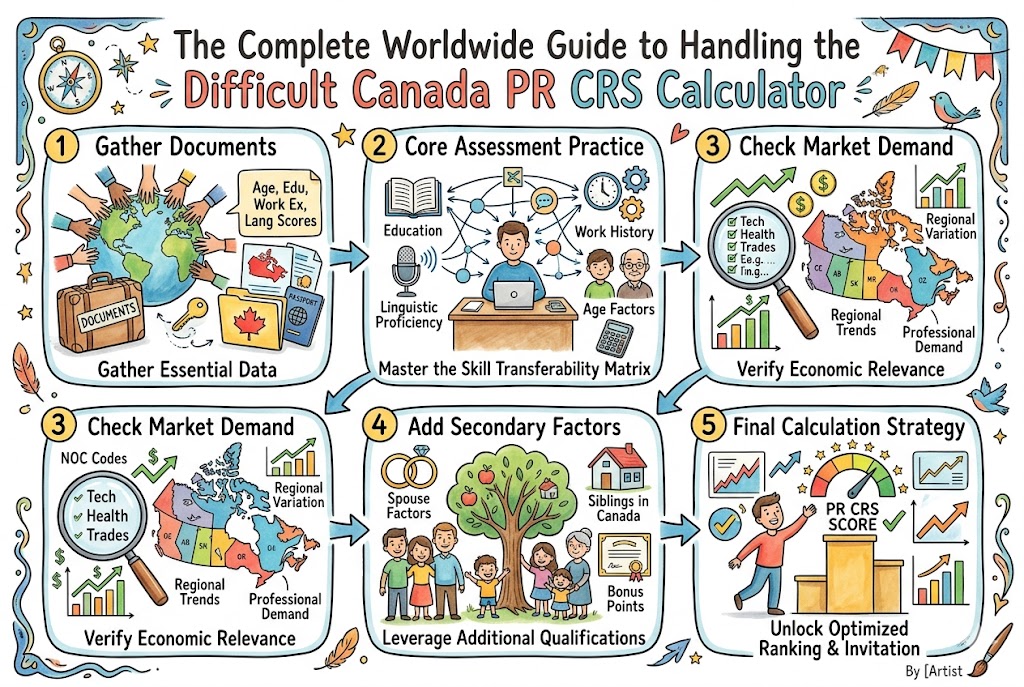
Gathering Necessary Documents
You must avoid guesswork when entering information into the system, as inaccurate inputs produce completely invalid results. Begin by collecting your actual academic transcripts, employment reference letters, and historical tax records. If you have already completed official language testing, keep the specific score breakdown sheet nearby during data entry. Having these concrete reference documents ensures that your calculated score reflects your true legal profile.
Practicing the Core Assessments
Before booking expensive official language exams, use mock evaluation scores to test various performance outcomes within the calculator. This practice reveals the exact target grades required to achieve a competitive ranking in the selection pool. Aiming for arbitrary test marks often leaves candidates short of the actual cut-off threshold by just a few points. Through deliberate simulation, you identify the precise language benchmarks necessary to unlock high-value skill transferability bonuses.
Checking Market Demand Lists
Immigration frameworks prioritize specific economic sectors, updating their occupation in-demand lists regularly to match real-time employment vacancies. Cross-reference your specific professional history against these official databases before executing your calculation. If your job code aligns with a targeted economic sector, you open up specialized selection pathways. The calculation tool helps you track whether your specific profession qualifies for these highly advantageous occupational draws.
Adding Secondary Factors
Do not overlook minor profile elements, as secondary attributes frequently provide the critical points needed to clear competitive cut-off lines. Enter details regarding your sibling relationships, regional family ties, or a partner’s language proficiency. The system integrates these secondary data points into the final matrix, adding small but significant point increments. Accumulating these minor bonuses often bridges the gap between remaining in the pool and receiving an invitation.
Calculating the Final Result
Once you populate every data field with verified information, trigger the final calculation algorithm to reveal your definitive score. Review the detailed breakdown section carefully to ensure the system applied every eligible point bonus correctly. Save this final report as your baseline profile metric, using it to track your progress as you upgrade your qualifications. This calculated baseline forms the foundation of your entire international immigration strategy.
Strategies to Optimize Your PR Points Calculator Score
The Performance Enhancement Strategy
The fastest and most accessible method to maximize your points profile involves retaking standardized language examinations. Moving your scores up by a fraction of a band can unlock substantial points within the skill-transferability matrix. Many applicants settle for baseline passing marks, unaware that achieving top linguistic tiers triggers exponential point additions. Dedicating focused effort to mastering test mechanics yields an immediate, powerful upgrade to your competitive ranking.
Bonus Qualification Advantages
Pursuing a secondary academic qualification or securing a local employment offer dramatically transforms an uncompetitive application profile. Completing a short, one-year postgraduate certificate adds significant weight to your educational score when combined with an existing bachelor’s degree. Simultaneously, landing a legitimate job offer from an approved domestic employer provides a substantial points boost. These intentional upgrades require time and effort, but they reliably lift your profile above competitive cut-off lines.
Specialized Opportunity Pathways
Securing a nomination from a regional provincial stream offers the ultimate advantage, instantly guaranteeing a formal invitation to apply. Regional authorities search the main candidate pool constantly for profiles that possess specific local work experience or niche professional talents. Aligning your application strategy with regional demographic needs bypasses general pool competition completely. The PR Points Calculator highlights these specialized pathways, showing you how to capture these life-changing regional nominations.
Common Mistakes in the PR Points Calculator Process
- Overestimating Personal Attributes: Applicants frequently enter highly optimistic language marks or unverified educational levels into the digital tool, resulting in an inflated score. This error creates a false sense of security, which collapses completely when formal background verification occurs.
- Selecting Incorrect Occupational Classification Codes: Choosing an inappropriate occupational code mismatches your actual day-to-day job duties with official government definitions. This mistake leads to the loss of vital professional experience points during final processing.
- Relying on Expired Documentation: Language test results and academic credential evaluations carry strict legal validity time limits. Inputting outdated test data into the system generates an invalid calculation, causing immediate disqualification during official profile audits.
Real-Life Case Scenarios Using PR Points Calculator
The Early Career Scenario
Liam, a twenty-six-year-old software developer, possesses a bachelor’s degree and two years of international work experience. When he initially inputs his baseline credentials, his score falls short of the competitive pool cut-off marks. However, the calculation tool demonstrates that achieving maximum language scores will unlock substantial skill-transferability points. Liam studies intensely for his language exam, achieves top marks, and successfully raises his score enough to secure an invitation.
The Experienced Professional Scenario
Elena, a thirty-eight-year-old project manager, holds a Master’s degree but loses valuable points due to the system’s age-reduction rules. To offset this natural demographic decline, she leverages the calculator to explore alternative regional pathways. She identifies a specific province experiencing a severe shortage of project management professionals. By targeting this region, Elena secures a provincial nomination, adds six hundred bonus points, and guarantees her permanent residency.
The Specialized Hero Scenario
Marcus, a thirty-one-year-old aircraft technician, possesses excellent technical skills but struggles with general entry scores. The PR Points Calculator reveals that his specific profession qualifies for specialized, occupation-targeted selection draws. Instead of competing against the entire global pool, Marcus adjusts his strategy to target these focused technical categories. Consequently, he receives an invitation during a specialized occupational round, despite holding a lower overall general score.
Frequently Asked Questions (FAQs)
- How long do my language test results remain valid within the calculation system?Your standardized language test results maintain official legal validity for exactly two years from the specific date you took the exam. Once this time frame expires, the system automatically removes the corresponding points from your active profile. You must retake the test to restore those points.
- Can I claim points for professional work experience gained during my university studies?The calculation framework generally excludes full-time work experience acquired while enrolled in full-time domestic institutional studies. The system views student employment as a secondary activity rather than primary skilled career experience. However, exceptions exist for specific international co-op programs.
- What happens to my calculated score on my birthday each year?The underlying algorithm automatically reduces your allocated age points the moment you cross into a new age bracket past thirty. This systemic drop occurs in real time within the active candidate pool. You must optimize other profile elements to balance this natural point loss.
- Does a job offer from any global company grant me bonus points?No, the system only recognizes valid job offers extended by verified domestic employers who possess official government authorization. The position must meet strict structural criteria, including full-time status and non-seasonal durations. Casual or unverified employment offers yield zero points.
- How does a spouse’s profile alter my overall point calculation?Including a partner shifts a small percentage of the total point allocation from the primary applicant to the spouse. If your spouse possesses high language scores and advanced degrees, they actively boost your overall score. Conversely, a weak partner profile lowers your total points.
- Is there a maximum cap on the points I can accumulate?Yes, the system enforces a strict mathematical ceiling of twelve hundred points within the comprehensive ranking matrix framework. Core human capital combined with skill transferability caps out at six hundred points. Additional factors provide up to six hundred bonus points.
- Do I need an academic credential evaluation for a degree completed domestically?No, qualifications earned directly from accredited domestic universities bypass the formal international credential evaluation process entirely. The system recognizes local degrees instantly, awarding maximum baseline points automatically. This exemption saves applicants significant time and money.
- Can learning basic French provide a meaningful boost to my score?Yes, demonstrating even moderate proficiency in French as a secondary language adds considerable bonus points to your profile. Furthermore, achieving advanced French fluency unlocks massive standalone bonuses, opening up specialized linguistic selection streams.
- How often do the competitive selection cut-off scores change?The cut-off thresholds fluctuate during every selection draw, which typically occur every one to two weeks. These variations depend entirely on the total volume of candidates entering the pool and government immigration targets. The score is never permanently fixed.
- What is the difference between a primary occupation and a secondary job entry?Your primary occupation constitutes the main professional domain where you fulfill all core occupational descriptions for a sustained period. Secondary entries represent auxiliary jobs that add to your total years of experience. Both categories contribute points if skilled.
- Will my score drop if I change my primary occupation code?Modifying your occupational code alters your score only if the new position belongs to a different skill tier. If you shift from a skilled managerial tier to an unskilled labor classification, your score drops significantly. Always verify skill tiers beforehand.
- Can I update my profile information after entering the active pool?Yes, you can continuously update your profile details whenever your real-life qualifications change, such as earning a new degree. The calculator updates your score immediately upon submission of these new verified details. This flexibility allows for constant profile optimization.
CONCLUSION
Mapping an international migration strategy requires an objective understanding of data-driven selection systems. Guessing your competitive standing leads to frustration, lost opportunities, and wasted financial resources. Embracing the empirical clarity of a digital point analyzer allows individuals to take total control of their relocation journey. This powerful analytical tool strips away systemic ambiguity, providing a transparent, step-by-step roadmap toward permanent residency. By identifying qualification gaps early, candidates make informed decisions, optimize their personal profiles, and maximize their selection probability. Ultimately, utilizing this structured calculator transforms a complicated bureaucratic hurdle into an inspiring, achievable path toward a prosperous global future.