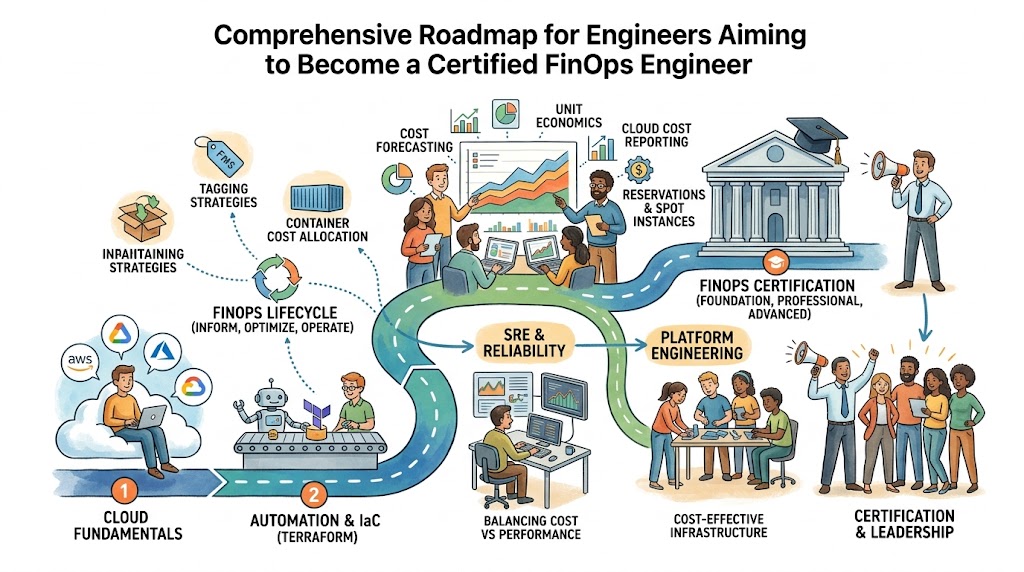
The Certified FinOps Engineer designation serves as a vital bridge between cloud financial management and technical engineering practices. This guide targets software engineers, SREs, and cloud architects who need to master the art of cloud cost optimization without sacrificing performance or velocity. As organizations scale their cloud footprint, the ability to architect for cost-efficiency has become a core requirement for platform engineering teams. By following this career path, professionals can move beyond basic cost reporting to implementing automated, real-world financial governance within their CI/CD pipelines. Choosing the right certification through FinOpsSchool allows you to validate these niche skills and position yourself as a high-value asset in the global cloud economy.
What is the Certified FinOps Engineer?
The Certified FinOps Engineer represents a shift from traditional accounting to real-time, engineering-led cloud financial accountability. It exists because modern enterprises realized that finance teams cannot manage cloud costs effectively without the deep involvement of the engineers who build the systems. This certification focuses on production-ready learning, moving away from theoretical concepts toward practical infrastructure-as-code and automation strategies. It aligns perfectly with modern DevOps workflows where cost is treated as a first-class metric, similar to latency or security, ensuring that cloud spending is always tied to business value.
Who Should Pursue Certified FinOps Engineer?
Systems engineers, Site Reliability Engineers, and cloud architects stand to benefit most from this certification as they possess the technical control over cloud resources. However, it is equally relevant for engineering managers who must justify department budgets and data professionals managing high-cost compute clusters. Beginners can use this path to differentiate themselves in a crowded job market, while experienced leads find it essential for driving enterprise-level cloud migrations. Whether you are operating in the Indian tech hubs or working for a global multinational, these skills are universally applicable across every cloud-native organization.
Why Certified FinOps Engineer is Valuable in the Future and Beyond
The demand for FinOps expertise is surging because cloud waste remains a multi-billion dollar problem for global enterprises. As toolsets evolve and shift toward serverless or AI-driven infrastructure, the fundamental principles of financial engineering remain a constant requirement for business longevity. This certification ensures that your skills remain relevant regardless of whether you use AWS, Azure, or GCP, as it focuses on the logic of optimization rather than just tool-specific clicks. Professionals who master these concepts see a significant return on time, as they become the gatekeepers of cloud profitability and operational efficiency.
Certified FinOps Engineer Certification Overview
The program is delivered via the official curriculum and is hosted on FinOpsSchool. This certification framework uses a practical assessment approach designed to test how an engineer reacts to real-world spending spikes and architectural inefficiencies. It moves through various ownership stages, teaching engineers how to inform, optimize, and operate within a cloud environment. The structure is built to mimic the daily challenges of a FinOps practitioner, ensuring that those who pass can immediately contribute to their organization’s financial health through code and policy enforcement.
Certified FinOps Engineer Certification Tracks & Levels
The certification is structured into three primary tiers: Foundation, Professional, and Advanced. The Foundation level introduces the core vocabulary and the lifecycle of cloud financial management, making it ideal for those new to the domain. The Professional level dives deep into the engineering aspects, such as tagging strategies, container cost allocation, and rightsizing automation. Advanced levels are tailored for those pursuing leadership or specialized roles in SRE and Platform Engineering, showing a clear progression from individual contributor to strategic technical lead.
Complete Certified FinOps Engineer Certification Table
| Track | Level | Who it’s for | Prerequisites | Skills Covered | Recommended Order |
|---|---|---|---|---|---|
| Core FinOps | Foundation | Beginners, Managers | Basic Cloud Knowledge | Vocabulary, Lifecycle | First |
| Engineering | Professional | SREs, DevOps Engineers | Foundation Level | Automation, IAAC | Second |
| Architecture | Advanced | Solutions Architects | Professional Level | Unit Economics, Scaling | Third |
| Specialized | Expert | Principal Engineers | Advanced Level | Enterprise Strategy | Fourth |
Export to Sheets
Detailed Guide for Each Certified FinOps Engineer Certification
Certified FinOps Engineer – Foundation
What it is This certification validates a fundamental understanding of the FinOps framework and the three phases of the lifecycle: Inform, Optimize, and Operate.
Who should take it It is suitable for junior cloud engineers, project managers, and finance professionals who need to communicate effectively with technical teams about cloud spending.
Skills you’ll gain
- Understanding cloud billing models.
- Navigating the FinOps principles.
- Identifying the various personas involved in cloud cost management.
Real-world projects you should be able to do
- Create a basic cost transparency report for a small department.
- Map cloud resources to specific business units using basic metadata.
Preparation plan
- 7–14 days: Review the core FinOps glossary and lifecycle documentation daily.
- 30 days: Participate in community webinars and practice with sample billing datasets.
- 60 days: Not usually required for this level, but helpful for non-technical candidates to learn cloud basics.
Common mistakes
- Overlooking the cultural aspect of FinOps in favor of just looking at numbers.
- Failing to memorize the specific terminology used in the framework.
Best next certification after this
- Same-track option: Certified FinOps Engineer Professional.
- Cross-track option: Cloud Practitioner (AWS/Azure/GCP).
- Leadership option: FinOps Certified Practitioner.
Certified FinOps Engineer – Professional
What it is This level validates the ability to implement technical solutions for cost control, including automation and policy-as-code.
Who should take it DevOps engineers and SREs who are responsible for maintaining infrastructure and want to automate cost-saving measures.
Skills you’ll gain
- Implementing automated rightsizing scripts.
- Managing Kubernetes cost allocation and visibility.
- Architecting spot instance and reservation strategies.
Real-world projects you should be able to do
- Deploy a policy-as-code framework that prevents the creation of unapproved expensive resources.
- Build a dashboard that tracks unit economics for a specific microservice.
Preparation plan
- 7–14 days: Deep dive into cloud provider-specific billing APIs and CLI tools.
- 30 days: Hands-on practice with container cost monitoring tools like Kubecost.
- 60 days: Implement a pilot optimization project in a sandbox environment.
Common mistakes
- Focusing too much on manual cleanup instead of scalable automation.
- Ignoring the impact of performance when recommending cheaper resource tiers.
Best next certification after this
- Same-track option: Certified FinOps Engineer Advanced.
- Cross-track option: Kubernetes Administrator (CKA).
- Leadership option: Platform Engineering Lead.
Choose Your Learning Path
DevOps Path
Engineers on this path focus on integrating cost checkpoints into the CI/CD pipeline. They treat “cost” as a build failure if a deployment exceeds a predefined budget. The goal is to empower developers to see the financial impact of their code changes before they hit production. This path emphasizes infrastructure-as-code tools like Terraform or Pulumi to enforce financial governance.
DevSecOps Path
This path merges security compliance with financial integrity. Professionals learn how orphaned resources or misconfigured security groups can lead to both data breaches and massive billing overages. By identifying “zombie” resources through a security lens, they simultaneously reduce the attack surface and the cloud bill. It is a dual-purpose approach to environment hygiene.
SRE Path
Site Reliability Engineers focus on the intersection of performance, reliability, and cost. They use FinOps to ensure that the system is not just “up,” but “optimally up” for the lowest possible price. This path involves deep analysis of load balancing, data transfer costs, and storage tiering. SREs learn to balance the cost of five-nines availability against the actual business necessity.
AIOps Path
In the AIOps domain, engineers use machine learning to predict spending patterns and detect anomalies. They implement intelligent systems that can automatically scale down resources during low-traffic periods based on historical data. This path focuses on the proactive side of FinOps, using data science to stay ahead of billing surprises. It is highly technical and data-driven.
MLOps Path
MLOps professionals deal with the extremely high costs of GPU clusters and training large models. This path teaches how to optimize model training jobs and manage the lifecycle of expensive data experiments. They learn to implement specialized scheduling to use spot instances for non-urgent training tasks. This ensures that innovation does not lead to financial ruin for the company.
DataOps Path
DataOps focuses on the costs associated with big data processing, warehousing, and ETL pipelines. Engineers learn to optimize SQL queries and storage formats like Parquet to reduce compute and retrieval costs. Since data growth is often exponential, this path is critical for maintaining a sustainable data platform. It emphasizes efficient data movement and lifecycle management.
FinOps Path
The pure FinOps path is for those who want to specialize entirely in cloud financial management. These professionals act as the central hub between finance, engineering, and business units. They focus on procurement, negotiating enterprise agreements, and establishing the organizational FinOps culture. This path leads to roles like Head of Cloud Business Office.
Role → Recommended Certified FinOps Engineer Certifications
| Role | Recommended Certifications |
|---|---|
| DevOps Engineer | Certified FinOps Professional, CKA |
| SRE | Certified FinOps Advanced, Prometheus Certified |
| Platform Engineer | Certified FinOps Engineer, Terraform Associate |
| Cloud Engineer | Certified FinOps Foundation, Cloud Architect |
| Security Engineer | Certified FinOps Professional, CCSK |
| Data Engineer | Certified FinOps Engineer, Data Engineering Pro |
| FinOps Practitioner | Certified FinOps Expert, Cloud Digital Leader |
| Engineering Manager | Certified FinOps Foundation, MBA/Project Mgmt |
Export to Sheets
Next Certifications to Take After Certified FinOps Engineer
Same Track Progression
Once you master the engineering side, moving toward advanced architectural certifications is the logical next step. This involves learning how to design multi-cloud strategies that leverage the financial strengths of different providers. Deepening your knowledge in specific areas like container financial management or serverless optimization will make you a niche expert in the field.
Cross-Track Expansion
Broadening your skills into Platform Engineering or Site Reliability Engineering provides a more holistic view of the cloud. Understanding how cost interacts with security (DevSecOps) or data (DataOps) allows you to solve complex, cross-departmental problems. This makes you a versatile engineer who can navigate both the technical and financial hurdles of large-scale systems.
Leadership & Management Track
For those looking to move into technical leadership, focusing on business strategy and cloud governance is essential. Transitioning into roles like a Cloud Business Office Lead requires a mix of technical depth and executive communication. Certifications in ITIL or project management can complement your FinOps technical background for these senior positions.
Training & Certification Support Providers for Certified FinOps Engineer
DevOpsSchool This provider offers extensive resources for engineers looking to master the intersection of automation and cloud financial management. Their curriculum focuses on practical labs and real-world scenarios that prepare students for high-level engineering roles. They provide a structured environment for those who prefer guided learning over self-study methods.
Cotocus This organization specializes in cloud-native technologies and provides deep-dive sessions into FinOps engineering practices. Their training modules are designed to help professionals implement cost-saving measures directly into their existing cloud workflows. They emphasize the use of modern toolsets to achieve financial transparency in complex environments.
Scmgalaxy Known for its community-driven approach, this platform provides a wealth of knowledge on software configuration management and its financial implications. They offer insights into how version control and deployment strategies can be optimized to reduce unnecessary cloud spending. It is a great resource for hands-on technical professionals.
BestDevOps This portal focuses on delivering high-quality content for DevOps and SRE practitioners who need to stay current with industry trends. Their FinOps training paths are built by industry veterans who understand the challenges of managing large-scale cloud budgets. They provide clear, actionable advice for individual career growth.
devsecopsschool.com This site bridges the gap between security and financial operations, teaching engineers how to secure their cloud while keeping it lean. They offer specialized courses that highlight the hidden costs of security misconfigurations. This is an essential resource for those operating in highly regulated industries.
sreschool.com Focused on site reliability, this provider helps engineers understand the cost of reliability and how to optimize it. Their training covers the technical aspects of infrastructure monitoring and its direct link to cloud billing. They are a primary source for SREs looking to add financial engineering to their toolkit.
aiopsschool.com This organization explores the world of artificial intelligence for IT operations, including automated cost anomaly detection. Their courses help engineers implement AI-driven tools to manage cloud finances more efficiently. They cater to the next generation of engineers who use automation to solve complex problems.
dataopsschool.com Providing specialized training for data professionals, this site focuses on the unique financial challenges of big data and analytics. Their curriculum helps data engineers build cost-effective data pipelines and storage solutions. They address the specific needs of the data-heavy enterprise.
finopsschool.com As a dedicated resource for cloud financial management, this site provides comprehensive certification paths for all levels. They offer a deep repository of knowledge specifically focused on the FinOps framework and its technical execution. It is the central hub for anyone serious about becoming a FinOps professional.
Frequently Asked Questions
- How difficult is the Certified FinOps Engineer exam for a beginner?
The foundation level is accessible to beginners with basic cloud knowledge, but the professional level requires hands-on engineering experience. It is recommended to have at least six months of cloud exposure before attempting the technical tiers.
- What is the expected return on investment for this certification?
Professionals often see immediate career growth as companies are desperate for engineers who can reduce cloud waste. It frequently leads to higher-tier roles in SRE and Platform Engineering teams.
- Do I need to be a coder to pass the engineer track?
Yes, the engineering track expects a degree of familiarity with scripting and infrastructure-as-code. You will need to understand how to manipulate cloud resources via APIs or command-line tools.
- How long does it take to prepare for the professional level?
Most candidates spend about 30 to 60 days preparing, depending on their existing cloud experience. This includes studying the framework and practicing with technical automation tools.
- Is this certification recognized globally?
Yes, the principles taught are universal and are recognized by major cloud providers and enterprises worldwide. It is a standard for cloud financial management in the tech industry.
- Which cloud provider is the exam based on?
The certification is generally cloud-agnostic, focusing on principles that apply to AWS, Azure, and GCP. However, you should be familiar with the major billing tools of the top three providers.
- Does this certification expire after a certain period?
Most professional certifications require renewal or continuing education every two to three years to ensure skills stay current. Check the official hosting site for specific recertification policies.
- Can a finance professional take the engineer track?
While possible, it is challenging without a technical background in cloud infrastructure. Finance professionals are usually better suited for the Practitioner or Foundation tracks.
- Are there any prerequisites for the Foundation level?
There are no formal prerequisites, but a general understanding of how cloud computing works will be very helpful. Familiarity with SaaS and IaaS concepts is a good starting point.
- How does this differ from a standard Cloud Architect certification?
Cloud Architect certifications focus on building for performance and scale, while FinOps focuses specifically on building for financial efficiency and value.
- Will this certification help me in a DevOps role?
Absolutely, as cost is now considered a key pillar of the DevOps lifecycle. It allows you to contribute to “Cost-as-Code” initiatives within your team.
- Are there lab-based questions in the exam?
The advanced levels often include scenario-based questions that test your ability to solve real-world billing and architectural problems.
FAQs on Certified FinOps Engineer
- What specific tools are covered in the FinOps engineering curriculum?
The curriculum covers a mix of native cloud tools like AWS Cost Explorer and Azure Cost Management, alongside third-party tools like Kubecost and Terraform.
- How does this certification address Kubernetes costs?
It provides specific strategies for allocating costs in shared cluster environments, which is one of the biggest challenges in modern cloud engineering.
- Is there a focus on unit economics in the exam?
Yes, understanding how to measure the cost per business transaction is a core part of the professional and advanced levels.
- Does the course cover reserved instances and savings plans?
It goes deep into the math and strategy behind commitment-based discounts to ensure maximum savings for the organization.
- Are tagging policies part of the technical assessment?
Tagging is treated as the foundation of visibility, so the exam heavily tests your ability to design and enforce strict tagging schemas.
- How does FinOps integrate with the software development life cycle?
The training explains how to shift cost conversations left, integrating financial feedback into the early stages of design and deployment.
- Is anomaly detection a major topic?
Yes, engineers are taught how to set up alerts and automated responses to sudden, unexpected spikes in cloud spending.
- Does the certification cover multi-cloud financial management?
The advanced tracks specifically address the complexities of managing and normalizing costs across multiple different cloud service providers.
Final Thoughts: Is Certified FinOps Engineer Worth It?
Investing your time in the Certified FinOps Engineer path is a strategic move that pays dividends as organizations mature their cloud operations. We are moving away from an era of “growth at any cost” into an era of “sustainable, efficient growth.” This certification proves you have the technical discipline to build systems that are not only powerful but also financially responsible. It changes your perspective from being someone who just spends the company’s money to someone who actively manages its capital. If you want to be more than just another engineer and become a business-aligned technical leader, this is the right path to take. Focus on the practical implementation, stay curious about the numbers, and you will find yourself indispensable in the modern cloud landscape.