Introduction
Cloud computing has transformed the way organizations build, deploy, and scale applications. Instead of investing heavily in physical infrastructure, businesses can access computing resources on demand and pay only for what they use. While this flexibility creates tremendous opportunities, it also introduces a major challenge: controlling cloud costs.
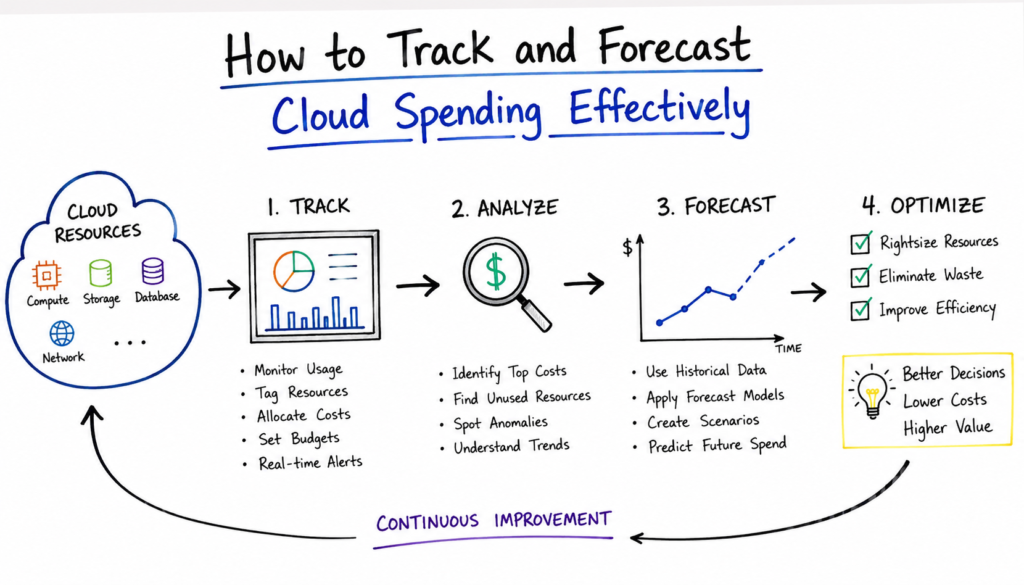
Many organizations move to the cloud expecting lower expenses, only to discover that spending becomes difficult to predict. Resources can be deployed within minutes, teams can consume services independently, and costs can grow rapidly without proper visibility. As cloud environments become more complex, organizations need structured approaches to track, analyze, and forecast spending accurately.
This is where cloud financial management and operational excellence become critical. Training platforms such as Finopsschool help professionals understand the principles, practices, and frameworks required to manage cloud costs effectively while supporting business growth.
Tracking and forecasting cloud spending is not simply about reducing costs. It is about understanding where money is being spent, identifying optimization opportunities, aligning technology investments with business goals, and ensuring long-term financial sustainability. Organizations that master cloud cost management gain better control over budgets, improve operational efficiency, and make more informed decisions.
In this comprehensive guide, we will explore the strategies, tools, operational concepts, forecasting methods, common mistakes, real-world use cases, and career pathways related to cloud spending management.
Understanding Cloud Spending and Why It Matters
Cloud spending refers to the total cost incurred from consuming cloud services such as compute instances, storage resources, databases, networking services, monitoring platforms, and specialized services.
Unlike traditional IT environments, cloud expenses are highly dynamic. Costs can fluctuate daily based on usage patterns, application demand, scaling activities, and new deployments.
Several factors contribute to cloud spending:
- Virtual machine usage
- Container workloads
- Storage consumption
- Network traffic
- Managed databases
- Security services
- Backup and recovery systems
- Monitoring and observability tools
- Development and testing environments
Without proper monitoring, organizations may encounter:
- Unexpected budget overruns
- Resource waste
- Duplicate services
- Overprovisioned infrastructure
- Inefficient scaling practices
- Reduced profitability
Effective tracking and forecasting help organizations avoid these challenges while maintaining operational agility.
The Foundation of Cloud Cost Visibility
Before forecasting cloud expenses, organizations must first establish complete visibility into their spending.
Visibility answers important questions such as:
- Which teams are consuming resources?
- Which applications generate the highest costs?
- What services contribute most to monthly spending?
- Are resources being utilized efficiently?
- Where does waste exist?
Organizations typically achieve visibility through:
Resource Tagging
Tagging involves assigning metadata to cloud resources.
Examples include:
- Department
- Application
- Project
- Environment
- Cost center
- Team owner
Proper tagging enables accurate cost allocation and reporting.
Cost Allocation
Cost allocation assigns expenses to specific business units or projects.
Benefits include:
- Improved accountability
- Better budgeting
- Transparent spending
- Easier chargeback processes
Centralized Reporting
A centralized dashboard provides a unified view of spending across the organization.
Decision-makers can quickly identify:
- Cost spikes
- Resource trends
- Budget variances
- Forecast deviations
Visibility forms the foundation for every successful cloud cost strategy.
Key Metrics for Tracking Cloud Spending
Organizations should monitor several critical metrics to understand spending behavior.
Total Cloud Cost
This represents the overall amount spent on cloud services during a specific period.
It serves as the primary financial indicator for cloud operations.
Cost by Service
Breaking expenses down by service category reveals where money is being consumed.
Examples include:
- Compute
- Storage
- Networking
- Databases
- Analytics
- Security
Cost by Team
Tracking expenses by department helps identify accountability and ownership.
Cost per Application
Application-level visibility supports business decision-making and profitability analysis.
Cost per Customer
Organizations delivering software products often measure cloud spending per customer to understand margins.
Resource Utilization
Comparing cost against utilization highlights inefficiencies.
Examples include:
- Low CPU usage
- Underutilized storage
- Idle virtual machines
Budget Variance
Budget variance measures the difference between actual spending and planned spending.
Large variances often indicate forecasting issues or operational inefficiencies.
Building an Effective Cloud Cost Tracking Framework
A structured framework ensures consistent cost management across the organization.
Establish Ownership
Every cloud resource should have a designated owner.
Ownership creates accountability and reduces resource sprawl.
Define Budget Policies
Budgets should exist at multiple levels:
- Team level
- Project level
- Department level
- Organizational level
Implement Cost Monitoring
Continuous monitoring helps detect anomalies before they become major financial problems.
Create Cost Reviews
Regular reviews allow teams to:
- Analyze spending trends
- Investigate anomalies
- Identify optimization opportunities
- Adjust forecasts
Standardize Reporting
Consistent reporting improves communication between technical and financial stakeholders.
Cloud Spending Forecasting Fundamentals
Forecasting predicts future cloud costs based on historical data, current usage patterns, and business plans.
Accurate forecasting helps organizations:
- Plan budgets
- Support growth initiatives
- Avoid financial surprises
- Improve resource allocation
Forecasting should be viewed as an ongoing process rather than a one-time exercise.
Methods for Forecasting Cloud Spending
Several approaches can be used depending on organizational maturity.
Historical Trend Analysis
Historical spending patterns provide valuable forecasting insights.
Organizations analyze:
- Monthly costs
- Quarterly growth
- Seasonal fluctuations
- Usage spikes
Past behavior often reveals future trends.
Growth-Based Forecasting
This method incorporates expected business growth.
Factors include:
- New customers
- New products
- Geographic expansion
- Increased workloads
Resource-Based Forecasting
Resource forecasts estimate future infrastructure needs.
Examples:
- Additional virtual machines
- Expanded storage
- Increased database capacity
Scenario Planning
Organizations develop multiple spending scenarios.
Typical scenarios include:
| Scenario | Description |
|---|---|
| Conservative | Minimal growth |
| Expected | Normal growth |
| Aggressive | Rapid expansion |
Scenario planning improves financial preparedness.
Machine Learning Forecasting
Advanced organizations use predictive analytics to forecast spending.
These systems analyze:
- Historical usage
- Seasonal behavior
- Application demand
- Infrastructure changes
Machine learning improves forecasting accuracy over time.
Factors That Influence Cloud Cost Forecasts
Forecasting accuracy depends on understanding key cost drivers.
Application Growth
Growing applications consume more resources.
Customer Acquisition
More customers generally increase infrastructure demand.
Data Expansion
Data growth impacts storage and processing costs.
New Service Adoption
Introducing new cloud services affects spending patterns.
Architectural Changes
Infrastructure modernization can increase or decrease costs.
Business Seasonality
Many industries experience predictable demand cycles.
Forecasts should account for seasonal variations.
Key Operational Concepts You Must Know
Successful cloud cost management requires understanding several operational principles.
Cost Allocation
Cost allocation ensures every expense can be traced to a responsible owner.
Chargeback
Teams are billed for the resources they consume.
This promotes financial accountability.
Showback
Showback provides spending visibility without directly charging teams.
It helps build cost awareness.
Resource Rightsizing
Rightsizing aligns infrastructure capacity with actual demand.
Benefits include:
- Reduced waste
- Improved efficiency
- Better utilization
Reserved Capacity Planning
Organizations commit to predictable workloads for cost savings.
FinOps Collaboration
Financial operations encourage collaboration between:
- Engineering teams
- Finance departments
- Business stakeholders
The goal is balancing innovation with financial responsibility.
Cost Governance
Governance establishes policies that guide cloud spending decisions.
Strong governance reduces risk and improves consistency.
Platform Implementation vs. Culture — What’s the Real Difference?
Many organizations invest heavily in cloud management platforms yet still struggle with cost control.
The reason often comes down to culture.
Platform Implementation
Platform implementation focuses on technology.
Examples include:
- Monitoring tools
- Cost dashboards
- Budget alerts
- Reporting systems
- Automation platforms
These solutions provide visibility and data.
Culture
Culture focuses on behavior and decision-making.
Teams must:
- Understand cost implications
- Take ownership of spending
- Participate in optimization efforts
- Align technology choices with business value
Why Culture Matters More
A sophisticated platform cannot compensate for poor operational habits.
Organizations succeed when:
- Engineers consider costs during design
- Leaders review spending regularly
- Finance and engineering collaborate effectively
- Accountability becomes part of daily operations
Technology enables cost management, but culture sustains it.
Real-World Use Cases of Modern Operations
Modern operations practices extend beyond simple cost reduction.
Application Optimization
Teams identify inefficient workloads and improve performance while reducing expenses.
Capacity Planning
Forecasting helps determine future infrastructure requirements.
Product Profitability Analysis
Organizations evaluate profitability by comparing revenue against cloud costs.
Multi-Team Cost Accountability
Departments gain visibility into their spending and usage patterns.
Budget Management
Forecasting supports strategic financial planning.
Cloud Migration Planning
Organizations estimate future spending before migrating workloads.
Enterprise Growth Planning
Operational insights help leaders make informed investment decisions.
Continuous Optimization
Regular monitoring drives ongoing efficiency improvements.
Strategies for Reducing Cloud Spending Without Sacrificing Performance
Reducing costs should never compromise business outcomes.
Several strategies achieve both objectives.
Eliminate Idle Resources
Unused resources generate unnecessary expenses.
Common examples include:
- Idle virtual machines
- Unused storage volumes
- Abandoned environments
Rightsize Infrastructure
Resources should match actual demand.
Overprovisioning increases costs without delivering value.
Automate Scheduling
Development environments often do not require continuous operation.
Automated shutdown schedules reduce waste.
Optimize Storage
Different storage tiers support different workloads.
Selecting the appropriate tier lowers costs.
Improve Architecture
Efficient architectures consume fewer resources.
Examples include:
- Serverless designs
- Event-driven systems
- Managed services
Review Resource Utilization Regularly
Continuous review ensures optimization opportunities are identified early.
Creating a Cloud Cost Governance Framework
Governance provides structure for cost management.
Define Financial Policies
Policies establish spending expectations across teams.
Create Approval Processes
Large expenditures should undergo review before deployment.
Standardize Resource Naming
Consistent naming improves reporting and accountability.
Enforce Tagging Standards
Tagging supports accurate cost allocation.
Conduct Regular Audits
Audits identify compliance gaps and optimization opportunities.
Measure Governance Effectiveness
Organizations should track:
- Budget compliance
- Resource utilization
- Forecast accuracy
- Optimization savings
Common Mistakes in Operations Engineering
Even experienced organizations encounter operational challenges.
Understanding common mistakes helps avoid them.
Ignoring Cost Visibility
Lack of visibility prevents informed decision-making.
Poor Tagging Practices
Incomplete tagging reduces reporting accuracy.
Overprovisioning Resources
Many teams deploy larger resources than necessary.
Focusing Only on Cost Reduction
Cost optimization should balance efficiency, performance, and business value.
Infrequent Reviews
Cloud environments change rapidly.
Infrequent reviews allow waste to accumulate.
Lack of Ownership
Resources without owners often remain unmanaged.
Weak Forecasting Processes
Forecasts based on assumptions rather than data produce unreliable results.
Limited Cross-Functional Collaboration
Finance and engineering teams must work together.
Siloed decision-making creates inefficiencies.
Building a Mature Cloud Cost Management Program
Maturity develops through progressive improvement.
Stage 1: Visibility
Organizations gain insight into spending.
Stage 2: Accountability
Teams assume responsibility for costs.
Stage 3: Optimization
Continuous improvement becomes standard practice.
Stage 4: Forecasting
Future spending predictions become increasingly accurate.
Stage 5: Strategic Alignment
Cloud investments align directly with business objectives.
Mature organizations treat cloud costs as strategic business metrics.
How to Become an Operations Expert — Career Roadmap
Operations expertise combines technical knowledge, financial awareness, and business understanding.
Step 1: Learn Cloud Fundamentals
Understand:
- Compute services
- Storage systems
- Networking concepts
- Security principles
A strong technical foundation is essential.
Step 2: Understand Cost Structures
Learn how cloud providers charge for services.
Study:
- Consumption models
- Pricing mechanisms
- Billing structures
Step 3: Develop Monitoring Skills
Gain experience with:
- Observability tools
- Cost dashboards
- Performance metrics
Step 4: Learn Financial Operations
Understand:
- Budgeting
- Forecasting
- Cost allocation
- Financial analysis
Step 5: Master Automation
Automation improves efficiency and consistency.
Important areas include:
- Infrastructure automation
- Policy automation
- Cost optimization automation
Step 6: Improve Communication Skills
Operations experts frequently collaborate with:
- Engineers
- Executives
- Finance teams
- Product managers
Strong communication creates alignment.
Step 7: Build Real-World Experience
Hands-on projects accelerate learning.
Focus on:
- Cost optimization initiatives
- Governance implementation
- Forecasting projects
- Resource management
Recommended Skill Development Areas
| Technical Skills | Business Skills |
|---|---|
| Cloud Architecture | Budget Planning |
| Automation | Forecasting |
| Monitoring | Financial Analysis |
| Security | Stakeholder Communication |
| Infrastructure Management | Strategic Planning |
Successful operations professionals combine both domains.
Advanced Forecasting Techniques
Organizations seeking greater accuracy often adopt advanced forecasting approaches.
Predictive Analytics
Predictive models identify future spending patterns.
Workload Modeling
Specific applications receive dedicated forecasts.
Demand Forecasting
Business growth projections influence infrastructure planning.
Trend Correlation
Spending trends are correlated with business metrics.
Examples include:
- Customer growth
- Transaction volume
- Product adoption
Continuous Forecast Refinement
Forecasts should evolve as new information becomes available.
Regular updates improve accuracy.
Measuring Forecast Accuracy
Forecasting effectiveness should be measured continuously.
Forecast Variance
Variance compares forecasted spending with actual spending.
Forecast Confidence
Confidence levels indicate expected reliability.
Trend Stability
Stable trends often produce more accurate forecasts.
Review Frequency
Frequent reviews improve forecasting performance.
Organizations that measure forecasting outcomes continually improve prediction quality.
FAQ Section
What is cloud spending management?
Cloud spending management is the process of monitoring, analyzing, optimizing, and forecasting cloud expenses to ensure efficient use of resources and budget control.
Why is forecasting cloud costs important?
Forecasting helps organizations plan budgets, avoid unexpected expenses, allocate resources effectively, and support business growth with confidence.
How often should cloud spending be reviewed?
Most organizations benefit from reviewing cloud spending regularly through ongoing monitoring and scheduled cost analysis sessions.
What is rightsizing in cloud operations?
Rightsizing involves matching resource capacity to actual workload requirements to eliminate waste and improve efficiency.
What role does tagging play in cost management?
Tagging enables accurate cost allocation, reporting, accountability, and spending analysis across teams and projects.
Is cost reduction the primary goal of cloud financial management?
No. The primary goal is maximizing business value while maintaining financial efficiency and operational performance.
What skills are required for cloud operations careers?
Key skills include cloud architecture, automation, monitoring, forecasting, financial analysis, governance, and stakeholder communication.
Can small organizations benefit from cloud forecasting?
Yes. Organizations of all sizes benefit from improved budgeting, visibility, and cost control through forecasting practices.
Final Summary
Tracking and forecasting cloud spending effectively is essential for organizations seeking financial control, operational efficiency, and sustainable growth. Cloud environments provide flexibility and scalability, but they also introduce complexity that can lead to unpredictable expenses when left unmanaged.
Successful cloud cost management begins with visibility. Organizations must understand where resources are being consumed, who owns them, and how spending aligns with business objectives. Through tagging, cost allocation, governance, monitoring, and regular reviews, teams gain the insights needed to make informed decisions.
Forecasting transforms historical spending data into future planning intelligence. By combining trend analysis, growth projections, scenario planning, workload modeling, and continuous refinement, organizations can improve budget accuracy and reduce financial surprises.
Equally important, organizations must recognize the difference between implementing cost management platforms and building a cost-conscious culture. Technology provides the tools, but people, processes, accountability, and collaboration drive lasting success.
Whether you are an engineer, cloud architect, operations specialist, finance professional, or business leader, mastering cloud spending management creates significant value. By applying the principles outlined in this guide, organizations can optimize resources, improve forecasting accuracy, strengthen governance, and achieve greater confidence in their cloud investments.