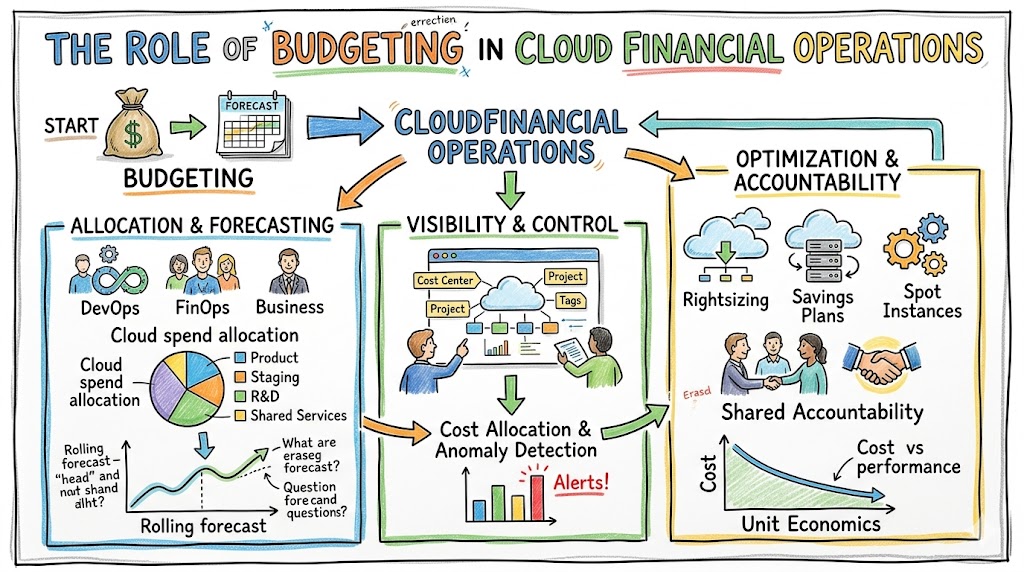
Managing infrastructure costs has evolved from a yearly procurement cycle into a dynamic, hourly challenge. Organizations frequently migrate to the cloud with the expectation of natural cost savings, yet they often encounter unexpected monthly invoices instead. This financial variance highlights why a structured approach to cloud spending remains essential for modern engineering and finance teams. To build a sustainable framework, organizations rely on educational ecosystems like Finopsschool to bridge the gap between architectural decisions and fiscal accountability.
Cloud financial planning operates differently than traditional IT procurement. Instead of upfront hardware purchases, engineering teams deploy resources instantly, generating immediate operational expenses. Consequently, budgeting acts as a continuous optimization loop rather than a static annual restriction. This comprehensive guide explores how real-time spending controls, cross-functional collaboration, and automated guardrails help businesses align architectural choices directly with corporate strategic goals.
Key Operational Concepts You Must Know
Unit Economics in the Cloud
Understanding the true value of cloud infrastructure requires shifting focus from absolute spend to unit economics. Unit economics measures cloud expenditures against business output metrics, such as cost per active user, cost per API call, or cost per completed transaction.
When absolute cloud costs increase, the finance team might worry about overspending. However, if the cost per transaction drops concurrently, the application actually becomes more cost-effective as it scales. Tracking these metrics ensures that technology expenditures reflect business growth rather than operational waste.
+--------------------------------------------------------------+
|               UNIT ECONOMICS EVALUATION MATRIX               |
+--------------------------------------------------------------+
|  Operational Metric  |  Financial Metric  |  Efficiency KPI  |
+----------------------+--------------------+------------------+
|  Total API Requests  |  Compute Spend     |  Cost / 1k Calls |
|  Active Subscriptions|  Database Spend    |  Cost / User     |
|  Data Processed (TB) |  Storage Spend     |  Cost / TB Sync  |
+--------------------------------------------------------------+
Dynamic Forecasting Models
Traditional fixed spending forecasts fail in elastic cloud environments. Modern engineering teams implement rolling, driver-based forecasting models that adapt automatically to consumption changes.
These dynamic frameworks combine historical usage trends with upcoming product roadmaps and seasonal business adjustments. By continuously updating spending projections, engineering and finance teams prevent end-of-quarter budget surprises and allocate engineering capacity where it generates the highest return.
       [Historical Data] ---> +-------------------------+
                              |   Dynamic Forecasting   | ---> [Optimized Resource
       [Product Roadmap] ---> |          Engine         |       Allocation Plan]
                              +-------------------------+
Shared Cost Allocation Strategies
Unallocated cloud spending makes accurate budget planning impossible. Container clusters, shared relational databases, and centralized network gateways complicate the direct mapping of line-item costs to specific teams.
Organizations resolve this complexity by adopting clear proportional allocation strategies. Companies distribute centralized costs based on actual consumption percentages, fixed internal agreements, or engineering headcount, ensuring every department remains fully accountable for its shared operational footprint.
Platform Implementation vs. Culture — What’s the Real Difference?
| Operational Vector | Platform Implementation Approach | Cultural Transformation Approach |
| Primary Focus | Deploying native tooling, tagging dashboards, and automated scanning scripts. | Shifting engineer mindsets to view cost as a core non-functional requirement. |
| Ownership Structure | Maintained exclusively by a centralized infrastructure group or finance team. | Distributed across all product owners, system architects, and scrum teams. |
| Success Metrics | Percentage of tagged infrastructure resources and system uptime statistics. | Speed of autonomous optimization fixes implemented by development squads. |
| Tooling & Setup | Heavy reliance on vendor consoles, SaaS cost monitors, and automated alerts. | Continuous peer reviews, shared knowledge bases, and team retrospectives. |
| Response Type | Reactive adjustments based on automated policy violation alerts. | Proactive architecture design focused on long-term efficiency. |
The Limits of Tool-Centric Deployments
Purchasing an expensive cost management platform rarely solves underlying spending inefficiencies. Automated software dashboards easily highlight orphaned storage volumes and oversized virtual instances, but they cannot fix the organizational habits that created them.
Without dedicated operational accountability, optimization alerts remain ignored in engineering backlogs. Platforms provide visibility, but sustainable financial efficiency requires human intervention, contextual engineering knowledge, and architectural ownership.
Fostering Shared Accountability
A healthy spending culture treats cost management as a standard architectural metric, equivalent to application latency, security, and system availability. Software engineers make fiscal decisions every time they launch a microservice or choose a replication strategy.
                  +---------------------------------------+
                  |    The Shared Accountability Loop     |
                  +---------------------------------------+
                  |  1. Architecture: Design for Cost     |
                  |  2. Deployment: Track Real-Time Spend |
                  |  3. Review: Assess Unit Economics     |
                  +---------------------------------------+
To build this shared accountability, organizations display localized spending impacts inside daily development tools. When developers see how their design changes affect departmental budgets, they naturally design leaner, more efficient code.
Real-World Use Cases of Modern Operations
Automated Scaling for E-Commerce Platforms
A large retail enterprise experienced extreme traffic spikes during promotional events, followed by deep consumption drops at night. Their static cloud deployment led to severe overprovisioning and significant budget waste during low-traffic periods.
[Traffic Ingestion] ---> [Predictive Auto-Scaler] ---> [Just-in-Time Fleet Adjustments]
                                                       |--> Active during Peak Demand
                                                       |--> Terminated during Low Traffic
The engineering group addressed this by building a predictive auto-scaling engine integrated with real-time billing APIs. The system adjusted compute capacity based on incoming transaction volume, automatically terminating idle resources during quiet hours. This operational change maintained application performance during peak demand while reducing monthly compute expenses by forty percent.
Multi-Tenant Container Cost Distribution
A software-as-a-service vendor ran hundreds of distinct client workloads across shared Kubernetes infrastructure. The centralized architecture prevented the accounting team from determining the exact profit margins of individual customer contracts.
+-----------------------------------------------------------------------+
|                KUBERNETES COST ALLOCATION ARCHITECTURE                |
+-----------------------------------------------------------------------+
|  [Client Workload A]  --> Pod Context Tracking \                      |
|  [Client Workload B]  --> Pod Context Tracking  +-> [Cost Allocation] |
|  [Client Workload C]  --> Pod Context Tracking /                      |
+-----------------------------------------------------------------------+
The platform engineering group implemented container-level resource tracking to measure namespaces, CPU usage, and memory consumption per client. They fed this utilization data directly into internal financial systems to map infrastructure spend to specific accounts. This granular transparency allowed product managers to renegotiate unprofitable enterprise agreements and optimize software deployment strategies.
Automated Lifecycle Governance for Analytical Data
A financial analytics organization accumulated petabytes of raw transactional records across cloud object storage. Unmanaged data growth drove storage fees steadily higher, threatening project profitability.
[Hot Ingestion Layer] ---> [Cold Archival Tier] ---> [Automated Deletion Engine]
(Immediate Analysis)        (Compliance Retention)    (Purge Expired Records)
The infrastructure team configured automated data lifecycle rules across all storage buckets. The policies transitioned raw ingestion files to colder, lower-cost storage tiers after thirty days, eventually purging expired records after seven years. This data governance strategy stabilized the storage budget without impacting internal analytics or compliance mandates.
Common Mistakes in Operations Engineering
Over-Reliance on Reactive Alerting
Many engineering organizations configure basic billing alerts that trigger only after spending crosses a specific monthly threshold. Relying solely on these notifications means teams discover budget overruns days or weeks after the anomalous event occurred.
CRITICAL PATH:
[Anomalous Resource Launch] =======> [Days of Elevated Spend] =======> [Monthly Billing Alert]
                                                                        (Too Late to Prevent Loss)
By the time leadership reviews a reactive alert, the business has already incurred the financial loss. Teams should instead implement real-time anomaly detection models that monitor hourly usage changes, catching misconfigured database clusters and infinite code loops before they impact the monthly budget.
Mismanaged Commitment Purchasing Strategies
Cloud providers offer significant discounts in exchange for long-term capacity commitments, such as reserved instances and savings plans. However, purchasing these plans without a stable product roadmap often leads to financial waste.
+--------------------------------------------------------------+
|               COMMITMENT UTILIZATION TRACKING                |
+--------------------------------------------------------------+
|  Purchased Capacity  |  Actual Active Usage  |  Waste Factor |
+----------------------+-----------------------+---------------+
|  100 Compute Units   |  60 Compute Units     |  40 Units     |
|                      |                       |  (Unused Paid |
|                      |                       |   Commitment) |
+------------------------------+-------------------------------+
If an engineering team migrates a major workload from virtual machines to serverless functions shortly after buying compute reservations, the pre-purchased commitments sit idle. Organizations must coordinate architectural changes with financial procurement teams to prevent locking capital into obsolete infrastructure.
Neglecting Non-Production Environments
Engineers spend significant time optimizing high-visibility production systems while ignoring development, staging, and testing environments. Left unmonitored, these non-production zones can grow to represent a massive portion of total infrastructure costs.
Development teams routinely launch multi-node staging environments for temporary testing and forget to terminate them before weekends. Without automated shutdown schedules and aggressive resource lifecycle policies, these idle sandbox environments quietly drain departmental engineering budgets.
How to Become an Operations Expert — Career Roadmap
- Master Cloud Infrastructure Fundamentals
- Study core compute, storage, container, and networking abstractions across major cloud providers.
- Learn how API calls generate infrastructure configurations and corresponding billing line items.
- Practice building infrastructure components using declarative templates to understand predictable resource deployment.
- Develop Data Literacy and Analytical Skills
- Learn to write efficient SQL queries to parse through massive, unaggregated cloud billing datasets.
- Build interactive internal dashboards that highlight spending anomalies and unit economic variations.
- Study statistical forecasting techniques to predict future resource needs based on historical growth patterns.
- Cultivate Cross-Functional Communication Mastery
- Translate complex cloud architecture concepts into clear business risks and financial opportunities for executive stakeholders.
- Help finance teams understand software engineering concepts like elasticity, microservices, and technical debt.
- Facilitate regular cost review meetings that keep engineering roadmaps aligned with corporate financial goals.
+-----------------------------------------------------------------+
|               OPERATIONS EXPERT COMPETENCY TRIAD                |
+-----------------------------------------------------------------+
|       Cloud Infrastructure    |    Data & Analytics             |
|       - Compute Architectures |    - SQL Billing Analytics      |
|       - Network Routing Costs |    - Anomaly Detection Models   |
+-------------------------------+---------------------------------+
|                    Cross-Functional Leadership                  |
|                    - Engineering/Finance Translation            |
|                    - Strategic Business Planning                |
+-----------------------------------------------------------------+
FAQ Section
- What is the difference between traditional IT budgeting and cloud budgeting?
Traditional budgeting relies on fixed capital expenditures planned months in advance for physical hardware. Cloud budgeting requires managing variable operational expenses that change dynamically based on real-time resource consumption.
- How often should engineering teams review their cloud expenditures?
Teams should monitor cloud spending daily using automated anomaly detection systems, while conducting deeper strategic cost reviews during every sprint planning session or bi-weekly retrospective.
- Why is a clear tagging policy important for financial operations?
Tagging assigns metadata to infrastructure resources, allowing financial systems to map specific costs directly to corresponding applications, cost centers, business owners, and environment types.
- Who should own the cloud budget within an organization?
Responsibility is shared across teams. A centralized group sets governance frameworks, but individual product teams must own the costs of the specific architectures they deploy.
- How do savings plans differ from standard on-demand pricing models?
On-demand pricing charges a flat hourly rate with no long-term commitments, whereas savings plans offer substantial discounts in exchange for a committed dollar-per-hour spend over a multi-year period.
- Can automated infrastructure optimization scripts break production environments?
Yes, aggressive automated cleanup scripts can accidentally terminate critical dependencies if the system lacks robust exclusion tags and staging validation steps.
- What are the signs of an inefficient cloud architecture?
High absolute spend alongside low resource utilization, untagged infrastructure assets, flat forecasting lines, and rising costs per business unit indicate an inefficient deployment.
- How do container technologies complicate cost allocation?
Containers share underlying virtual machine resources, making it difficult to split individual component costs without advanced cluster-level namespace tracking tools.
- Should companies build internal cost management platforms or buy SaaS tools?
Startups and mid-sized teams usually benefit from buying existing SaaS tools to save engineering time, while massive enterprises often build custom internal platforms to handle unique scale requirements.
- How can engineers maintain high performance while cutting infrastructure costs?
Engineers achieve this balance by implementing auto-scaling architectures, configuring right-sized databases, and selecting optimal storage classes without reducing application redundancy.
Final Summary
Sustainable financial operations depend on strong cultural ownership rather than simply deploying software dashboards. As cloud architectures grow more complex, organizations must move away from reactive cost tracking. True efficiency requires engineering teams to evaluate the financial impact of their code designs alongside performance and security metrics.
By implementing clear unit economics, automating infrastructure guardrails, and building cross-functional accountability, businesses transform budgeting from an administrative restriction into a strategic advantage. This balance ensures technology investments drive profitable, scalable business growth over the long term.