Introduction
Cloud computing has transformed how organizations build, deploy, and scale their technology infrastructure. Businesses can now launch services faster, expand globally, and adapt to changing market conditions without investing heavily in physical infrastructure. While this flexibility creates significant opportunities, it also introduces new financial challenges. As cloud environments grow, costs become increasingly difficult to track, manage, and optimize.
Financial teams often struggle to understand where cloud spending occurs, which departments consume the most resources, and whether investments deliver expected business value. Without clear visibility, organizations face budget overruns, forecasting challenges, and inefficient resource utilization. Therefore, cloud cost transparency has become a critical business requirement rather than a technical preference.
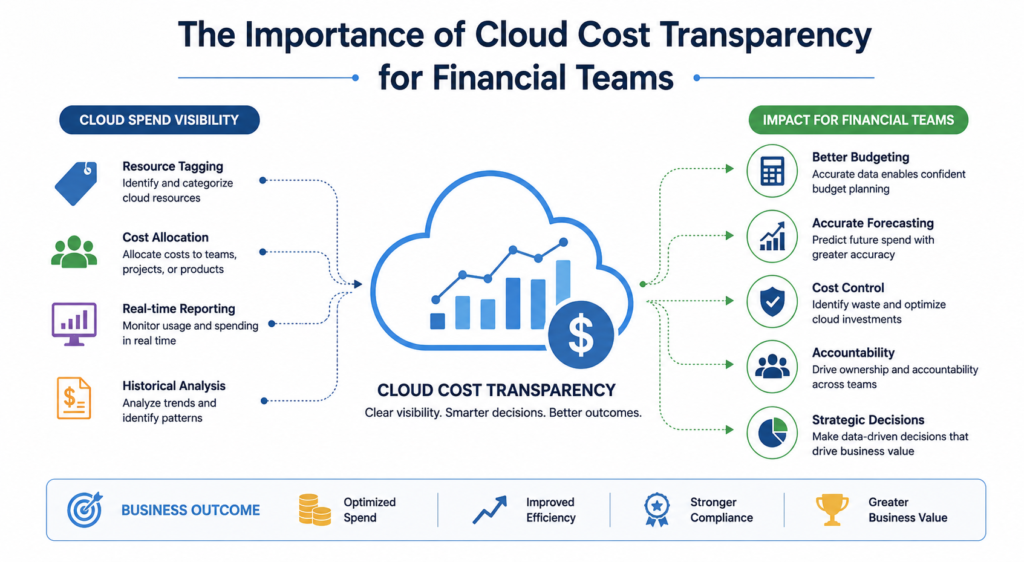
Organizations that establish cloud cost transparency gain better control over expenses, improve accountability, strengthen financial planning, and support strategic decision-making. They can identify waste, allocate costs accurately, and align technology spending with business objectives.
Many organizations rely on expert training and guidance from Finopsschool to build practical FinOps capabilities and improve collaboration between finance, operations, and engineering teams. Through proper education and operational practices, companies can create a culture where cloud spending remains visible, measurable, and optimized.
Understanding Cloud Cost Transparency
Cloud cost transparency refers to the ability to clearly understand, track, analyze, and communicate cloud spending across an organization. It provides detailed visibility into how resources are consumed, who uses them, why costs occur, and how spending aligns with business objectives.
Traditional IT infrastructure often involved predictable capital expenditures. Companies purchased hardware, software licenses, and networking equipment upfront. Cloud environments operate differently. Resources can be provisioned instantly, scaled dynamically, and billed based on usage. While this flexibility improves agility, it also creates complexity.
A single application may consume hundreds of cloud services. Multiple teams can deploy resources independently. Development, testing, analytics, artificial intelligence workloads, storage systems, and production applications all generate costs continuously.
Without transparency, finance teams receive invoices containing large numbers without sufficient context. They may know the total amount spent but lack insight into specific business drivers behind the expenses.
Cloud cost transparency bridges this gap by providing detailed visibility into spending patterns, resource ownership, utilization levels, and cost allocation structures.
When organizations implement transparency successfully, financial teams gain confidence in budgeting, forecasting, and strategic investment decisions.
Why Financial Teams Need Cloud Cost Transparency
Financial teams play a crucial role in maintaining organizational profitability and fiscal discipline. As cloud spending becomes a larger portion of operating expenses, finance departments require deeper visibility into technology costs.
Improved Budget Planning
Accurate budgets depend on reliable historical data and spending patterns. Cloud cost transparency allows finance professionals to understand consumption trends across departments and projects.
Instead of estimating future expenses based on limited information, financial teams can create realistic forecasts supported by actual usage metrics. This improves budgeting accuracy and reduces financial surprises.
Better Forecasting
Cloud environments change constantly. New applications launch regularly, customer demand fluctuates, and infrastructure requirements evolve over time.
Transparent cloud reporting helps financial teams anticipate future spending based on growth patterns, seasonal trends, and business expansion initiatives. As a result, forecasting becomes more predictable and reliable.
Cost Accountability
Transparency creates accountability across departments. Teams understand how their decisions affect overall spending.
When engineering teams see the financial impact of resource allocation choices, they become more conscious of efficiency. Similarly, business units gain visibility into the costs associated with their initiatives.
Waste Reduction
Unused resources often remain active for months without being noticed. Idle virtual machines, unattached storage volumes, and forgotten development environments contribute significantly to cloud waste.
Financial transparency enables organizations to identify these inefficiencies and eliminate unnecessary spending.
Executive Decision Support
Leadership teams require accurate financial information to make informed decisions. Cloud cost transparency provides valuable insights into investment returns, operational efficiency, and technology spending trends.
Executives can evaluate initiatives based on measurable financial outcomes rather than assumptions.
The Relationship Between Finance, Operations, and Engineering
Cloud financial management cannot succeed when departments operate independently. Effective transparency requires collaboration between finance, operations, and engineering teams.
Finance professionals focus on budgeting, forecasting, profitability, and cost control. Engineering teams prioritize innovation, performance, reliability, and scalability. Operations teams manage infrastructure, monitoring, security, and service delivery.
These groups often speak different languages and measure success differently.
Finance may focus on monthly spending targets. Engineers may prioritize application performance. Operations teams may emphasize system reliability.
Cloud cost transparency creates a common framework that aligns all stakeholders around shared business objectives.
When teams collaborate effectively:
- Finance gains deeper visibility into technical spending.
- Engineers understand financial implications.
- Operations teams optimize resource utilization.
- Leadership receives accurate reporting.
- Business units become accountable for consumption.
This alignment drives better decision-making throughout the organization.
Key Operational Concepts You Must Know
Understanding cloud cost transparency requires familiarity with several operational concepts that influence spending visibility and financial accountability.
Cost Allocation
Cost allocation assigns cloud expenses to specific departments, projects, products, customers, or business units.
Without proper allocation, organizations struggle to determine who generates costs and why spending occurs.
Accurate allocation enables accountability and supports informed budgeting decisions.
Common allocation methods include:
- Department-based allocation
- Project-based allocation
- Product-based allocation
- Customer-based allocation
- Environment-based allocation
Effective allocation provides financial clarity throughout the organization.
Resource Tagging
Resource tagging involves attaching metadata to cloud resources.
Tags help identify ownership, purpose, environment, department, and business function.
Examples include:
- Team Name
- Application Name
- Environment
- Cost Center
- Business Unit
Proper tagging significantly improves cost reporting accuracy and transparency.
Chargeback
Chargeback means billing departments for their actual cloud consumption.
Each team receives financial responsibility for resources used.
This approach encourages cost-conscious behavior and promotes accountability.
Organizations often implement chargeback when cloud maturity increases.
Showback
Showback provides visibility into departmental spending without directly charging teams.
Departments receive reports showing their resource consumption and associated costs.
This approach builds awareness while avoiding internal billing complexities.
Many organizations adopt showback before transitioning to chargeback models.
Cost Optimization
Cost optimization focuses on maximizing business value while minimizing unnecessary spending.
Optimization activities include:
- Rightsizing resources
- Removing idle infrastructure
- Purchasing commitments strategically
- Improving workload efficiency
- Automating resource management
Optimization supports both financial and operational objectives.
Unit Economics
Unit economics connects cloud costs to measurable business outcomes.
Examples include:
- Cost per customer
- Cost per transaction
- Cost per order
- Cost per user
- Cost per service request
This approach helps organizations evaluate profitability and operational efficiency.
FinOps
FinOps combines finance, engineering, and operations practices to improve cloud financial management.
It encourages shared responsibility for spending decisions and promotes continuous optimization.
FinOps has become a foundational discipline for organizations seeking greater cloud cost transparency.
Platform Implementation vs. Culture — What’s the Real Difference?
Organizations often assume that purchasing a cloud management platform automatically solves transparency challenges. However, technology alone cannot create financial accountability.
Success depends on both platform implementation and organizational culture.
Understanding Platform Implementation
Cloud management platforms provide visibility into spending data, utilization metrics, forecasting models, and optimization opportunities.
These platforms help organizations:
- Analyze cloud spending
- Generate reports
- Monitor trends
- Track resource ownership
- Identify waste
- Support budgeting
Implementation provides the technical foundation for transparency.
However, software cannot change behavior on its own.
Understanding Organizational Culture
Culture influences how people make decisions, collaborate, and respond to financial information.
Organizations with strong cost-awareness cultures encourage employees to consider financial impacts during everyday activities.
Engineers evaluate cost efficiency alongside performance.
Managers review spending regularly.
Executives prioritize accountability.
Finance teams engage proactively with technical stakeholders.
This behavioral alignment creates sustainable transparency.
Why Culture Often Matters More
Many organizations invest heavily in reporting tools but continue experiencing cost overruns.
The problem is rarely a lack of data.
Instead, teams ignore reports, misunderstand financial metrics, or fail to act on optimization opportunities.
Strong culture ensures that information leads to action.
Employees become active participants in financial management rather than passive consumers of reports.
Building a Transparency Culture
Organizations can strengthen transparency culture by:
- Sharing spending data openly
- Establishing accountability frameworks
- Creating financial awareness programs
- Encouraging cross-functional collaboration
- Defining optimization goals
- Recognizing cost-conscious behavior
When culture and technology work together, transparency becomes part of daily operations.
Real-World Use Cases of Modern Operations
Cloud cost transparency delivers measurable benefits across various operational scenarios.
Application Portfolio Management
Large organizations often operate hundreds of applications.
Some applications generate substantial business value while others provide limited returns.
Transparency helps identify which applications justify their cloud spending and which require optimization.
Leaders can make informed investment decisions based on financial performance.
Multi-Cloud Environments
Many organizations use multiple cloud providers simultaneously.
This approach increases flexibility but also introduces complexity.
Transparency solutions consolidate spending information across environments, creating a unified financial view.
Financial teams gain visibility into overall cloud investments regardless of provider.
Product Profitability Analysis
Product teams need to understand infrastructure costs associated with service delivery.
Transparency enables accurate profitability calculations by connecting cloud expenses directly to products.
Organizations can identify profitable offerings and optimize underperforming services.
Development Environment Management
Development environments frequently consume resources outside production workloads.
Transparency helps organizations track development costs, eliminate idle resources, and improve utilization efficiency.
Teams gain visibility into spending patterns and optimize accordingly.
Customer Cost Analysis
Software companies often serve customers with varying infrastructure requirements.
Transparency helps calculate customer-specific costs.
This information supports pricing strategies, profitability analysis, and customer segmentation initiatives.
Capacity Planning
Accurate capacity planning depends on understanding historical usage patterns.
Transparency enables organizations to predict future resource requirements and budget appropriately.
This reduces unexpected spending increases and improves financial stability.
Common Mistakes in Operations Engineering
Many organizations struggle with cloud financial management due to avoidable operational mistakes.
Ignoring Resource Ownership
Resources without clear ownership create accountability gaps.
When nobody owns a resource, nobody optimizes it.
Organizations should establish ownership standards for every cloud asset.
Poor Tagging Practices
Inconsistent tagging reduces reporting accuracy.
Missing tags make cost allocation difficult and create visibility challenges.
Organizations should enforce standardized tagging policies across all environments.
Focusing Only on Monthly Bills
Many teams review costs only after invoices arrive.
This reactive approach delays optimization efforts.
Continuous monitoring enables faster responses and better spending control.
Treating Cost Management as a Finance Problem
Cloud spending decisions occur primarily within technical teams.
Therefore, engineering and operations departments must participate actively in cost management.
Shared responsibility produces better results.
Overlooking Small Expenses
Small inefficiencies accumulate over time.
Unused storage, forgotten instances, and underutilized resources may appear insignificant individually but create substantial costs collectively.
Regular reviews help eliminate these hidden expenses.
Lack of Communication
Poor communication between departments often causes transparency failures.
Finance teams may not understand technical requirements, while engineers may not understand financial objectives.
Regular collaboration improves alignment and decision-making.
Measuring the Wrong Metrics
Organizations sometimes focus exclusively on total spending.
More meaningful metrics include:
- Cost per customer
- Cost per transaction
- Resource utilization
- Service profitability
- Efficiency trends
These measurements provide deeper operational insights.
How to Become an Operations Expert — Career Roadmap
Operations professionals play a critical role in cloud financial management. Organizations increasingly seek experts who understand both technical infrastructure and business economics.
Step 1: Learn Cloud Fundamentals
Start by understanding cloud architecture, compute services, storage systems, networking, and security principles.
Strong cloud knowledge forms the foundation for operational expertise.
Focus on understanding how services consume resources and generate costs.
Step 2: Develop Infrastructure Skills
Learn infrastructure management concepts including:
- Virtual machines
- Containers
- Kubernetes
- Networking
- Automation
- Monitoring
Operational visibility depends on understanding infrastructure behavior.
Step 3: Master Cost Management Concepts
Study:
- Cost allocation
- Budgeting
- Forecasting
- Unit economics
- Cost optimization
- Resource utilization
These concepts bridge technical and financial disciplines.
Step 4: Learn FinOps Practices
FinOps skills are increasingly valuable across industries.
Develop expertise in:
- Cost reporting
- Optimization strategies
- Governance frameworks
- Financial accountability
- Stakeholder collaboration
FinOps knowledge differentiates modern operations professionals.
Step 5: Build Automation Skills
Automation reduces manual effort and improves consistency.
Learn:
- Scripting
- Infrastructure as Code
- Policy automation
- Monitoring automation
- Resource lifecycle management
Automation enhances both operational efficiency and financial control.
Step 6: Improve Business Understanding
Technical expertise alone is insufficient.
Operations experts should understand:
- Revenue models
- Profitability drivers
- Customer economics
- Business strategy
- Financial planning
Business knowledge improves decision-making effectiveness.
Step 7: Develop Communication Skills
Operations experts frequently interact with executives, engineers, finance professionals, and business leaders.
Strong communication skills help translate technical information into business insights.
This ability significantly increases career opportunities.
Recommended Learning Path
| Career Stage | Focus Area |
|---|---|
| Beginner | Cloud Fundamentals |
| Intermediate | Infrastructure Management |
| Intermediate | Cost Optimization |
| Advanced | FinOps Practices |
| Advanced | Financial Analysis |
| Expert | Strategic Operations Leadership |
Benefits of Cloud Cost Transparency for Organizations
Organizations that embrace transparency experience advantages across multiple dimensions.
Increased Financial Predictability
Predictable spending improves planning and reduces budget surprises.
Finance teams gain confidence in forecasting future investments.
Stronger Governance
Transparency supports governance initiatives by creating accountability and visibility.
Organizations can enforce spending policies more effectively.
Better Resource Utilization
Teams identify underutilized resources and improve efficiency.
This reduces waste while maintaining performance.
Faster Decision-Making
Accessible financial data accelerates decision-making processes.
Leaders evaluate opportunities using reliable information.
Enhanced Collaboration
Transparency encourages collaboration between technical and financial stakeholders.
Shared visibility improves organizational alignment.
Greater Business Value
Ultimately, transparency ensures that cloud investments support business objectives and generate measurable value.
FAQ Section
What is cloud cost transparency?
Cloud cost transparency is the ability to clearly track, analyze, allocate, and understand cloud spending across an organization.
Why is cloud cost transparency important for finance teams?
It helps finance teams improve budgeting, forecasting, accountability, and financial decision-making.
What is the difference between chargeback and showback?
Chargeback bills departments for actual usage, while showback provides spending visibility without direct billing.
How does tagging support cost transparency?
Tagging identifies resource ownership and business purpose, making cost allocation and reporting more accurate.
What is FinOps?
FinOps is a collaborative practice that brings together finance, engineering, and operations teams to optimize cloud spending.
Can small organizations benefit from cloud cost transparency?
Yes. Organizations of all sizes can reduce waste, improve forecasting, and increase financial accountability through transparency.
What role do engineers play in cloud cost management?
Engineers influence resource consumption directly. Their decisions significantly affect overall cloud spending.
How often should cloud costs be reviewed?
Organizations should monitor costs continuously and conduct regular reviews to identify optimization opportunities.
Is technology alone enough to achieve transparency?
No. Technology provides visibility, but organizational culture and collaboration drive meaningful action.
What skills are required for operations experts?
Cloud architecture, automation, cost management, financial analysis, communication, and FinOps knowledge are highly valuable skills.
Final Summary
Cloud cost transparency has become an essential capability for modern organizations. As cloud adoption continues to expand, financial teams need deeper visibility into spending patterns, resource utilization, and business value generation. Transparency enables accurate budgeting, reliable forecasting, stronger governance, and informed decision-making.
Successful organizations recognize that cloud financial management requires collaboration between finance, operations, engineering, and leadership teams. While platforms provide valuable insights, sustainable success depends on creating a culture of accountability and cost awareness.
By understanding operational concepts such as cost allocation, tagging, chargeback, showback, optimization, unit economics, and FinOps, organizations can build a strong foundation for financial control. They can identify inefficiencies, improve utilization, reduce waste, and maximize the value of cloud investments.