Introduction
Cloud computing has transformed how organizations build, deploy, and scale technology services. However, as cloud adoption grows, so does the challenge of controlling costs, optimizing resource utilization, and ensuring financial accountability. Many organizations struggle with unexpected cloud bills, underutilized resources, and limited visibility into spending patterns. As a result, cloud financial management has become a critical business function rather than just a technical responsibility.
Cloud financial management combines financial planning, operational excellence, governance, and technology optimization. Organizations now rely on specialized platforms and methodologies to monitor spending, forecast budgets, allocate costs, and improve return on investment. Companies that establish strong cloud financial practices gain better visibility into resource consumption, reduce waste, and align technology investments with business goals.
One organization helping professionals develop expertise in cloud financial management is Finopsschool. Through structured learning and practical knowledge, professionals can understand cloud cost optimization, governance strategies, budgeting techniques, and modern financial operations practices that support sustainable cloud growth.
Understanding Cloud Financial Resource Management
Cloud financial resource management refers to the process of monitoring, analyzing, controlling, and optimizing cloud spending across an organization. While cloud services offer flexibility and scalability, they also introduce variable costs that can quickly grow if not managed properly.
Organizations often use multiple cloud platforms, hundreds of services, and thousands of resources. Without proper oversight, teams may provision unnecessary instances, overallocate storage, or maintain idle environments. These inefficiencies increase operational costs and reduce overall business value.
Effective cloud financial management focuses on visibility, accountability, forecasting, optimization, and governance. Teams must understand how resources are consumed, identify spending trends, and implement controls that encourage responsible usage. Financial operations teams work closely with engineering, finance, procurement, and leadership teams to ensure cloud investments generate measurable outcomes.
Modern cloud financial management is not simply about reducing costs. Instead, it focuses on maximizing business value while maintaining performance, security, reliability, and innovation.
Why Cloud Cost Management Matters More Than Ever
Organizations increasingly rely on cloud infrastructure to support digital transformation initiatives. As workloads become more complex, cloud spending often grows faster than anticipated. Without structured financial management, organizations may face budget overruns, inaccurate forecasting, and resource inefficiencies.
Cloud cost management enables organizations to understand where money is being spent and why. It provides insights into application costs, team consumption patterns, and resource utilization metrics. These insights help decision-makers allocate budgets more effectively and prioritize investments.
Additionally, cloud cost optimization improves operational efficiency. Teams can identify unused resources, right-size workloads, automate shutdown schedules, and leverage pricing discounts. These improvements reduce waste while maintaining service quality.
Businesses that invest in financial governance also improve accountability. When teams understand the financial impact of their technical decisions, they become more responsible in resource provisioning and application design. This alignment between technology and finance creates long-term operational success.
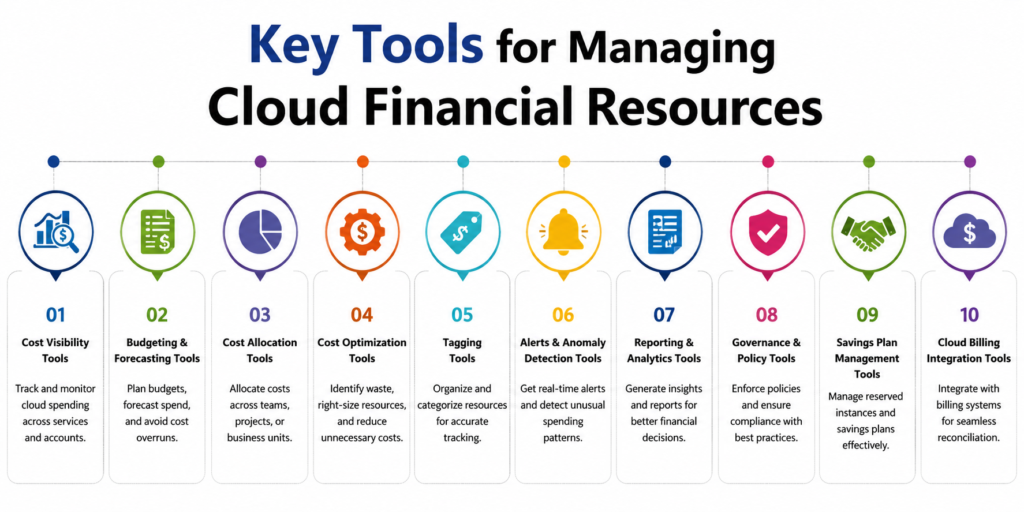
Key Tools for Managing Cloud Financial Resources
Cloud Cost Management Platforms
Cloud cost management platforms provide centralized visibility into spending across multiple cloud environments. These solutions collect billing information, analyze usage patterns, and generate actionable recommendations.
Organizations use these platforms to track spending trends, monitor budgets, and identify optimization opportunities. Dashboards present detailed insights into resource consumption, enabling stakeholders to understand where costs originate.
These tools often include forecasting capabilities that predict future spending based on historical usage patterns. Finance teams can use these predictions to create more accurate budgets and avoid unexpected expenses.
Cost management platforms also help organizations establish accountability by allocating expenses to business units, departments, projects, or applications.
Resource Optimization Tools
Resource optimization tools focus on improving infrastructure efficiency. They analyze workload performance and identify opportunities to reduce costs without affecting service quality.
These platforms recommend rightsizing virtual machines, eliminating idle resources, and adjusting storage allocations. They continuously monitor environments to ensure resources remain aligned with actual demand.
Optimization tools help organizations balance cost and performance effectively. Rather than simply reducing spending, they ensure workloads operate at optimal efficiency levels while supporting business requirements.
Many organizations achieve substantial savings by implementing optimization recommendations across development, testing, and production environments.
Budgeting and Forecasting Solutions
Budgeting tools help organizations plan cloud spending and establish financial controls. These platforms allow teams to define spending limits, allocate budgets, and monitor actual consumption against forecasts.
Forecasting capabilities use historical data, growth trends, and workload patterns to estimate future expenses. This visibility helps organizations prepare for scaling initiatives and infrastructure expansions.
Budget alerts notify stakeholders when spending approaches predefined thresholds. Early warnings allow teams to investigate anomalies and take corrective action before budgets are exceeded.
Financial planning becomes significantly more effective when budgeting tools integrate directly with cloud cost management platforms.
Cost Allocation and Chargeback Tools
Cost allocation solutions distribute cloud expenses across departments, projects, teams, and business units. These tools provide transparency into resource ownership and spending responsibility.
Organizations often use tagging strategies to associate resources with specific cost centers. Cost allocation platforms analyze these tags and generate detailed reports showing who is consuming resources and why.
Chargeback and showback models promote accountability. Teams gain visibility into their spending patterns and can make informed decisions about resource utilization.
This transparency encourages more responsible cloud consumption and helps organizations align technology spending with business priorities.
Governance and Compliance Platforms
Governance tools enforce financial policies and operational standards across cloud environments. These platforms ensure that resources comply with organizational requirements and cost-control policies.
Governance frameworks may include automated rules for provisioning, budget enforcement, tagging standards, and resource lifecycle management. Automation reduces manual oversight while improving consistency.
Compliance monitoring helps organizations identify policy violations and address issues proactively. Financial governance platforms strengthen accountability and reduce the risk of uncontrolled spending.
Strong governance practices create a foundation for sustainable cloud financial management.
Key Operational Concepts You Must Know
Successful cloud financial management requires a strong understanding of operational concepts that influence spending, efficiency, and governance.
Cost visibility is one of the most important concepts. Organizations must understand where spending occurs and which resources contribute to expenses. Visibility enables informed decision-making and supports optimization efforts.
Resource utilization measures how effectively infrastructure is being used. Low utilization often indicates waste, while excessively high utilization may impact performance. Finding the right balance is essential for maximizing value.
Cost allocation ensures expenses are assigned accurately to teams, projects, and business units. Proper allocation improves accountability and financial transparency.
Forecasting helps organizations anticipate future spending requirements. Accurate forecasts support budgeting, strategic planning, and investment decisions.
Automation reduces manual effort and improves consistency. Automated resource management, scheduling, and policy enforcement help organizations optimize costs while maintaining operational reliability.
Governance establishes rules and standards that guide cloud usage. Effective governance ensures financial objectives align with organizational goals and operational requirements.
Together, these concepts form the foundation of modern cloud financial operations and enable organizations to achieve sustainable cloud growth.
Platform Implementation vs. Culture — What’s the Real Difference?
Many organizations invest heavily in cloud financial management platforms yet fail to achieve meaningful results. The reason often lies in the difference between platform implementation and organizational culture.
Platform implementation focuses on technology deployment. Organizations purchase tools, configure dashboards, establish reporting mechanisms, and automate workflows. While these activities provide valuable capabilities, technology alone cannot solve financial management challenges.
Culture focuses on behavior, accountability, and collaboration. Teams must understand the financial implications of their decisions and actively participate in optimization efforts. Finance, engineering, operations, and leadership teams must work together toward shared objectives.
A strong financial operations culture encourages transparency, ownership, and continuous improvement. Engineers consider costs during design decisions. Finance teams understand technical requirements. Leadership supports data-driven decision-making.
Organizations that prioritize culture alongside technology achieve significantly better outcomes. Tools provide visibility and automation, but culture drives sustainable behavioral change. The combination of both elements creates long-term success in cloud financial management.
Real-World Use Cases of Modern Operations
Modern cloud financial operations support a wide range of business objectives across industries and organizational sizes.
A software development company may use financial operations practices to optimize application hosting costs. By monitoring resource utilization and implementing automated scaling, the company reduces expenses while maintaining application performance.
An e-commerce organization may rely on forecasting tools to prepare for seasonal demand fluctuations. Accurate predictions help teams allocate budgets and scale infrastructure efficiently during peak periods.
Financial institutions often use governance platforms to enforce compliance requirements and maintain spending controls. Automated policies ensure resources meet regulatory standards while preventing unnecessary expenditures.
Healthcare organizations may implement cost allocation frameworks to track spending across departments and projects. Detailed visibility enables leadership teams to evaluate resource consumption and prioritize investments.
Technology startups frequently leverage optimization tools to maximize value from limited budgets. Efficient resource management allows startups to scale operations without excessive infrastructure costs.
These examples demonstrate how financial operations practices support strategic objectives, operational efficiency, and sustainable growth.
Common Mistakes in Operations Engineering
Many organizations encounter challenges when implementing cloud financial management practices. Understanding common mistakes helps teams avoid costly errors and improve outcomes.
One common mistake involves focusing exclusively on cost reduction. While reducing expenses is important, organizations must also consider performance, reliability, security, and business value. Excessive cost-cutting may negatively impact operations.
Another mistake is failing to establish ownership. Without clear accountability, teams may provision resources without considering financial consequences. Defined ownership improves visibility and responsibility.
Organizations also frequently neglect tagging strategies. Inconsistent resource tagging limits cost allocation capabilities and reduces financial transparency. Proper tagging practices support accurate reporting and analysis.
Ignoring automation can create inefficiencies. Manual processes increase operational overhead and introduce opportunities for human error. Automation improves consistency and scalability.
Poor communication between finance and engineering teams is another significant challenge. Successful financial operations require collaboration and shared understanding across departments.
Finally, many organizations delay optimization efforts until costs become problematic. Continuous monitoring and proactive management produce better long-term results than reactive cost-cutting initiatives.
Building a Successful Cloud Financial Strategy
A successful cloud financial strategy begins with visibility. Organizations must establish comprehensive monitoring capabilities that provide insights into spending patterns, resource utilization, and business impact.
The next step involves defining measurable objectives. Goals may include reducing waste, improving forecasting accuracy, increasing accountability, or optimizing workload performance. Clear objectives guide decision-making and support progress measurement.
Organizations should also establish governance frameworks that define policies, standards, and responsibilities. Governance ensures consistency while supporting financial accountability.
Automation plays a critical role in modern financial strategies. Automated resource scheduling, rightsizing recommendations, and policy enforcement improve efficiency and reduce operational complexity.
Continuous improvement is equally important. Teams should regularly review performance metrics, analyze trends, and refine processes based on lessons learned. Financial operations is an ongoing discipline rather than a one-time project.
When organizations combine visibility, governance, automation, and collaboration, they create a foundation for sustainable cloud financial success.
How to Become an Operations Expert — Career Roadmap
Cloud financial operations offers exciting career opportunities for professionals interested in technology, finance, and business strategy. Building expertise requires a combination of technical knowledge, financial understanding, and practical experience.
Beginners should start by learning cloud computing fundamentals. Understanding infrastructure, storage, networking, and application services provides essential context for financial management activities.
Next, professionals should develop knowledge of cloud billing models, pricing structures, budgeting techniques, and cost optimization strategies. These concepts form the foundation of financial operations expertise.
Hands-on experience is critical. Professionals should practice analyzing usage reports, implementing tagging strategies, creating budgets, and identifying optimization opportunities. Real-world experience strengthens analytical and problem-solving skills.
Collaboration skills are equally important. Financial operations professionals work with engineering teams, finance departments, procurement specialists, and executive leadership. Effective communication supports cross-functional success.
Career progression often includes roles such as:
- Cloud Operations Analyst
- Cloud Cost Analyst
- Financial Operations Specialist
- Cloud Governance Consultant
- Cloud Optimization Engineer
- FinOps Practitioner
- FinOps Manager
- Cloud Financial Architect
- Director of Cloud Operations
Continuous learning remains essential because cloud technologies, pricing models, and operational practices evolve regularly. Professionals who combine technical expertise with financial insight can build highly rewarding careers.
Future Trends in Cloud Financial Management
Cloud financial management continues to evolve as organizations expand their cloud adoption strategies. Artificial intelligence and machine learning increasingly support cost optimization efforts by identifying inefficiencies and recommending improvements automatically.
Predictive analytics capabilities continue to improve forecasting accuracy. Organizations can anticipate spending changes more effectively and respond proactively to emerging trends.
Automation is becoming more sophisticated. Advanced platforms can automatically adjust resource allocations, enforce governance policies, and optimize workloads without extensive manual intervention.
Multi-cloud and hybrid cloud environments also increase the importance of centralized financial management. Organizations require unified visibility across diverse technology ecosystems.
Sustainability considerations are influencing financial decisions as well. Businesses increasingly evaluate resource efficiency and environmental impact alongside traditional cost metrics.
These trends highlight the growing strategic importance of financial operations within modern organizations.
FAQ Section
What is cloud financial management?
Cloud financial management is the practice of monitoring, controlling, optimizing, and governing cloud spending to maximize business value while maintaining operational efficiency.
Why is cloud cost visibility important?
Cost visibility helps organizations understand spending patterns, identify waste, improve accountability, and make informed financial decisions.
What is resource optimization?
Resource optimization involves adjusting infrastructure resources to match actual workload requirements, reducing waste while maintaining performance.
How does cost allocation improve accountability?
Cost allocation assigns expenses to specific teams, projects, or departments, allowing stakeholders to understand and manage their resource consumption.
What role does automation play in financial operations?
Automation improves efficiency by enforcing policies, scheduling resources, generating recommendations, and reducing manual management activities.
Can small businesses benefit from cloud financial management?
Yes. Small businesses often have limited budgets, making cost visibility, forecasting, and optimization especially valuable for sustainable growth.
What skills are required for a financial operations career?
Professionals need cloud computing knowledge, financial analysis skills, cost optimization expertise, communication abilities, and practical operational experience.
Why is governance important in cloud environments?
Governance establishes standards, policies, and controls that promote responsible resource usage and prevent uncontrolled spending.
Final Summary
Cloud financial management has become an essential discipline for organizations that rely on cloud technologies. As cloud environments grow in scale and complexity, businesses require structured approaches to control spending, optimize resources, and improve accountability. Effective financial operations practices provide visibility, governance, forecasting, automation, and continuous optimization.
Organizations that implement modern cloud financial management tools gain deeper insights into resource consumption and business value. However, technology alone is not enough. Success requires collaboration between finance, engineering, operations, and leadership teams. A strong culture of accountability and continuous improvement supports sustainable outcomes.
By understanding operational concepts, avoiding common mistakes, adopting proven strategies, and developing the right skills, professionals and organizations can maximize the value of their cloud investments. As cloud adoption continues to expand, financial operations expertise will remain a critical capability for driving efficiency, innovation, and long-term business success.