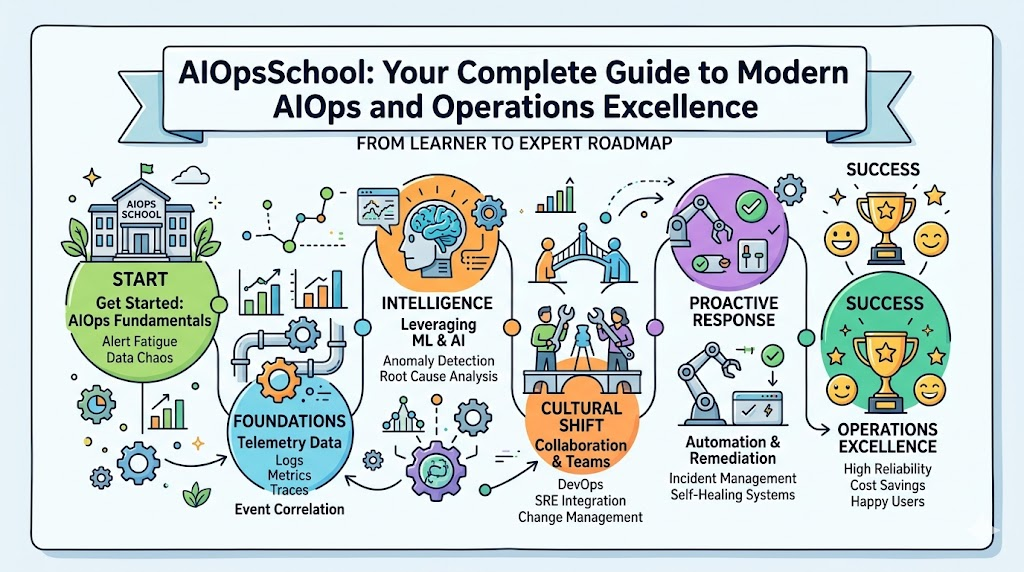
Introduction
Modern IT teams face a growing challenge. Applications run across cloud platforms, containers, microservices, and distributed environments. Every component generates logs, metrics, traces, and alerts. As systems become more complex, operations teams struggle with alert fatigue, delayed incident response, and lengthy troubleshooting cycles.
This is where AIOps Training becomes valuable. Organizations need professionals who can combine artificial intelligence, machine learning, and operational expertise to manage increasingly complex environments. Whether you are an IT administrator, SRE, DevOps engineer, or operations specialist, understanding AIOps can help you improve service reliability and reduce operational overhead.
At AiOpsSchool, professionals learn practical approaches to applying AIOps principles to real-world operational challenges. Before exploring tools, use cases, and career opportunities, it is important to understand what AIOps actually means and why it has become a critical capability for modern IT organizations.
What Is AIOps?
What is AIOps? In simple terms, AIOps stands for Artificial Intelligence for IT Operations. It combines data collection, analytics, machine learning, and automation to help IT teams detect problems, identify root causes, and resolve incidents faster.
Traditional operations rely heavily on human monitoring and manual troubleshooting. AIOps enhances these activities by analyzing massive volumes of operational data and identifying patterns that humans may miss.
Instead of reviewing thousands of alerts individually, an AIOps platform can correlate related events, recognize abnormal behavior, and suggest or execute corrective actions.
The primary goal of AIOps is straightforward: improve operational efficiency, reduce downtime, and help teams make better decisions based on data-driven insights.
Key Operational Concepts You Must Know
Before implementing AIOps, it is important to understand several foundational concepts that support effective AIOps in IT operations.
Observability
Observability refers to the ability to understand what is happening inside a system by examining its outputs. A highly observable environment enables teams to quickly identify performance issues and service disruptions.
Telemetry: Logs, Metrics, and Traces
Telemetry data forms the foundation of AIOps analysis.
- Logs record system events and activities.
- Metrics provide numerical measurements such as CPU usage or response time.
- Traces show the complete journey of requests across distributed services.
Together, these data sources provide visibility into system behavior.
Event Correlation
Large environments generate thousands of alerts every day. Event correlation connects related alerts into a single incident, reducing noise and helping teams focus on the actual problem.
Baseline vs. Anomaly
A baseline represents normal system behavior. An anomaly occurs when behavior deviates significantly from that baseline.
For example, if application latency normally remains below 100 milliseconds and suddenly increases to 500 milliseconds, the system recognizes this as an anomaly.
Automation and Remediation
Automation allows repetitive tasks to execute without human intervention. Remediation refers to corrective actions taken to restore normal operations.
Examples include:
- Restarting failed services
- Scaling infrastructure automatically
- Clearing resource bottlenecks
- Routing incidents to the appropriate teams
These concepts form the operational vocabulary that every AIOps practitioner should understand.
AIOps for Beginners
For professionals new to the field, AIOps for beginners is not about becoming a data scientist. It is about learning how modern operations teams use intelligence and automation to manage complexity.
Three reasons make this an excellent time to learn AIOps:
- Organizations are adopting cloud-native architectures that generate vast amounts of operational data.
- Businesses demand faster incident detection and resolution to maintain customer satisfaction.
- Automation and AI capabilities continue to expand, creating new career opportunities for operations professionals.
The combination of operational expertise and AI-driven analytics is becoming increasingly valuable across industries.
AIOps vs DevOps vs MLOps
Many professionals confuse these disciplines because they often work together. However, their objectives differ significantly.
The comparison between AIOps vs DevOps and AIOps vs MLOps becomes clearer when examining their primary focus areas.
| Concept | Primary Focus | Core Question It Answers |
|---|---|---|
| AIOps | Intelligent IT operations and incident management | How can we detect, predict, and resolve operational issues faster? |
| DevOps | Software delivery and collaboration | How can we release software reliably and continuously? |
| MLOps | Machine learning lifecycle management | How can we deploy and manage machine learning models effectively? |
DevOps focuses on accelerating software delivery through collaboration and automation.
MLOps focuses on managing machine learning models throughout their lifecycle.
AIOps focuses on improving operational visibility, reducing incident response times, and enhancing infrastructure reliability through AI-driven analysis.
Although they serve different purposes, organizations often combine all three approaches to create efficient and resilient technology ecosystems.
Platform Implementation vs. Culture — What’s the Real Difference?
One of the biggest misconceptions in the industry is that AIOps is simply a technology purchase. Organizations often invest in sophisticated platforms but fail to achieve meaningful results because they overlook the human side of transformation.
Successful AIOps Training teaches both technology and operational behavior. The platform provides insights, but people and processes determine whether those insights create value.
Buying and configuring a tool is only the beginning. Teams must also develop:
- Cross-functional collaboration
- Trust in automated recommendations
- Consistent operational processes
- Clear escalation procedures
- Effective change management practices
Without cultural alignment, even advanced AIOps platforms can become expensive monitoring dashboards.
The distinction becomes clearer in the following comparison.
| Platform Implementation | Operational Culture |
|---|---|
| Installing software | Building trust in data-driven decisions |
| Configuring integrations | Encouraging cross-team collaboration |
| Collecting telemetry | Acting consistently on insights |
| Creating dashboards | Sharing operational accountability |
| Automating workflows | Establishing governance and confidence |
| Setting alert rules | Reducing resistance to change |
Organizations that excel in AIOps in IT operations understand that technology and culture must evolve together.
Core AIOps Use Cases
The most valuable AIOps use cases focus on improving operational efficiency and reducing service disruptions.
- Anomaly Detection
Identify unusual system behavior before it causes outages. - Event Correlation
Consolidate related alerts into meaningful incidents. - AIOps Root Cause Analysis
Analyze operational data to identify the source of problems quickly. - Predictive Capacity Planning
Forecast future resource requirements using historical trends. - Automated Remediation
Execute predefined corrective actions automatically. - AIOps in IT Operations
Improve monitoring, incident response, service availability, and operational efficiency across complex environments.
These use cases deliver measurable improvements in reliability and productivity.
Real-World Use Cases of Modern Operations
Modern organizations apply AIOps use cases in different ways depending on their operational requirements.
E-Commerce Platform
An online retailer notices increasing checkout latency during a promotional campaign. AIOps correlates infrastructure metrics, application logs, and transaction traces to identify a database bottleneck before customers abandon purchases. This enables rapid intervention and protects revenue.
Banking Environment
A financial institution detects unusual login activity across multiple applications. AIOps identifies related security anomalies and correlates events from different systems, helping analysts investigate suspicious behavior more efficiently while maintaining compliance requirements.
SaaS Provider
A software company uses predictive analytics to forecast infrastructure demand based on customer growth patterns. By leveraging AIOps in IT operations, the organization provisions resources proactively and avoids performance degradation during peak usage periods.
These examples demonstrate how AIOps delivers practical business value beyond traditional monitoring.
AIOps Tools You Should Know
Understanding major AIOps Tools is an important step toward building practical expertise. The following AIOps tools list provides a useful starting point.
Monitoring and Observability Platforms
- Dynatrace
- Datadog
- New Relic
- Splunk Observability
- AppDynamics
Event Correlation and ITSM Tools
- ServiceNow IT Operations Management
- IBM Cloud Pak for Watson AIOps
- Moogsoft
- BigPanda
Open-Source Stacks
- Prometheus
- Grafana
- Elasticsearch
- OpenTelemetry
- Jaeger
Cloud-Native Services
- Amazon CloudWatch
- Azure Monitor
- Google Cloud Operations Suite
Studying these platforms through an AIOps Tutorial can help professionals understand how observability, analytics, and automation work together in production environments.
Common Mistakes in Operations Engineering
Many organizations struggle during adoption because they repeat common mistakes. Understanding these pitfalls can significantly improve outcomes.
Over-Alerting and Ignoring Noise Reduction
Too many alerts overwhelm operations teams and hide critical incidents.
Lesson: Prioritize alert quality over alert quantity.
Treating AIOps as Set-and-Forget Technology
Models, thresholds, and workflows require continuous refinement.
Lesson: Review operational outcomes regularly and adjust accordingly.
Ignoring Data Quality and Normalization
Poor-quality telemetry leads to inaccurate insights.
Lesson: Standardize and validate data sources before advanced analytics.
Automating Remediation Too Early
Automation without sufficient confidence can create larger incidents.
Lesson: Build trust gradually before enabling autonomous actions.
Lack of Cross-Team Buy-In
Operations, development, security, and infrastructure teams must collaborate effectively.
Lesson: Establish shared goals and operational ownership.
Avoiding these mistakes improves both AIOps in IT operations and the effectiveness of AIOps root cause analysis efforts.
AIOps for SRE
For Site Reliability Engineers, AIOps for SRE delivers measurable operational benefits.
SRE teams focus heavily on reliability metrics such as:
- Mean Time to Detect (MTTD)
- Mean Time to Resolve (MTTR)
- Service Level Objectives (SLOs)
AIOps helps reduce MTTD by identifying anomalies earlier.
It improves MTTR by correlating events and accelerating root cause discovery.
It supports SLO achievement by proactively detecting performance degradation before customer impact occurs.
As systems continue to scale, AIOps becomes an increasingly important capability for reliability engineering teams.
Seeing AIOps in Action
Consider a large SaaS provider experiencing intermittent application slowdowns affecting thousands of users.
Problem
Customers report increased response times during peak business hours. Traditional monitoring generates hundreds of alerts from databases, APIs, containers, and networking systems.
Detection
The AIOps platform identifies abnormal latency patterns and compares them against historical baselines.
Correlation
Related alerts from multiple systems are grouped into a single incident instead of generating hundreds of independent notifications.
Root Cause Analysis
Using AIOps root cause analysis, the platform discovers that a recently deployed microservice is consuming excessive database connections.
Remediation
An automated workflow scales infrastructure resources and reroutes traffic while engineers investigate the deployment issue.
Result
- Incident detection reduced from 25 minutes to 3 minutes
- Resolution time reduced from 90 minutes to 20 minutes
- Customer complaints reduced significantly
- Operational costs lowered through faster recovery
This example illustrates how AIOps in IT operations transforms reactive troubleshooting into proactive incident management.
How to Become an Operations Expert — Career Roadmap
Building expertise requires a structured learning path. The following roadmap can help professionals progress efficiently.
- Develop Foundational Operations Knowledge
Learn networking, operating systems, monitoring, troubleshooting, and cloud fundamentals. - Master Core AIOps Concepts
Understand observability, telemetry, anomaly detection, event correlation, and automation. - Gain Hands-On Tool Experience
Practice with monitoring platforms, open-source observability stacks, and automation frameworks. - Pursue Professional Credentials
Complete structured AIOps Training, enroll in an AIOps Course, and earn relevant certifications. - Choose a Specialization
Focus on SRE, DevOps, platform engineering, cloud operations, or enterprise observability.
Consistent practice and real-world experience remain the most important ingredients for long-term success.
Frequently Asked Questions
What is the main goal of AIOps?
AIOps helps organizations detect, analyze, and resolve operational issues faster using AI-driven insights and automation.
Is AIOps suitable for beginners?
Yes. Many learning programs introduce foundational concepts before progressing to advanced implementations.
What is an AIOps Course?
An AIOps Course provides structured learning covering observability, automation, analytics, operational workflows, and tool usage.
What is AIOps Certification?
AIOps Certification validates knowledge and practical understanding of AIOps concepts, tools, and operational practices.
What is AIOps Foundation Certification?
AIOps Foundation Certification typically focuses on core concepts, terminology, and fundamental practices suitable for beginners and intermediate professionals.
Do I need coding experience to learn AIOps?
Basic scripting knowledge helps, but many concepts can be learned without advanced programming skills.
Which roles benefit most from AIOps?
SREs, DevOps engineers, cloud engineers, infrastructure administrators, platform engineers, and operations managers all benefit significantly.
How long does it take to become proficient?
Most professionals can develop foundational competence within a few months through structured learning and hands-on practice.
Why Get an AIOps Certification?
Earning an AIOps Certification provides several professional advantages.
Increased Resume Credibility
Certifications demonstrate commitment to continuous learning and validate relevant industry knowledge.
Structured Learning Path
Training programs organize concepts logically, helping learners build knowledge systematically.
Better Career Opportunities
Organizations increasingly seek professionals who understand automation, analytics, and modern operational practices.
Salary and Role Growth
Certified professionals often qualify for advanced positions involving reliability engineering, cloud operations, and platform management.
For newcomers, an AIOps Foundation Certification provides an excellent starting point before pursuing more advanced specializations.
Where to Learn AIOps
Professionals seeking structured learning opportunities often look for programs that combine theory, practical exercises, and real-world implementation experience.
AiOpsSchool provides resources designed to help learners build expertise through progressive learning paths.
Key learning opportunities include:
- AIOps Training focused on operational excellence and practical implementation
- AIOps Course programs covering foundational and advanced concepts
- AIOps Certification pathways that validate professional skills
- AIOps Tutorial resources that support hands-on tool exploration and practice
The combination of conceptual understanding and practical application helps learners prepare for modern operations environments.
Final Thoughts
The future of IT operations depends on intelligent automation, proactive monitoring, and data-driven decision-making. As organizations continue to adopt cloud-native architectures and distributed systems, professionals who understand AIOps will play an increasingly important role in maintaining reliability and operational efficiency.
Investing in AIOps Training helps build the skills needed to manage modern technology environments, while earning an AIOps Certification demonstrates expertise that organizations actively seek. For professionals looking to strengthen their operational capabilities and advance their careers, exploring the learning paths available at AiOpsSchool.com is a practical next step.