Introduction
Cloud computing has transformed how businesses operate, but it has also introduced a new challenge: unpredictable and spiraling costs. Many organizations find themselves staring at monthly cloud bills that seem to have no rhyme or reason. This is where FinOps comes into play. FinOps, short for Financial Operations, is a cultural practice that brings together finance, technology, and business teams to manage cloud spending effectively. At its core, FinOps helps organizations understand their cloud usage patterns, optimize costs, and make informed decisions about their cloud investments. Building an effective cloud budget isn’t just about setting a number; it’s about creating a system that continuously monitors, analyzes, and optimizes your cloud expenditure. If you’re ready to take control of your cloud finances, Finopsschool offers comprehensive training and resources to help you master this essential practice.
Understanding the FinOps Framework
FinOps operates on a simple yet powerful principle: everyone in the organization takes ownership of cloud costs. This represents a significant shift from traditional IT budgeting, where only the finance department worried about expenses. The framework consists of three main phases: Inform, Optimize, and Operate. During the Inform phase, teams gain visibility into their cloud spending through proper tagging, allocation, and reporting. The Optimize phase focuses on finding opportunities to reduce waste and improve efficiency. Finally, the Operate phase involves continuous improvement and governance. When you build your cloud budget with FinOps, you’re not just creating a static document. You’re establishing a dynamic system that adapts to changing business needs while keeping costs under control. This approach ensures that every dollar spent on cloud services delivers maximum value to your organization.
Key Operational Concepts You Must Know
Before diving into budget creation, you need to understand several critical operational concepts that form the backbone of FinOps. First, showback and chargeback are mechanisms for allocating cloud costs to different departments or teams. Showback simply displays costs to teams without charging them, while chargeback actually bills them for their usage. Both approaches encourage accountability and cost-conscious behavior. Second, unit economics helps you understand the cost per business transaction or user, making it easier to measure the efficiency of your cloud operations. Third, commitment discounts, such as Reserved Instances and Savings Plans, offer significant savings in exchange for committing to specific usage levels. Fourth, rightsizing involves continuously adjusting your cloud resources to match actual demand, ensuring you’re not paying for idle capacity. Fifth, automation plays a crucial role in implementing cost controls, such as automatically shutting down non-production instances during off-hours. Finally, data visualization transforms complex cost data into actionable insights through dashboards and reports. Mastering these concepts will give you the foundation needed to build a budget that actually works for your organization.
Platform Implementation vs. Culture — What’s the Real Difference?
Many organizations mistakenly believe that implementing FinOps platforms automatically solves their cloud cost problems. However, this is a dangerous misconception. Platform implementation involves selecting and deploying tools that provide visibility into cloud costs, automate cost management tasks, and generate reports. Tools like CloudHealth, Apptio Cloudability, and AWS Cost Explorer are excellent for these purposes. They offer features like cost allocation, budget alerts, and optimization recommendations. However, these tools are only as effective as the culture that supports them. Culture, on the other hand, encompasses the behaviors, attitudes, and practices that drive cost-conscious decision-making. Without a strong FinOps culture, teams will ignore cost data, bypass governance policies, and continue to overspend. The real difference lies in sustainability. Platform implementation provides temporary fixes, while cultural change creates lasting results. Organizations that succeed with FinOps invest equally in both aspects. They choose the right tools but also foster an environment where everyone takes responsibility for cloud costs. This means training teams, establishing clear accountability, and rewarding cost-saving behaviors. Remember, platforms enable FinOps, but culture makes it work.
Why Traditional Budgeting Fails in the Cloud
Traditional budgeting methods simply don’t work in the cloud environment. The old approach of setting an annual budget based on historical spending falls apart when cloud costs fluctuate wildly. Cloud services are variable, usage patterns change constantly, and new services appear regularly. Static budgets become obsolete within months, leaving finance teams scrambling to explain variances. Moreover, traditional budgets often lack the granularity needed to understand where money is actually going. They typically treat cloud spend as a single line item, obscuring the details needed for optimization. Another critical issue is the lag time in traditional budgeting processes. By the time a budget is approved, cloud prices may have changed, new services may have launched, or business priorities may have shifted. This rigidity makes it impossible to respond quickly to changing circumstances. Additionally, traditional budgets often fail to account for the shared responsibility model of cloud cost management. They don’t encourage teams to consider the financial implications of their architectural decisions. To build an effective cloud budget, you need a more dynamic approach that embraces the fluid nature of cloud computing.
Building Your FinOps Budget Framework
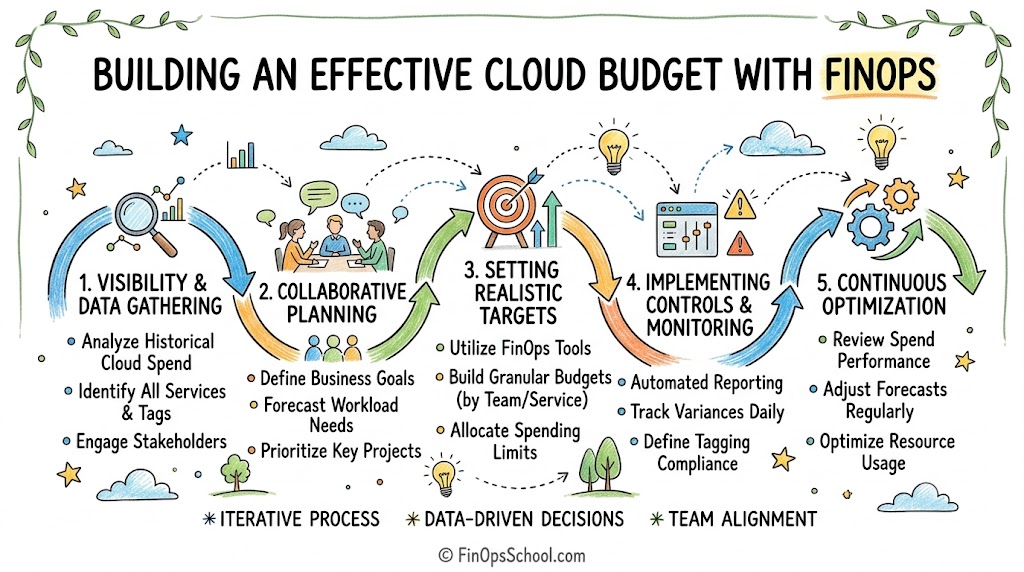
Creating an effective cloud budget requires a structured framework that aligns with your business objectives. Start by establishing a baseline of your current cloud spending. This involves collecting historical data from your cloud providers and categorizing it by service, team, and project. Next, forecast future spending based on expected growth, new initiatives, and planned migrations. Use data-driven forecasting methods rather than guesswork. Then, set clear budget targets for different teams and projects, making sure they align with overall business goals. These targets should be ambitious but achievable. Implement continuous monitoring systems that track actual spending against budget targets in real-time. This allows you to identify issues early and take corrective action. Create automated alerts that notify relevant stakeholders when spending approaches or exceeds thresholds. Finally, establish a process for budget reviews where teams can discuss variances, share learnings, and adjust plans as needed. This framework transforms your budget from a static document into a living system that guides decision-making throughout the organization.
The Three Stages of FinOps Budget Maturity
FinOps budget maturity follows a predictable path that organizations typically traverse over time. In the Crawl stage, teams focus on gaining visibility into their cloud costs. They implement basic tagging and reporting, identify major cost drivers, and start tracking spending against budgets. The primary goal here is awareness rather than optimization. During the Walk stage, organizations begin actively managing their cloud costs. They implement showback or chargeback mechanisms, start rightsizing resources, and take advantage of commitment discounts. Budgets become more sophisticated, incorporating growth projections and business drivers. Teams at this stage regularly review spending and make adjustments. Finally, the Run stage represents full FinOps maturity. Organizations have automated cost management processes, integrated financial planning with engineering activities, and established a culture of cost consciousness. Budgets at this stage are dynamic, continuously optimized, and closely tied to business outcomes. Understanding where your organization falls on this maturity curve helps you set realistic goals for budget development and identify the specific improvements needed to advance to the next stage.
Essential Components of a Cloud Budget
A comprehensive cloud budget includes several essential components that work together to provide complete financial control. Direct costs represent your actual cloud service consumption, including compute, storage, networking, and database services. These should be broken down by category for better visibility. Indirect costs include support services, third-party tools, and managed services that support your cloud operations. While these may be smaller, they still need tracking. Reserved capacity commitments should be accounted for as separate line items, as they represent fixed costs that reduce overall spending. Growth allocations set aside budget for planned expansion, new applications, or increased usage from existing services. Buffer or contingency accounts for unexpected costs or usage spikes, providing a safety net against surprises. Optimization targets establish goals for cost reduction through rightsizing, instance optimization, and waste elimination. Finally, training and enablement budgets support the cultural transformation needed for effective FinOps. Including all these components creates a complete picture of your cloud financial landscape.
Setting Realistic Cloud Budget Targets
Establishing realistic budget targets is crucial for maintaining credibility with stakeholders. Begin by analyzing historical spending patterns over several months to identify seasonal trends and growth rates. This provides a foundation for future projections. Consider business drivers like planned product launches, marketing campaigns, or seasonal peaks that might affect cloud usage. Work with engineering teams to understand their technology roadmap, including new services they plan to adopt. Factor in known changes to cloud pricing, such as rate reductions or new service introductions. Account for planned optimization efforts that should reduce costs over time. Set targets that challenge teams to improve efficiency while remaining achievable. A good approach is to set a primary target for total cloud spend, supported by secondary targets for specific services or teams. Communicate these targets clearly, explaining the rationale behind them. Ensure that targets align with overall business objectives and financial constraints. Review and adjust targets regularly based on actual performance and changing circumstances.
Monitoring and Managing Your Cloud Budget
Effective budget management requires continuous monitoring and proactive intervention. Start by implementing real-time dashboards that display current spending against budget targets. These dashboards should be accessible to relevant stakeholders and easy to understand. Set up automated notifications that alert teams when spending exceeds certain thresholds or deviates from expected patterns. This early warning system allows for timely intervention. Establish regular review cycles where teams analyze spending, identify variances, and discuss corrective actions. Weekly or monthly reviews work best depending on your organization’s size and complexity. Create a process for change management that ensures budget impacts of new initiatives are assessed before implementation. This prevents unexpected cost increases. Develop escalation procedures for situations where spending threatens to exceed budget significantly. Finally, document lessons learned from budget management experiences and incorporate them into future planning. Effective monitoring transforms budget management from a reactive exercise into a proactive discipline.
Common Mistakes in Operations Engineering
Many operations teams make critical errors when managing cloud costs, and understanding these mistakes is essential for building an effective budget. Ignoring idle resources is perhaps the most common mistake, with teams leaving unused instances running indefinitely. This represents pure waste and directly impacts the bottom line. Overprovisioning resources based on peak usage estimates rather than actual demand leads to paying for capacity that’s rarely needed. Underutilizing commitment discounts by failing to reserve instances or purchase savings plans misses significant savings opportunities. Neglecting storage optimization results in paying for unnecessary storage capacity and data transfer costs. Poor tagging practices make it impossible to allocate costs accurately, creating blind spots in budget management. Failing to implement proper governance allows uncontrolled spending through unauthorized resource provisioning. Overlooking data transfer costs when designing architectures can lead to unexpectedly high networking charges. Siloed operations where teams don’t share cost data or best practices leads to duplicated efforts and wasted resources. Finally, treating optimization as a one-time event rather than a continuous process ensures that inefficiencies will reappear over time. Recognizing these mistakes is the first step toward avoiding them.
Real-World Use Cases of Modern Operations
Understanding how organizations apply FinOps principles in practice provides valuable lessons for building your cloud budget. A global e-commerce company used FinOps to reduce cloud costs by 30% while maintaining high availability and performance during peak shopping seasons. They achieved this through a combination of rightsizing, spot instance usage, and automated scaling policies. A SaaS startup employed showback mechanisms to allocate costs to development teams, resulting in a 25% reduction in non-production spending. Developers became more conscious of their resource usage and optimized their code accordingly. A financial services firm implemented advanced budgeting with predictive analytics to forecast cloud costs accurately. This allowed them to allocate budgets more effectively and avoid surprises. A healthcare organization used FinOps to demonstrate regulatory compliance in their cloud spending, satisfying auditors while optimizing costs. They tracked every dollar spent on HIPAA-compliant services and could prove they were getting value for money. An educational institution leveraged FinOps to stretch their limited budget further, implementing automated shutdown policies that saved over $100,000 annually. These use cases demonstrate that FinOps works across industries, organization sizes, and cloud environments.
How to Become an Operations Expert — Career Roadmap
Becoming a FinOps or cloud operations expert requires a deliberate approach to skill development and career planning. Start by building a strong foundation in cloud computing fundamentals across major providers like AWS, Azure, and Google Cloud. This includes understanding core services, pricing models, and architectural best practices. Next, develop financial literacy by learning about cloud pricing structures, billing processes, and financial analysis techniques. Earn relevant certifications such as AWS Certified Solutions Architect, Google Professional Cloud Architect, or the FinOps Certified Practitioner credential. These validate your expertise and demonstrate commitment to the field. Gain practical experience by working on real cloud projects, managing budgets, and implementing optimization initiatives. Seek opportunities to work on cross-functional teams that include finance, engineering, and business stakeholders. Build communication skills to translate technical concepts into business language and influence decision-making. Develop leadership abilities by mentoring others and leading FinOps transformations. Stay current with industry trends through continuous learning, attending conferences, and participating in professional communities. Finally, consider specializing in specific areas like cost optimization, governance, or financial analytics to differentiate yourself. This roadmap provides a clear path to expertise in the growing field of cloud financial operations.
Building a FinOps Culture in Your Organization
Creating a FinOps culture is often the biggest challenge organizations face, but it’s essential for long-term success. Start by securing executive sponsorship to demonstrate that cost management is a priority. Leaders must champion the cause and allocate resources for FinOps initiatives. Implement education and training programs that teach teams about cloud costs, optimization techniques, and financial accountability. Make training engaging and relevant to different roles. Establish clear accountability by assigning cost owners for different services, projects, or teams. These owners are responsible for managing their budgets and optimizing their spending. Create incentive structures that reward cost-saving behaviors, such as bonuses or recognition programs for teams that achieve optimization targets. Celebrate successes and share best practices across the organization. Implement communication channels where teams can share cost data, discuss challenges, and collaborate on solutions. Foster a blame-free environment where teams feel safe exploring optimization opportunities without fear of punishment for trying new approaches. Finally, measure and share cultural metrics, such as adoption rates, cost awareness scores, and participation in FinOps activities. Building this culture requires patience and persistence, but the benefits far outweigh the effort.
Financial Governance and Compliance
Financial governance ensures that your cloud spending aligns with organizational policies and regulatory requirements. Start by establishing spending policies that define acceptable cloud usage, approval processes, and spending limits. These should be documented, communicated, and enforced consistently. Implement budget controls that prevent spending from exceeding approved amounts without proper authorization. This might include hard stops at budget limits or soft limits with escalation procedures. Develop compliance frameworks that address regulatory requirements specific to your industry, such as GDPR, HIPAA, or SOC2. Ensure that cloud spending complies with these frameworks without compromising security. Create audit trails that document all financial decisions and cost management actions. This provides accountability and supports compliance reviews. Establish vendor management processes that ensure service providers meet financial and compliance requirements. Implement regular reviews of governance policies to ensure they remain relevant and effective. Finally, integrate governance automation where possible, using tools that enforce policies automatically without manual intervention. Strong governance provides the structure needed for effective budget management while maintaining compliance.
Continuous Optimization Strategies
Optimization isn’t a one-time activity but an ongoing process that should be embedded in your budget management approach. Start by implementing automated rightsizing that continuously monitors resource utilization and recommends appropriate instance sizes. Use tools that can automatically apply these recommendations with proper approvals. Adopt elasticity patterns that scale resources up and down based on demand, ensuring you only pay for what you use. Implement spot instance adoption for workloads that can tolerate interruptions, taking advantage of significant discounts. Optimize your storage strategy by moving infrequently accessed data to colder storage tiers and deleting obsolete data regularly. Use containerization and serverless architectures where appropriate, as these can reduce costs compared to traditional VM-based deployments. Implement content delivery networks to reduce data transfer costs, particularly for global applications. Regularly review your commitment portfolio, adjusting reserved capacity based on evolving usage patterns. Use machine learning to identify optimization opportunities that might not be obvious from manual analysis. Finally, benchmark your cost efficiency against industry peers to identify areas for improvement. Continuous optimization ensures your cloud budget stays effective even as your environment evolves.
Measuring FinOps Success
Measuring the success of your FinOps initiatives is critical for maintaining momentum and justifying continued investment. Start by tracking cost savings generated through optimization efforts, including rightsizing, commitment discounts, and waste elimination. Calculate ROI for optimization projects to demonstrate their business value. Monitor cost efficiency metrics such as cost per transaction, cost per user, or cost per application. These show how well you’re converting cloud spend into business outcomes. Track budget accuracy by measuring how closely actual spending aligns with budget targets. Improving this metric indicates better forecasting and planning. Measure adoption rates for FinOps practices, such as tagging compliance, budget reviews, and optimization initiatives. Higher adoption correlates with better outcomes. Monitor time to detect and respond to cost anomalies, as faster response times reduce waste. Track stakeholder satisfaction with FinOps processes through surveys and feedback. Measure optimization velocity by counting completed optimization projects over time. Finally, monitor cloud unit economics to ensure you’re getting value from your cloud investments. These metrics provide a comprehensive view of FinOps effectiveness and guide improvement efforts.
FAQ Section
What is FinOps and why is it important?
FinOps is a cultural practice that brings together finance, technology, and business teams to manage cloud spending effectively. It’s important because cloud costs can spiral out of control without proper management, and FinOps provides a framework for controlling expenses while maximizing value from cloud investments.
How do I get started with FinOps in my organization?
Start by gaining visibility into your cloud costs through proper tagging and reporting. Then, establish a cross-functional team with members from finance, engineering, and operations. Begin implementing basic optimization practices and gradually build out more advanced FinOps capabilities over time.
What are the main challenges in implementing FinOps?
Common challenges include resistance to cultural change, lack of executive support, poor data quality, insufficient skills and training, and difficulty measuring success. Overcoming these challenges requires a deliberate change management approach and sustained leadership commitment.
How often should I review my cloud budget?
You should review your cloud budget at least monthly, though weekly reviews are recommended for organizations with significant cloud spend. Additionally, you should have a more comprehensive review quarterly to assess strategy and make longer-term adjustments.
What tools do I need for effective FinOps?
While specific tools vary by organization, you’ll typically need cloud cost management platforms, tagging and tracking tools, optimization recommendation engines, and reporting dashboards. Many cloud providers offer built-in tools that can serve as starting points.
How can I reduce cloud costs without sacrificing performance?
Focus on rightsizing resources to match actual demand, adopt commitment discounts where appropriate, implement automated scaling, optimize storage strategy, and eliminate waste through regular cleanup of unused resources. Always test performance impacts before making changes.
Who should be responsible for cloud cost management?
While finance typically oversees budget management, responsibility should be distributed across the organization. Engineering teams should own their resource usage, finance should guide strategy, and operations should implement optimization. Everyone should be accountable for cost awareness.
What’s the difference between FinOps and traditional IT financial management?
FinOps takes a more dynamic, collaborative approach compared to traditional IT financial management. It emphasizes continuous optimization, distributed accountability, and real-time visibility rather than static annual budgets and centralized control.
How do I handle unexpected cloud cost spikes?
Establish automated alerts for cost anomalies, implement spending limits, investigate spikes promptly, and have contingency funds available. Conduct root cause analysis to prevent similar issues in the future and adjust processes accordingly.
Can FinOps work for small businesses?
Absolutely! FinOps principles scale to organizations of all sizes. Small businesses often benefit even more from FinOps because cloud costs represent a larger percentage of their operating budget. The key is to start with the basics and scale as you grow.
Final Summary
Building an effective cloud budget with FinOps requires a comprehensive approach that combines technical expertise, financial acumen, and cultural transformation. You must understand key operational concepts like showback, unit economics, and commitment discounts to create a solid foundation. Recognizing the distinction between platform implementation and cultural change is crucial, as tools enable but culture makes FinOps work. Traditional budgeting fails in the cloud, so you need a dynamic framework that embraces continuous improvement and stakeholder engagement. Your budget should include all essential components, from direct costs to training allocations, and targets should be realistic yet challenging. Monitoring must be continuous, with automated alerts and regular reviews. Avoid common operations engineering mistakes like ignoring idle resources or overprovisioning. Learn from real-world use cases to apply best practices effectively.