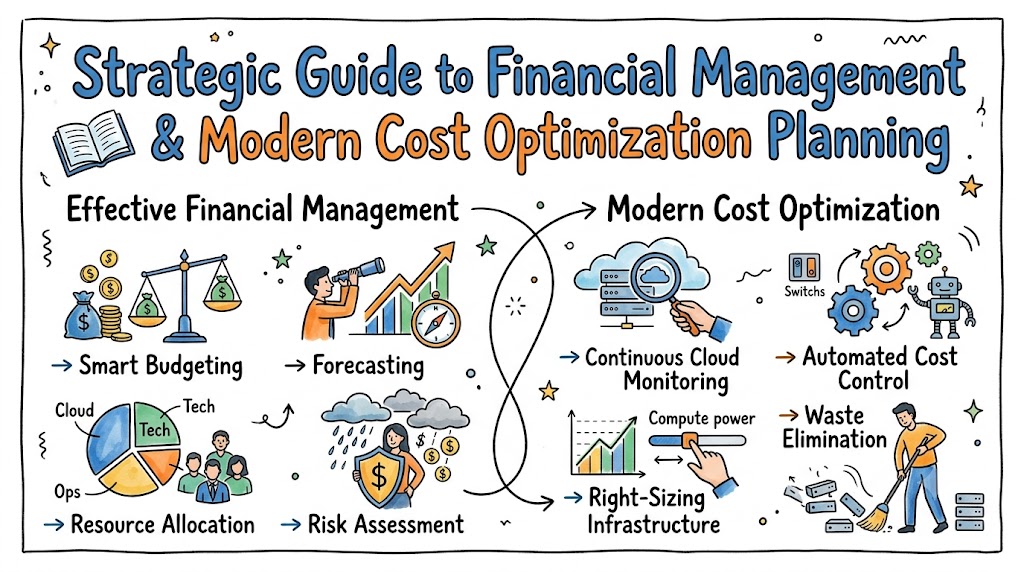
Organizations frequently struggle to control their cloud computing expenses because traditional budgeting methods fail to address dynamic, on-demand infrastructure scaling. Cloud budgeting and forecasting represents the strategic practice of predicting, monitoring, and controlling cloud expenditure to align technical deployment with business values. Consequently, engineering and finance teams must collaborate continuously to build precise financial models that prevent unexpected billing spikes. Implementing these methodologies allows companies to maximize their return on technology investments while maintaining high operational performance.
Managing cloud costs effectively requires deep visibility into every infrastructure component across multi-cloud environments. By establishing rigorous financial guardrails, organizations can easily transition from reactive firefighting to proactive resource optimization. You can master these complex practices through specialized guidance and training resources available at Finopsschool, which bridges the gap between engineering execution and financial accountability. This comprehensive approach ensures that software development remains both innovative and financially sustainable.
Key Operational Concepts You Must Know
Understanding Variable Spending Models
Traditional on-premises infrastructure relies heavily on fixed capital expenses that finance teams plan years in advance. However, cloud environments operate entirely on variable operating expenses that change every minute based on real-time consumption patterns. This fundamental shift means that any developer can launch expensive resources instantly with a single command line interface entry. Therefore, operational teams must understand that cloud budgeting is no longer a static annual exercise but a continuous real-time tracking discipline.
To manage this variable reality, organizations must adopt automated tagging architectures that assign every cloud resource to a specific business owner. When metadata tags lack consistency, tracking down the source of an overnight spending spike becomes an impossible manual task. Therefore, setting up automated policy enforcement represents the first critical step toward establishing operational cost visibility across enterprise teams.
Establishing Resource Visibility and Allocation
Granular visibility forms the foundational bedrock of any successful cloud financial management strategy within modern enterprise engineering teams. Organizations must categorize their infrastructure spend by departments, individual teams, specific environments, and unique client architectures. Accordingly, utilizing complex cost-allocation matrices allows finance departments to distribute shared container costs and network data transfer fees accurately.
[Cloud Cost Allocation]
       │
       ├──► Production Environment ──► App Services (Shared Cluster)
       │                                     │
       │                                     ├──► Marketing Team (30%)
       │                                     └──► Sales Team (70%)
       │
       └──► Development Environment ─► Sandbox Instances
                                             │
                                             └──► Engineering R&D (100%)
When teams lack this clear architectural visibility, engineering groups frequently face zero accountability for abandoned development environments. Therefore, establishing automated reporting dashboards provides engineers with the immediate feedback loop needed to clean up unused staging databases. This constant data availability transforms raw cloud billing records into actionable operational insights for engineering leaders.
Developing Dynamic Predictive Models
Predictive forecasting demands a sophisticated combination of historical consumption analysis, seasonal trend adjustments, and future product engineering roadmaps. Modern operations teams must look beyond simple linear regressions because microservice scaling patterns rarely follow straight paths over long periods. Instead, utilizing machine learning algorithms helps identify subtle workload anomalies and repetitive monthly processing cycles across application networks.
Furthermore, engineering teams must communicate directly with finance specialists whenever major architecture migrations or product rollouts approach. If a development team plans to launch a massive memory-intensive database next month, historical trends alone cannot predict that sudden spike. Therefore, combining historical data analytics with human project intelligence creates the most accurate financial forecasts possible.
Platform Implementation vs. Culture — What’s the Real Difference?
| Operational Dimension | Platform Implementation Focus | Cultural Transformation Focus |
|---|---|---|
| Primary Core Objective | Deploying cost-management dashboards, automated tracking tools, and tagging policies. | Establishing shared financial accountability across engineering and operations teams. |
| Measurement Metrics | Tool adoption rates, dashboard uptime, and automated alert resolution times. | Average time to remediate anomalies and proactive engineering architecture adjustments. |
| Team Responsibility | Dedicated centralized cloud operations tools team and systems architects. | Every single developer, product owner, and executive stakeholder. |
| Long-Term Impact | Provides the necessary data visibility and infrastructure enforcement mechanisms. | Drives permanent behavior changes that prevent waste before resource creation. |
The Limits of Technology Tools
Many enterprises mistakenly believe that purchasing an expensive cloud cost management platform will instantly solve their budgeting issues. Although these applications provide excellent data visualizations, software tools cannot inherently fix flawed human workflows or poor architectural designs. For instance, an automated alerting platform can notify a team about an idle database, but nothing changes if engineers ignore the notification.
Consequently, relying solely on platform implementation creates a false sense of security while infrastructure waste continues to accumulate silently. Teams must view technology as an enabler rather than a complete solution for deep financial inefficiencies. True optimization requires human intervention to restructure architecture and modify daily operational habits.
Building Shared Cost Accountability
Shifting toward an effective financial culture requires embedding cost consciousness directly into the standard software development lifecycle. Developers must consider financial efficiency as a core performance metric alongside application latency, security compliance, and system uptime. When engineering teams take pride in writing cost-optimized code, they naturally design systems that scale down during low-traffic periods.
Moreover, leadership teams must support this cultural evolution by celebrating optimization achievements rather than focusing exclusively on feature delivery. Providing visibility through gamified team leaderboards or public recognition fosters healthy competition around infrastructure efficiency. This collaborative environment ensures that financial sustainability becomes an organic priority for every team member.
Real-World Use Cases of Modern Operations
Automated Scaling and Infrastructure Right-Sizing
A prominent global e-commerce enterprise experienced massive traffic fluctuations between day and night cycles, leading to extreme cloud budget overruns. To solve this issue, their engineering team implemented automated right-sizing scripts that constantly match instance capacity with real-time demand. Additionally, they integrated predictive scaling algorithms that analyze historical traffic patterns to pre-warm server clusters right before peak hours.
- Production Cluster Optimization: The team transitioned all non-production environments to automatically shut down outside of standard working hours.
- Storage Tier Upgrades: They migrated legacy block storage volumes to modern performance tiers, reducing storage costs by one-third.
- Container Efficiency Adjustments: Engineers modified microservice resource requests to align exactly with observed CPU utilization metrics.
Capitalizing on Commitment Discounts
A fast-growing software-as-a-service provider faced skyrocketing computing expenses due to their heavy reliance on volatile on-demand instance pricing models. To stabilize their financial baseline, the operations team conducted a comprehensive analysis of their minimum continuous computing requirements across all regions. Subsequently, they strategically purchased a combination of flexible compute savings plans and regional reserved instances.
- Baseline Coverage Strategy: The organization covered 70% of their core compute footprint with long-term commitment discounts.
- Spot Instance Integration: They modified batch processing workloads to run exclusively on discounted spot instances rather than standard servers.
- Portfolio Management Review: Financial analysts instituted monthly commitment reviews to adjust coverage as application architectures evolved over time.
Eliminating Hidden Data Transfer Overhead
A multinational financial analytics platform discovered that cross-availability zone network data transfers constituted a massive portion of their monthly cloud bill. Engineering teams investigated the network architecture and realized their microservices were communicating inefficiently across arbitrary geographic zones. Therefore, they redesigned the application routing topology to keep localized service communication entirely within the same availability zone.
- VPC Endpoint Deployment: The company implemented private virtual private cloud endpoints to avoid traversing the public internet for internal storage access.
- Content Delivery Optimization: They leveraged advanced caching layers at the edge to reduce repetitive origin server data fetches significantly.
- Database Replication Cleanup: Operations teams consolidated redundant cross-region database replication streams into a single optimized synchronization pipeline.
Common Mistakes in Operations Engineering
Ignoring Minor Idle Resources
Engineers frequently spin up large experimental database instances or testing sandboxes to validate a quick proof-of-concept design over the weekend. However, these developers often forget to terminate these resources once their testing tasks conclude successfully. While a single idle virtual machine might only cost a few dollars daily, hundreds of these abandoned resources quickly accumulate across an enterprise.
[The Cost Accumulation Effect]
  Developer Sandbox (Left Running) ──► $5 / day
  Multiplied by 50 Engineers       ──► $250 / day
  Accumulated over 30 Days         ──► $7,500 / month (Unnecessary Waste)
To combat this widespread issue, operational teams must establish automated cleanup policies that terminate un-tagged or idle resources after predefined periods. If a resource lacks active connections or shows zero CPU utilization for a week, automated systems should flag it for deletion. Breaking this cycle of neglect requires constant vigilance and robust automated engineering governance policies.
Over-Provisioning for Theoretical Peak Loads
Traditional system administrators often design cloud environments with the outdated mindset of provisioning infrastructure to handle worst-case theoretical peak traffic scenarios continuously. This defensive practice leads to massive production clusters running at less than 10% average CPU capacity during normal operations. Consequently, companies pay exorbitant fees for computing power that remains completely unused for the vast majority of the year.
Modern operations demand that engineers trust automated scaling mechanisms to handle sudden traffic surges dynamically rather than relying on permanent over-provisioning. Teams must configure responsive scaling triggers that add capacity within minutes whenever application load metrics rise safely. Embracing elasticity allows organizations to maintain flawless user experiences without wasting precious financial capital on idle headroom.
Siloing Engineering from Finance Teams
When engineering groups build complex cloud architectures without communicating with financial planners, budgeting efforts are virtually guaranteed to fail catastrophically. Finance departments generally lack the technical expertise to understand why cloud invoices change, while engineers rarely see the broader corporate financial targets. This deep operational disconnection creates friction and leads to reactive executive panic whenever quarterly spending exceeds projections.
Organizations must break down these traditional structural silos by embedding financial representatives directly into engineering architecture design reviews. This collaborative approach ensures that cost estimates are calculated thoroughly before a single line of infrastructure-as-code is deployed to production. Open communication paths empower both departments to collaborate effectively toward shared corporate efficiency goals.
How to Become an Operations Expert — Career Roadmap
Mastering Foundational Infrastructure Skills
Aspiring cloud financial professionals must begin by acquiring a deep technical understanding of core cloud architecture components and pricing models. You need to understand exactly how compute, storage, networking, and serverless technologies generate costs across major public platforms. Additionally, learning to navigate native billing data systems allows you to query raw cost information with precision.
[Expert Career Progression]
  Foundational Infrastructure ──► Advanced Analytical Automation ──► Executive Financial Strategy
Furthermore, becoming proficient with infrastructure-as-code tools enables you to build standardized environments that include cost-tracking mechanisms automatically. This technical baseline ensures you can speak the same language as development teams when discussing complex system modifications. Credibility with engineering groups is essential for driving meaningful optimization initiatives across any enterprise organization.
Developing Advanced Analytical Automation Capabilities
As you advance in your professional journey, you must focus heavily on automating cost governance through programmatic scripting and advanced analytics tools. Master data pipeline creation to aggregate, clean, and enrich raw billing files with custom business metadata tags. Developing these skills allows you to build sophisticated internal allocation dashboards that provide deep insights to executives.
- Automated Policy Creation: Learn to write compliance policies that automatically detect and terminate non-compliant infrastructure components.
- Anomaly Detection Engineering: Build statistical monitoring systems that alert operational teams the moment spending departs from historical baselines.
- Container Cost Profiling: Develop methods to allocate shared Kubernetes cluster resources accurately to individual application microservices.
Stepping Into Executive Financial Strategy
The highest tier of operational expertise requires translating complex technical infrastructure metrics into clear business value narratives for corporate executives. You must learn to correlate cloud spending directly with core business performance indicators, such as cost-per-active-user or infrastructure-cost-per-transaction. This strategic ability allows corporate leadership to see cloud expenditure as a direct growth driver rather than a burden.
- Unit Economics Modeling: Design advanced financial frameworks that calculate the exact infrastructure cost of delivering a single business transaction.
- Vendor Contract Negotiation: Utilize detailed consumption data trends to negotiate favorable custom enterprise discount agreements with cloud providers.
- Cross-Functional Leadership: Direct large scale organizational change initiatives that establish permanent cloud financial cultures across global enterprise teams.
FAQ Section
- What is the primary difference between cloud budgeting and traditional IT budgeting practices?Traditional IT budgeting relies heavily on fixed capital expenditures planned months in advance for physical hardware purchases. Conversely, cloud budgeting deals with dynamic, variable operating expenses that change in real time based on infrastructure consumption patterns. This requires continuous monitoring and agile adjustments rather than static annual planning cycles.
- How often should enterprise teams review their cloud forecasting models to ensure accuracy?Operational teams should perform high-level reviews of their cloud spending dashboards daily to catch unexpected anomalies immediately. Furthermore, engineering and finance leaders must collaborate on a comprehensive monthly forecasting review to adjust budgets against product roadmaps. This balanced cadence ensures both immediate operational safety and accurate long-term financial planning.
- Why are metadata tagging strategies considered vital for successful cloud financial management?Metadata tags act as the primary accounting mechanism that tracks cloud resource ownership back to specific teams or applications. Without consistent tagging enforcement, identifying the source of a sudden infrastructure cost spike becomes nearly impossible. Automated tagging policies ensure absolute financial accountability across the entire engineering organization.
- Can automated tools completely replace the need for a dedicated cloud financial culture?Automated tools provide essential data visibility and monitoring alerts, but they cannot replace a conscious organizational culture. Software applications can identify waste, but human engineers must choose to modify architectures and follow optimization best practices. Long-term cost control requires a permanent behavioral shift across all development teams.
- What are commitment discounts and how do they help optimize enterprise infrastructure budgets?Commitment discounts allow organizations to secure significant pricing reductions by promising to utilize a specific amount of computing power over time. These agreements provide predictability for steady-state workloads while significantly reducing hourly on-demand computing expenses. Teams must balance these commitments carefully to maintain operational flexibility.
- How can organizations accurately allocate shared infrastructure costs like Kubernetes clusters?Allocating shared costs requires tracking container resource utilization metrics like CPU and memory requests within the cluster environments. Operations teams use specialized open-source tools to map these internal container metrics back to specific business units. This granular profiling prevents shared infrastructure from becoming an untraceable financial black box.
- What steps should an engineer take when an anomaly detection alert triggers overnight?The engineer must first identify the specific resource ID and owner associated with the sudden cost spike. Next, they should evaluate whether the increased spend stems from legitimate traffic surges or an infinite code loop error. If the resource is unneeded, they must terminate or right-size it immediately to limit financial exposure.
Final Summary
Achieving long-term financial efficiency in cloud environments requires a comprehensive balance of advanced technical automation, precise allocation models, and a shared culture of accountability. Organizations must move past outdated, rigid planning mentalities and fully embrace the flexible, dynamic reality of modern variable infrastructure consumption. By combining real-time visibility tools with engineering discipline, businesses can prevent wasteful over-provisioning without compromising application performance. Ultimately, mastering these operational practices ensures that technology investments serve as powerful catalysts for sustainable corporate growth and innovation.