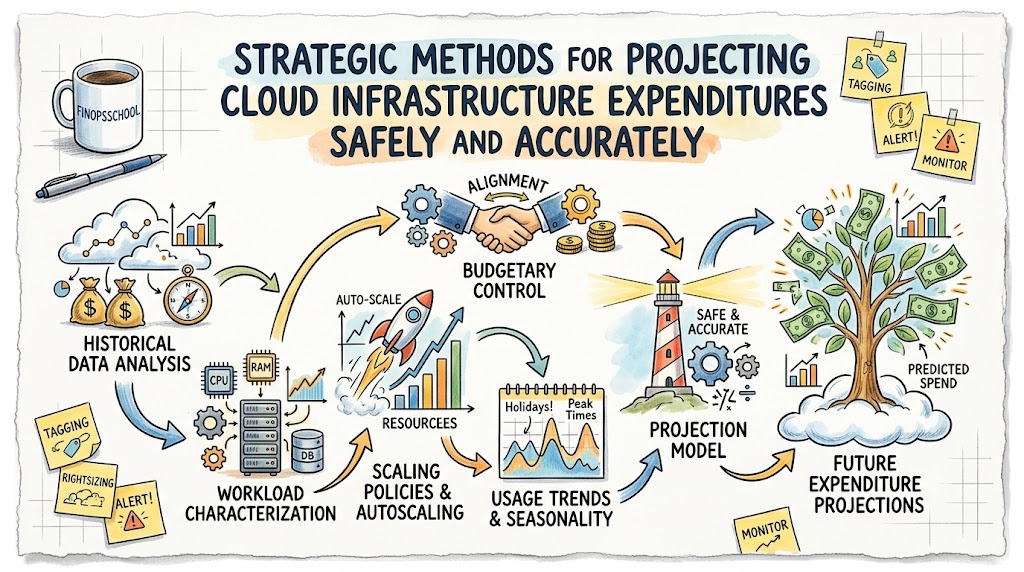
Predicting cloud infrastructure costs prevents budget overruns and optimizes your organizational resource allocation effectively. Cloud environments scale dynamically, which means costs fluctuate rapidly based on real-time demand and infrastructure adjustments. Therefore, organizations need a structured methodology to anticipate these financial shifts before they impact the bottom line. Accurate forecasting combines historical data analysis, machine learning algorithms, and deep engineering insights to project future infrastructure bills. By implementing these predictive practices, business leaders and engineering teams align their operational strategies with fiscal reality. Consequently, you can confidently innovate without fearing unexpected billing spikes at the end of the month.
Mastering this financial discipline requires guidance from industry experts who understand the intersection of development and finance. Fortunately, Finopsschool offers comprehensive programs designed to help professionals master the art of cloud financial management seamlessly. Through structured learning, teams acquire the exact skills needed to build robust forecasting models and eliminate cloud waste. Transitioning to a proactive financial stance transforms how your engineering teams provision resources across multi-cloud environments. Ultimately, establishing financial predictability enables your enterprise to scale its digital services efficiently and maintain healthy profit margins.
Mastering Cloud Financial Predictability
Predicting cloud expenditures demands a deep understanding of variable billing models across different providers. Unlike traditional data centers with fixed capital expenses, cloud infrastructure operates primarily on an operational expense model. Because developers can spin up resources instantly, spending patterns become volatile and difficult to track manually. Accurate forecasting solves this challenge by transforming historical usage statistics into actionable future projections.
To build a reliable forecast, you must analyze workloads, seasonal traffic spikes, and upcoming product launches simultaneously. Engineers and financial analysts must collaborate closely to map technical roadmaps to cloud cost metrics regularly. Whenever teams launch new features, the forecasting model must automatically account for the expected increase in compute power. This unified approach ensures that your financial projections remain accurate even during rapid development cycles.
Key Operational Concepts You Must Know
Unit Economics and Cost Allocation
To forecast costs accurately, you must first understand the fundamental unit economics of your digital applications. You should measure the cloud cost per daily active user or cost per transaction processed to gain true visibility. This baseline helps you project financial growth proportionally as your user base expands over time. Consequently, you can scale your budget models based on actual business performance indicators rather than rough guesses.
Effective cost allocation requires a comprehensive tagging strategy across all your cloud resources and microservices. You must assign every virtual machine, database, and storage bucket to a specific department or product team. When you tag resources correctly, you eliminate untracked expenses that typically distort financial forecasts. Furthermore, this transparency holds individual engineering teams accountable for the infrastructure resources they consume daily.
Trend Analysis and Seasonality
Analyzing historical data trends allows you to identify recurring spending patterns across your infrastructure. For instance, retail applications experience massive traffic surges during holiday seasons, which dramatically increases compute requirements. By evaluating previous cyclical peaks, you can factor these recurring anomalies into your upcoming budget models. This historical perspective ensures that your forecast accounts for predictable spikes without causing unnecessary financial panic.
In addition to seasonal variations, you must track long-term growth trends within your underlying infrastructure. Microservices naturally consume more data and storage as historical logs and database records accumulate over time. By calculating the monthly compounding growth rate of your storage solutions, you project future capacity needs accurately. Therefore, you can avoid unexpected capacity shortfalls while keeping your long-term storage budgets perfectly optimized.
Platform Implementation vs. Culture — What’s the Real Difference?
| Operational Focus | Platform Implementation | Cultural Transformation |
|---|---|---|
| Primary Goal | Deploying cost management software and dashboard tooling. | Changing engineering behavior and financial accountability. |
| Execution Method | Configuring automated alerts, tag policies, and reporting scripts. | Conducting regular cross-functional reviews and training sessions. |
| Long-Term Impact | Provides visibility into current infrastructure spending habits. | Drives continuous, organic optimization across all development teams. |
Deploying advanced cost optimization platforms provides the necessary visibility, but tooling alone cannot solve systemic cloud waste. Many organizations mistakenly believe that purchasing an expensive monitoring platform will immediately fix their budgeting issues. Although dashboards highlight where inefficiencies exist, they cannot alter the deployment habits of your development teams. Therefore, platform implementation serves merely as the foundational step toward achieving true cloud financial control.
True transformation occurs when you embed financial accountability directly into your engineering organization’s core culture. Developers must consider the financial implications of their architectural decisions during the initial design phase. When teams take pride in writing cost-efficient code, cloud optimization becomes a natural byproduct of development. Cultivating this shared responsibility ensures that cost management remains sustainable long after software platforms are installed.
Real-World Use Cases of Modern Operations
Migrating Monolithic Architectures to Microservices
A major e-commerce enterprise experienced massive budget variances due to an unpredictable monolithic infrastructure design. Because the entire system scaled as a single unit, minor traffic spikes triggered massive, unnecessary resource consumption. To resolve this, the engineering team decoupled the monolith into optimized, independent microservices. This architectural shift allowed them to scale specific components independently and forecast compute requirements with high precision.
Following the migration, the team implemented automated auto-scaling policies based on real-time transaction volumes. They utilized historical microservice data to predict the exact financial impact of upcoming promotional marketing campaigns. As a result, the organization reduced its overall cloud spend while maintaining perfect application availability. This successful transition demonstrates how modern cloud operations directly support accurate financial planning and corporate efficiency.
Automating Multi-Region Resource Scheduling
A global logistics corporation struggled with high cloud costs running non-production environments around the clock. Their development and testing instances remained active during weekends and nights, generating substantial idle resource waste. To combat this inefficiency, operations engineers deployed automated scheduling scripts across all non-production environments. These scripts automatically shut down non-essential virtual machines outside of standard regional working hours.
+------------------------------------------------------------+
|                AUTOMATED RESOURCE SCHEDULER               |
+------------------------------------------------------------+
|                                                            |
|  [Dev/Test Instances] ---> (Active during Working Hours)   |
|                                     |                      |
|                                     v                      |
|  [Automation Script] ----> (Shut down during Off-Hours)    |
|                                     |                      |
|                                     v                      |
|  [Cloud Budget] ---------> (Reduces Idle Waste by 30%)     |
|                                                            |
+------------------------------------------------------------+
By eliminating this idle uptime, the company stabilized its baseline infrastructure costs significantly. The financial analysts integrated these predictable shutdown schedules directly into their monthly forecasting tools. Consequently, the team achieved a reduction in quarterly budget variances, proving the value of automated operational control. This practical use case highlights how simple operational automation improves predictability across large-scale enterprise deployments.
Common Mistakes in Operations Engineering
- Ignoring Idle Resources: Engineers frequently provision high-performance instances for temporary testing and forget to terminate them afterward. These orphaned resources accumulate silent charges that disrupt financial projections significantly over time.
- Over-Provisioning Compute Capacity: Selecting larger virtual machine sizes than required guarantees excellent performance but creates massive financial waste. You should right-size your instances based on actual utilization metrics rather than theoretical peak demands.
- Neglecting Commitment Discounts: Failing to utilize reserved instances or savings plans means paying maximum on-demand rates unnecessarily. Organizations must analyze stable baseline workloads to leverage long-term discount options effectively.
- Mismanaging Storage Lifecycles: Storing obsolete database backups on high-speed, expensive premium storage drives up monthly bills unnecessarily. Implement automated lifecycle policies to move older data to archival tiers systematically.
How to Become an Operations Expert — Career Roadmap
Foundational Knowledge and Core Competencies
To kickstart your journey in operations engineering, you must first master Linux system administration and basic networking principles. Understand how data flows through virtual private clouds, subnets, and load balancers inside cloud environments. Additionally, learn at least one scripting language like Python or Bash to automate repetitive system tasks efficiently. This underlying technical expertise forms the bedrock of all advanced cloud management methodologies you will encounter later.
Next, familiarize yourself with fundamental financial concepts and cloud billing structures across major public providers. You must learn how vendors calculate costs for compute cycles, data egress, and storage operations. Developing this cross-functional knowledge allows you to bridge the historical gap between engineering teams and accounting departments. Consequently, you become a highly valuable asset capable of translating technical configurations into clear business expenses.
Advanced Automation and Strategic Leadership
Once you master the fundamentals, transition toward infrastructure as code tools like Terraform or OpenTofu. Automating infrastructure deployments ensures consistency while allowing you to embed cost control policies directly into your code repositories. Furthermore, study containerization technologies and orchestration platforms like Kubernetes to manage microservices at scale. These advanced tools enable you to build highly elastic systems that optimize resource utilization automatically.
- Associate Level: Focus on cloud certifications, basic scripting, and mastering cost-allocation tagging frameworks across small workloads.
- Professional Level: Implement automated right-sizing pipelines, manage commitment portfolios, and orchestrate multi-region auto-scaling architectures independently.
- Expert Leader: Design comprehensive corporate FinOps frameworks, align engineering roadmaps with corporate financial goals, and drive cultural transformation.
FAQ Section
- How often should our team update our cloud budget forecasts?You should update your infrastructure forecasts at least once a month to account for recent deployment changes. However, if your team practices continuous deployment, reviewing spending trends weekly provides much better accuracy and early anomaly detection.
- Can machine learning tools completely automate the forecasting process?Machine learning algorithms excel at identifying historical spending patterns and predicting future trends based on existing data. Nevertheless, human context remains essential because software cannot predict unannounced product launches or sudden strategic shifts.
- What is the fastest way to eliminate immediate cloud waste?The fastest method involves identifying and terminating unattached storage volumes and orphaned development instances immediately. Additionally, applying automated scheduling policies to non-production environments yields significant financial savings within the first billing cycle.
- Why do traditional financial forecasting models fail in the cloud?Traditional models assume static capital expenditures with highly predictable depreciation timelines over several years. Conversely, cloud environments feature highly dynamic, variable spending models that scale up or down instantly based on real-time traffic.
- How do we convince busy developers to care about cost optimization?You must integrate cost metrics directly into their existing operational dashboards and daily development workflows. When you treat cost optimization as a standard engineering performance metric, teams naturally prioritize building financially efficient architectures.
Final Summary
Accurate cloud cost forecasting requires a balanced combination of platform implementation, automated tracking, and a cost-aware engineering culture. By mastering unit economics, setting up precise tagging, and avoiding over-provisioning, organizations keep infrastructure costs fully predictable.
Transitioning from reactive budgeting to proactive financial modeling ensures your business scales efficiently without encountering unexpected billing surprises. Ultimately, treating cloud financial efficiency as a core engineering discipline allows your organization to innovate sustainably over the long term.